US-Iran War Reignited
....................................................................................................................



Good morning,
We’re starting Monday on very shaky ground. Nasdaq futures are tumbling over 1% and the S&P 500 is down 0.3%, while the Dow is Barely managing to hold flat (up just 9 points). The brief optimism we saw late last week has completely evaporated as a major military escalation in the Gulf forces investors to dump riskier tech assets and brace for a massive week of economic data and bank earnings.
The newly launched SK Hynix stock is crashing after its big debut. Just days after its explosive 13% surge during its Friday Nasdaq debut, South Korean memory giant SK Hynix is plunging 10.4% in premarket trading. The bleeding is even worse overseas, where its South Korean shares collapsed over 15%, dragging the country's entire Kospi index down a massive 9%. The panic is quickly spreading across the computer hardware sector: Micron is diving over 6%, SanDisk is down 7%, and heavyweights like AMD and Intel are dropping nearly 3% before the bell.
A weekend of airstrikes leaves the Strait of Hormuz in limbo. The trigger for this morning's market panic was a violent weekend escalation. President Trump ordered fresh airstrikes against Iran after an attack on a commercial ship. Tehran immediately retaliated by targeting U.S. facilities in multiple Gulf countries and declaring the vital Strait of Hormuz shipping lane completely closed. While President Trump disputed that claim on Sunday, insisting the waterway remains open, oil traders aren't taking any chances—Brent crude jumped nearly 3% to $78.17 a barrel.
A high-stakes "Triple Threat" week lies ahead. While geopolitics dominates the morning headlines, investors have to brace for three massive catalysts dropping later this week:
- The June CPI Inflation Report: Dropping tomorrow morning, this data will tell us if rising energy costs are starting to bleed back into core prices.
- Kevin Warsh’s Next Move: Wall Street will be parsing every word from the new Fed Chairman to see if a rate hike is firmly locked in for later this year.
- Q2 Bank Earnings: The corporate report card season officially begins. Heavyweights like JPMorgan, Goldman Sachs, and Morgan Stanley report this week, with analysts tracking if broader corporate profits really grew by the expected 23% year-over-year.
It's a defensive, highly nervous Monday open. Tech is taking a brutal beating from Tokyo to New York, and safety is the priority until tomorrow's critical inflation data brings some clarity.

🛢️Oil Prices Surge 3% as U.S. and Iran Wage Heavy Battles Over Strait of Hormuz
International crude benchmarks climbed sharply on Monday morning, with Brent crude advancing 2.8% to $78.14 a barrel and WTI gaining 2.5% to $73.24. Energy desks aggressively priced in a heavy risk premium after U.S. and Iranian forces exchanged massive missile and drone strikes over the weekend. Tensions spiked to critical levels after Tehran targeted U.S. facilities across neighboring Gulf states and declared the strategically vital shipping lane entirely closed.
📊 Wall Street Braces for High-Stakes Q2 Earnings Season and Critical Inflation Data
Following a relatively quiet week of baseline consolidation, global market participants are stepping into a packed five-day trading window. Volatility is expected to ramp up as the second-quarter corporate earnings season kicks off in full force alongside a highly anticipated cluster of macroeconomic inflation updates, forcing portfolio managers to parse retail margins against a backdrop of renewed geopolitical shocks.
📉 SK Hynix Sinks 15% in Seoul to Log Worst Session Despite Record U.S. Debut
In a dramatic turn of local trading, SK Hynix shares plunged 15.4% in Seoul on Monday, experiencing severe sell programs immediately following its blockbuster $26.5 billion public listing on the Nasdaq. Equity analysts note the deep downward correction is likely a temporary structural disconnect, driven by regional portfolio reallocations rather than a slowdown in core AI demand, which continues to dramatically outpace global memory hardware supply.
📈 TSMC Defies Hardware Weakness with Mind-Boggling 68% June Revenue Explosion
Taiwan Semiconductor Manufacturing Co. (TSMC) shares rose 1% after the manufacturing giant reported a spectacular 68% year-on-year surge in June revenue, tracking a 6.2% month-on-month build. The dominant contract chipmaker secured a first-half revenue total of NT$2404.48 billion for 2026—a 35.6% jump over the same period last year—providing undeniable fundamental proof of an accelerating global AI enterprise infrastructure buildout.
📈 Warren Buffett’s Berkshire Hathaway Erases Early Underperformance Deficit
As the second half of 2026 gets underway, Berkshire Hathaway's Class B shares remain 1.8% lower year-to-date, trailing the S&P 500's solid 10.7% capital gain by 12.4 percentage points. However, a powerful defensive rally throughout June allowed the legendary investor's conglomerate to claw back nearly a third of its historical 17.5 percentage point underperformance gap, illustrating a rotation into cash-rich value safety.
🥇 Gold Slumps Over 1% as Renewed Strait of Hormuz Closure Stokes Fed Rate Fears
Spot gold tumbled 1.5% to $4,059.11 an ounce on Monday morning, entirely erasing its near-term price momentum. While military conflict typically drives safe-haven accumulation, bullion is being heavily penalized as the sudden maritime shipping freeze drives crude oil sharply higher, triggering systematic expectations that central banks will maintain elevated interest rates to suppress raw energy inflation.
🌏 Asian Stocks Sink on Middle East War Escalation as South Korea's KOSPI Leads Losses
Exchanges across the Asia-Pacific region trended heavily lower on Monday as the explosive escalation of military actions between Washington and Tehran crushed global risk appetite. South Korea's benchmark KOSPI index spearheaded the regional drawdowns with a severe 7.95% collapse, heavily dragged down by localized margin liquidations and an immediate 11% slide in major technology components.

A Good Trade Can Be Ruined by a Bad Entry
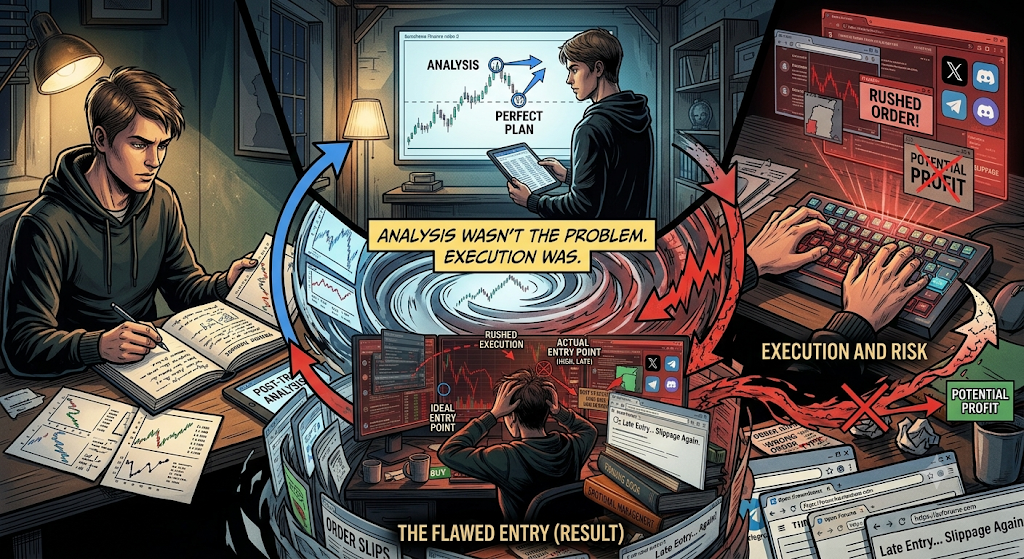
You wait patiently. The setup is there. Everything lines up.
Then you rush the execution.
You click too late. You use the wrong order type. You enter after the move has already started. By the time you're in, the trade doesn't look as good anymore.
The analysis wasn't the problem.
The execution was.
Many traders spend hours finding the perfect setup but only seconds thinking about how they'll enter and exit. Over time, poor execution adds up. Small mistakes become lower returns, even when you're right about the market.
Strong traders plan their execution as carefully as they plan the trade. They know where they'll enter, how they'll enter, and when they'll walk away if the price gets away from them.
Because a good idea deserves a good execution.
When you treat execution as part of your strategy, your results become more consistent. You stop giving away profits through avoidable mistakes and start making the most of the opportunities you find.
Precision improves performance.
Some of the biggest improvements in trading come from small changes in execution and decision-making.
If you enjoy exploring different market perspectives, you can discover a few market newsletters here:

Chaikin Money Flow (CMF)
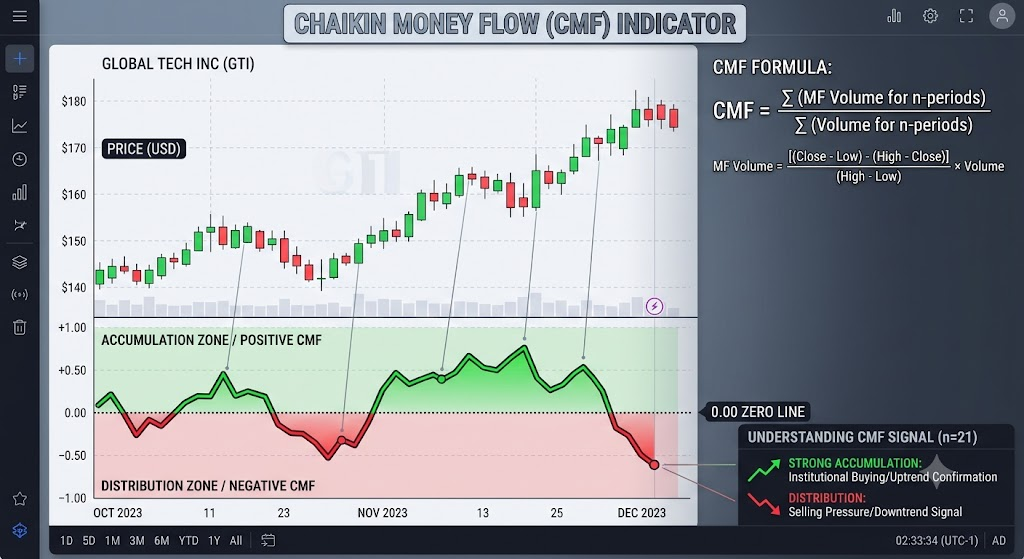
Chaikin Money Flow (CMF) is an institutional money tracker. Created by Marc Chaikin, this indicator combines both price action and trading volume to measure the amount of money flowing into or out of an asset over a set period (usually 21 days). It moves above and below a central Zero Line to show you whether the big institutions are accumulating (buying) or distributing (selling).
🔴 The Red Zone (Below the Zero Line)
The Meaning: The CMF line is trading completely below 0 (specifically crossing below -0.05). This proves that the market is closing in the lower half of its daily range on high volume.
The Move: Look to exit long positions or search for short setups. Money is actively fleeing the asset, meaning the institutional players are dumping their shares and driving the price downward.
🟡 The Yellow Zone (Hovering at the Zero Line)
The Meaning: The CMF line is flatlining right around the 0.00 mark, crossing back and forth in a tight window between -0.05 and +0.05.
The Move: Hold and wait. This indicates a complete lack of institutional conviction. Volume is evenly matched, and the market is in a noisy, sideways tug-of-war. Avoid trading until a clear break occurs.
🟢 The Green Zone (Above the Zero Line)
The Meaning: The CMF line climbs completely above 0 (specifically crossing above +0.05). This shows that the price is consistently closing near its daily highs on heavy volume.
The Move: Go! This confirms strong buying pressure. The "smart money" is actively pouring cash into the asset, providing a powerful tailwind for a sustained upward trend.
🔍 Two Simple Signals to Watch
1. The Institutional Divergence
Watch for moments when the price chart is climbing to new highs, but the CMF line is actively sinking lower.
- The Logic: This is a major warning sign called bearish divergence. It reveals that while the price looks strong, the underlying institutional volume is rapidly drying up. The rally is a illusion being kept alive by thin retail trading, and a sharp crash is usually imminent.
2. The Persistence Test (Trend Strength)
Pay attention to how long the CMF line can stay deep inside the Green or Red zones without snapping back to zero.
- The Logic: A healthy, powerful uptrend won't just poke above the zero line briefly—the CMF line will stay pinned deep in positive territory (above +0.10) for weeks. If you see CMF consistently riding high, it tells you that major funds are buying every single minor pullback, making it incredibly safe to ride the trend.
💡 The Simple Secret
Think of Chaikin Money Flow as a bank account tracker for the asset. A stock's price can fluctuate based on daily hype, but the CMF filters out the noise by multiplying that price movement by the actual volume traded. If the price goes up but the CMF bank account balance is shrinking, the move is fake.

You're Not Looking for Analysis. You're Looking for Permission.

You already know what you're going to do.
The chart is marked up.
Your entry is planned.
Your stop is defined.
But instead of placing the trade...
You open X.
Then YouTube.
Then Discord.
Then Telegram.
Then you message that trader whose opinion you "respect."
"What do you think about this setup?"
It sounds harmless.
Sometimes it is.
But be honest.
Were you really asking for another opinion?
Or were you hoping someone would tell you exactly what you already wanted to hear?
There's a huge difference.
Most traders think they're gathering information.
What they're actually gathering is emotional reassurance.
Because making a decision alone is uncomfortable.
If the trade loses, it's on you.
But if three experienced traders agreed with your idea?
Well... somehow the loss hurts a little less.
You've shared the responsibility.
The problem is that borrowed confidence disappears the moment the trade starts going against you.
The person who gave you the idea isn't sitting beside you when price drops.
They're not deciding whether to hold.
They're not managing your risk.
They're probably looking at an entirely different chart by then.
You're the one left carrying the position.
One trader admitted something that stuck with me.
He said, "I noticed I never entered a trade until I found someone online who agreed with me."
Not because he lacked technical skill.
Because he didn't trust his own judgment yet.
That's a painful place to trade from.
You end up outsourcing your confidence.
And over time, something even worse happens.
You stop developing your own decision-making muscles.
Think about learning to ride a bicycle.
If someone held the seat forever, you'd never learn balance.
Trading works the same way.
At some point, you have to wobble.
You have to make your own calls.
You have to be wrong sometimes.
That's how confidence is built.
Not by always being right...
...but by knowing you can handle being wrong.
Here's a challenge.
The next time you catch yourself looking for one more opinion before entering a trade, stop and ask:
"If nobody replied to my message... what would I do?"
Whatever your answer is...
That's probably the decision you trusted all along.
The best traders don't become independent because they stop learning from others.
They become independent because they stop needing someone else's agreement before trusting themselves.
Advice is valuable.
Validation is addictive.
Learn to tell the difference.