CXMT Skyrockets 500%
....................................................................................................................


Good morning,
We’re starting Monday on a strong positive note. Nasdaq futures are leading the charge, jumping 1.16%, while S&P 500 futures are up 0.72% and Dow futures are gaining 305 points (up 0.59%). After a painful stretch that saw the S&P 500 and Nasdaq post back-to-back weekly losses, investors are taking advantage of a sudden drop in energy costs to push markets back into the green.
Middle East tensions cool, dropping oil nearly 5%. The biggest driver behind this morning's rally is a temporary ceasefire in the fighting between the U.S. and Iran over the weekend. With the immediate threat to energy shipping lanes stepping back, Brent crude plunged nearly 5% to around $92 a barrel, while U.S. crude dropped over 5% to $84.84. However, geopolitical risks aren't completely gone—Tehran accused Kyiv of a "hostile act" after Ukraine struck an Iranian commercial vessel in the Caspian Sea, keeping traders on guard.
Asia markets end mostly green. The calmer mood spread across most international markets overnight. Australia’s benchmark jumped over 1.1%, while Japan's Topix gained 0.87% and South Korea’s Kospi added 0.44%. Hong Kong and mainland China also locked in modest gains as global risk sentiment improved.
A massive "Megacap Test" arrives this week. Wall Street is facing an absolute gauntlet of corporate updates this week. Heavyweights Amazon, Apple, Meta Platforms, and Microsoft are all set to report earnings. After Alphabet's disappointing update last week sparked fears over endless AI spending, these results will determine whether investors regain faith in the AI trade—or if chipmakers will face another round of selling.
The Fed decision lands on Wednesday. As if megacap tech earnings weren't enough, the Federal Reserve meets this Wednesday for its latest interest-rate decision. While most investors expect the Fed to wait until September to consider a rate hike, markets are pricing in a small chance that the central bank could surprise everyone with a quarter-point rate hike as soon as this week to tackle sticky inflation.
Lower oil prices are providing a great launchpad, but with four tech titans and a Fed rate decision on deck, this week is set to be a wild ride.

📊 U.S. Stock Futures Rally as Weekend Pause in U.S.-Iran Fighting Cools Crude
U.S. stock index futures rallied early Monday morning while oil prices declined, buoyed by a temporary pause in hostilities between Washington and Tehran over the weekend. Traders are turning their attention to a demanding week ahead, headlined by a heavy slate of megacap corporate earnings reports and a potentially pivotal Federal Reserve policy meeting.
🛢️Oil Slides 5% as Tehran Signals Halt to Attacks Contingent on U.S. Pause
Crude oil benchmarks dropped 5% after reports indicated that Iran is willing to suspend further military attacks as long as the U.S. refrains from striking. The potential de-escalation has provided immediate relief to energy desks, dampening fears of near-term shipping bottlenecks and supply disruptions in the Persian Gulf.
🤖 Nvidia and Tech Heavyweights Sign $950B in Landmark AI Deals with South Korea
South Korean President Lee Jae Myung met in San Francisco with major tech leaders—including Nvidia’s Jensen Huang and OpenAI’s Sam Altman—alongside top executives from Samsung, SK Group, Hyundai, and Naver. The summit culminated in roughly $950 billion in new AI agreements, cementing South Korea’s position at the center of the next global AI infrastructure buildout.
📈 KOSPI and U.S. Stock Futures Surge as Hormuz Talks Send Crude Prices Plunging
Global equity markets rallied on Sunday evening as the United States and Iran maintained a temporary pause in military strikes, clearing a path for technical diplomatic negotiations aimed at safely reopening the Strait of Hormuz.
💻 China Memory Chipmaker CXMT Skyrockets 500% in $8.6B Shanghai Debut
Hefei-based DRAM maker ChangXin Memory Technologies (CXMT) surged 500% during its blockbuster trading debut in Shanghai. The semiconductor firm, which held a 7.67% share of the global DRAM market in 2025, raised 57.92 billion yuan ($8.6 billion) in its initial public offering, with proceeds targeted primarily toward expanding memory wafer mass production.
₿ Dormant Bitcoin Movement Hits Four-Year Low as Long-Term Selling Eases
On-chain activity among long-inactive Bitcoin tokens fell to its lowest level since the third quarter of 2022, according to Galaxy data. The sharp decline in dormant BTC movement indicates that long-term "OG" holders have significantly scaled back token distribution following an extended period of profit-taking.
🌏 Asian Stocks Advance as Easing Middle East Tensions Lift Japan and South Korea
Bourses across Asia-Pacific rose on Monday, spearheaded by strong gains in Japan and South Korea as the U.S. and Iran refrained from retaliatory military strikes. The pause in conflict relieved immediate pressure on regional energy import costs, allowing investors to refocus on the upcoming wave of megacap technology earnings.

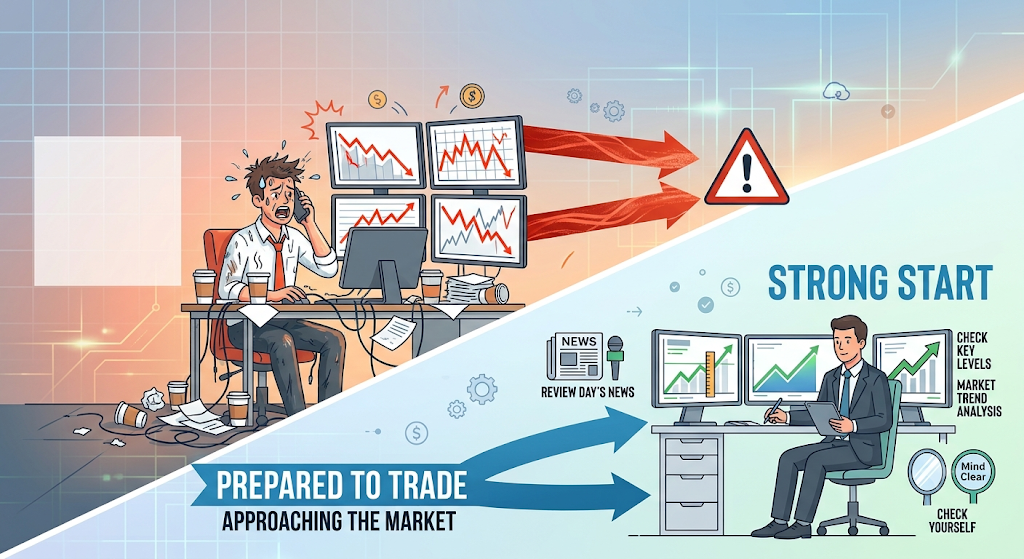
Many traders open their charts and jump straight into the market.
No plan. No review. No pause.
Just straight to looking for a trade.
That's where problems begin.
Without a routine, it's easy to carry stress, distractions, or emotions into your decisions. You end up reacting to the market instead of approaching it with a clear mind.
Strong traders prepare before they trade.
They review the day's news. They check key levels. They look at the market trend. Most importantly, they check themselves. If they're tired, distracted, or emotional, they know it's better to wait than to force a trade.
A pre-trade routine doesn't have to be complicated.
It just has to help you slow down and focus.
When you prepare your mind before the market opens, you make better decisions after it does.
Good trading starts before the first trade.
Every trader has a different way of preparing for the market. Reading different perspectives can help you improve your own routine and decision-making.
You can explore a few market newsletters here:

Rate of Change (ROC)
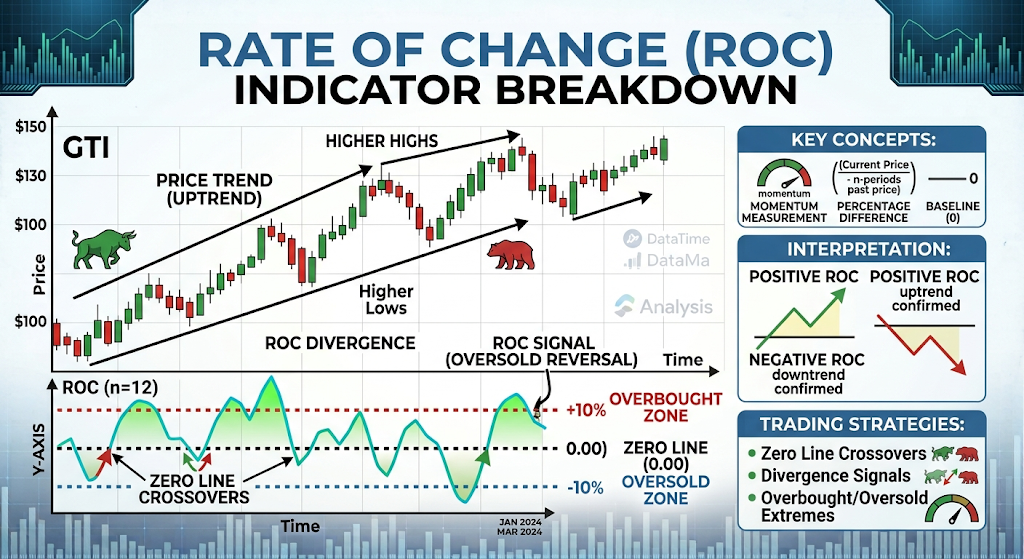
The Rate of Change (ROC) is a pure momentum oscillator that measures the percentage change in price between the current period and a set number of periods ago (typically 12 or 14 days). By tracking the speed of price moves relative to a central Zero Line, the ROC acts like a speedometer for the market, highlighting overextended rallies, panic sell-offs, and shifts in velocity.
🔴 The Red Zone (ROC Sinks Below Zero)
The Meaning: The ROC line drops into negative territory (below 0). This confirms that today’s price is lower than it was $N$ periods ago, meaning downside momentum is actively accelerating.
The Move: Look to exit long trades or explore short positions. Sellers are in control of the vehicle, and the market is losing altitude quickly.
🟡 The Yellow Zone (Hovering at the Zero Line)
The Meaning: The ROC line oscillates tightly around the 0.00 mark. The current price is virtually identical to where it was a few weeks ago.
The Move: Hold and wait. The market is in a flat, sideways drift with no speed advantage on either side. Avoid opening momentum trades until the line breaks decisively away from the center.
🟢 The Green Zone (ROC Crosses Above Zero)
The Meaning: The ROC line climbs into positive territory (above 0). This proves that today’s price is higher than it was $N$ periods ago, signaling that upward velocity is accelerating.
The Move: Go! A clean crossover above the Zero Line is your bullish green light. It confirms that buyers have taken the wheel and injected fresh speed into the move.
🔍 Two Simple Signals to Watch
1. The Momentum Divergence (Loss of Speed)
Pay attention when the price chart makes a higher high, but the ROC line prints a lower high (as shown in the chart above).
- The Logic: Even though the asset is making new price highs, its speed of growth is slowing down. This bearish divergence warns that the rally is running out of fuel, making a sharp pullback imminent.
2. The Overextended Extremes
Unlike bounded oscillators (like RSI), the ROC has no upper or lower limits. However, every asset establishes historical boundary peaks on its ROC indicator.
- The Logic: When the ROC spikes to an unusually high peak, the move is overextended and subject to a temporary mean-reversion drop. When it plunges to an extreme low trough, panic selling is exhausted, setting up a bounce.
💡 The Simple Secret
Think of the ROC as a car’s speedometer. A car can still be moving forward while slowing down from 80 mph to 30 mph—and that’s exactly what ROC captures before the price chart reflects it. By watching whether the ROC line is speeding up or tapping the brakes relative to the Zero Line, you can spot trend reversals long before the market comes to a complete halt.

You Fell in Love With Your Morning Bias
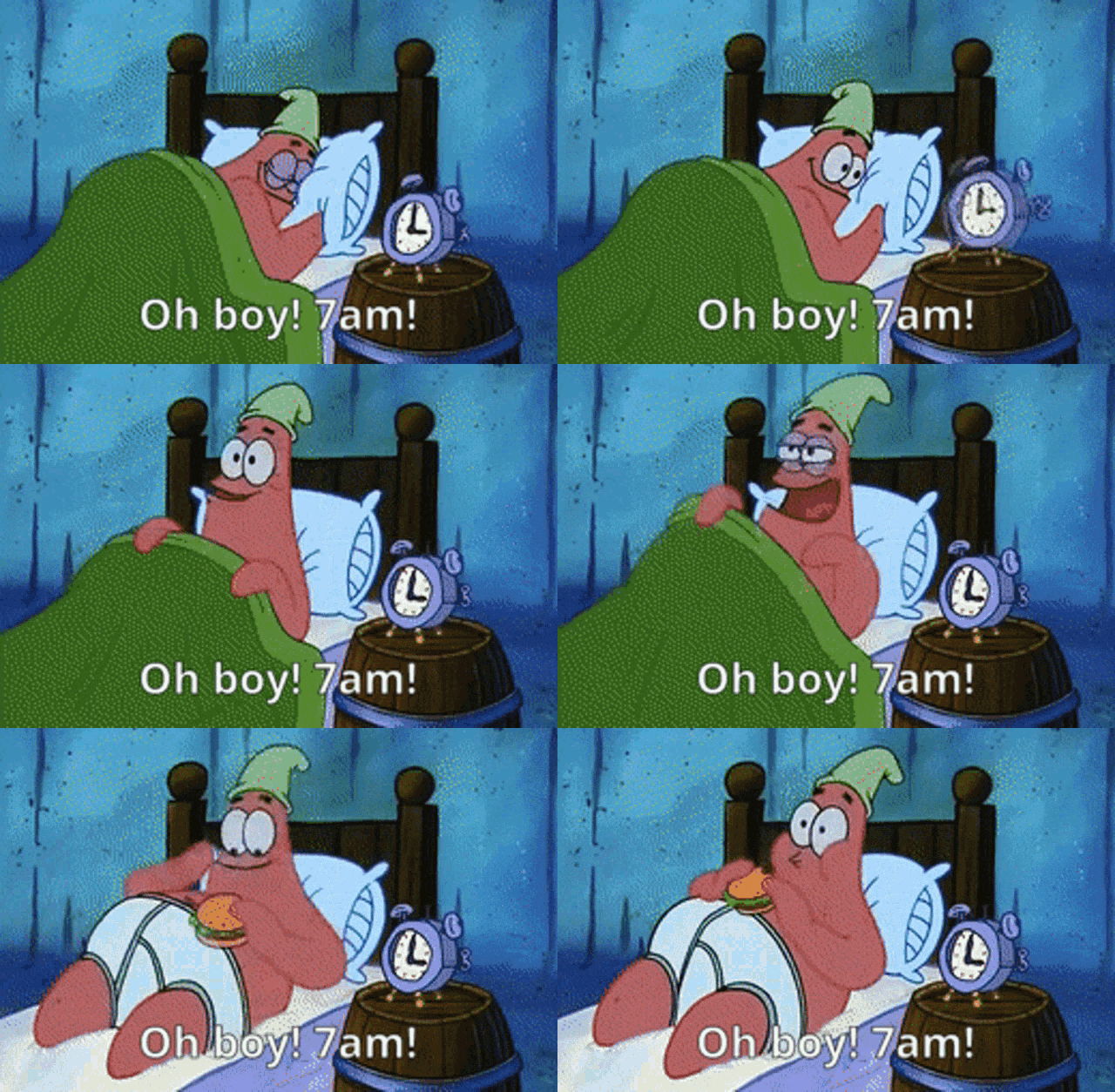
It's 7:00 AM.
Coffee in hand.
Charts open.
You do your analysis and come to a conclusion:
"Today is bullish."
Nothing wrong with that.
Having a bias helps you prepare.
The problem starts when your bias stops being a hypothesis...
...and becomes your identity for the day.
The market opens.
Price pushes higher.
You smile.
"Exactly as expected."
An hour later, buyers start fading.
Support breaks.
Momentum weakens.
Your setup for the long trade disappears.
But instead of adapting, you start explaining.
"It's just a pullback."
Another level breaks.
"They're just hunting stops."
Then another.
"The real move hasn't started yet."
Notice what happened?
You stopped reading the market.
You started defending your morning opinion.
A trader I knew had this habit every single day.
He'd spend an hour before the open building a detailed market thesis.
The analysis was excellent.
The execution wasn't.
Why?
Because once he committed to a direction, every candle became evidence that he was still right.
Even the ones screaming that he wasn't.
By lunchtime, he wasn't trading price anymore.
He was debating with it.
Here's something worth remembering:
Your pre-market analysis is a forecast, not a contract.
The market never promised to behave the way you expected.
And that's okay.
Good traders don't get paid for predicting the open.
They get paid for responding to what's actually happening.
One mindset shift can change everything:
Instead of asking,
"Was my morning analysis right?"
Ask,
"If I opened my charts for the very first time right now, with no opinion, what would I see?"
That's a powerful question.
Because it strips away your ego and brings you back to the only thing that matters:
Price.
Some of the best trades you'll ever take will come from admitting your first idea was wrong.
Not because you're inconsistent.
Because you're flexible.
Remember, the market isn't grading your forecasts.
It isn't keeping score of how smart your morning analysis sounded.
It only cares about one thing:
Can you let go of yesterday's opinion...
...or even the one you had three hours ago...
...when today's price tells a different story?