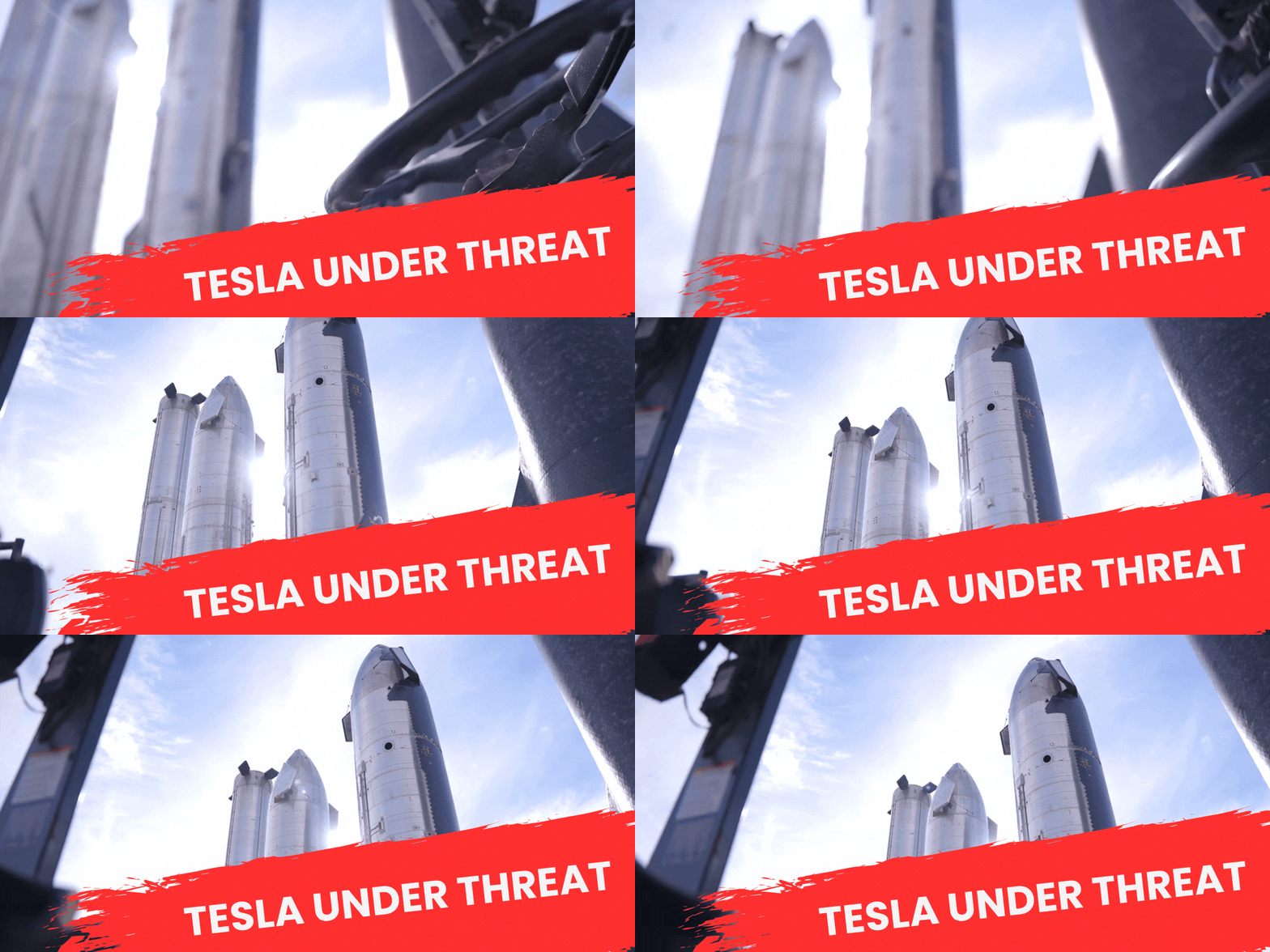
Tesla Under Threat
....................................................................................................................


Good Morning,
The earnings party is over, and Wall Street is facing a rocky holiday week—made even messier by a massive threat to Tesla.
Today is Memorial Day in the U.S., meaning the floor of the New York Stock Exchange and the Nasdaq are completely shut down as the country honors its fallen service members. But while the physical trading floors are quiet for the long weekend, the numbers are telling a tense story for the shortened week ahead.
Even with the S&P 500 sitting up 9% this year after eight straight weekly gains, the mood is shifting. The stellar corporate reports that helped investors ignore the U.S.-Israeli war with Iran are mostly wrapped up. Now, the market is exposed to a brutal bond selloff, with long-term Treasury yields surging to heights not seen in years due to war-related energy spikes. This inflation threat has completely flipped the script: the Fed is now weighing rate hikes instead of cuts, and Thursday’s upcoming PCE inflation index will show exactly how deep that damage goes.
Tesla Under Threat To make matters worse for the bulls, a massive storm is brewing specifically for Tesla. Wall Street portfolio managers are sounding the alarm that SpaceX's historic June IPO (targeting a massive $1.75 to $2 trillion valuation) is acting as a major structural distraction.
Analysts warn that this blockbuster debut presents a unique headwind for the EV pioneer by giving core institutional investors a shiny alternative for high-growth capital. Money could easily sap out of Tesla into spaceflight and satellite tech, while Elon Musk's personal focus will be heavily pulled toward the massive SpaceX roadshow at a time when the EV market is already highly competitive.
What to watch when trading resumes Tuesday:
- Macro Drag: Retailers like Costco and Best Buy report earnings, revealing if high gas prices are crushing consumer shopping.
- The AI Match: Salesforce and Dell report, trying to match Nvidia’s blowout $91 billion forecast.
- The Musk Split: How Tesla stock reacts to institutional capital eyeing the upcoming SpaceX public debut.

🚀 S&P 500 Surfs 7,500 as Markets Brace for Imminent Iran Peace Deal
Wall Street enters the final week of May from a massive position of strength, with the S&P 500 riding high at the 7,500 milestone and the Dow eyeing 51,000. Equities are riding a wave of earnings euphoria, further supercharged by weekend declarations from the White House hinting that a breakthrough to end the Middle East conflict is finally within reach.
⚠️ Wall Street Facing Tricky Backdrop of Spiking Yields as Earnings Wind Down
Despite the record-setting runs, analysts warn high-flying U.S. equities could face localized turbulence as a blockbuster corporate earnings season wraps up. The benchmark S&P 500 is riding an impressive eight-week winning streak, but investors are increasingly confronting a technical macro backdrop defined by spiking inflation indicators and rising long-term bond yields.
📉 Oil Plunges 5% After Trump Teases Impending Strait of Hormuz Reopening
Crude prices plummeted in Sunday futures trading following a direct announcement from President Trump that Washington and Tehran are close to finalizing an accord. International benchmark Brent sank 4.9% to $98.50 a barrel while West Texas Intermediate fell 5.2% to $91.60, dramatically erasing the geopolitical risk premium as maritime trade normalization looms.
🥇 Gold Jumps 1.6% as De-escalation Hopes Temper Broader Inflation Fears
Bullion prices surged past $4,580 an ounce, clawing back last week's moderate losses as concrete progress toward a Persian Gulf resolution lowered systemic inflation anxieties. While negotiations over specific language remain fluid and President Trump noted he won't "rush" the final signing, investors are aggressively bidding up gold on the shifting macro landscape.
🌏 Nikkei Breaches 65,000 for the First Time as Asian Markets Excel
Exchanges across Asia surged on Monday, spearheaded by a massive 2.8% explosion in Tokyo's Nikkei 225, which comfortably cleared the historic 65,000 line. Trading volumes remained concentrated due to Buddha's Birthday public holidays in Hong Kong and South Korea, while U.S. cash markets remain shut for Memorial Day.
🇪🇺 European Indices Set to Jump with DAX and CAC Futures Pointing Higher
European equity bourses are tracking their Asian counterparts sharply higher, with Germany's DAX poised to open up 1.1% and France's CAC 40 targeting a 0.9% gain. The regional optimism is being entirely dictated by the de-escalation of energy bottlenecks, helping buffer sentiment even with London's FTSE 100 out on a holiday.
🚀 SpaceX June IPO Looms Large as a Structural Distraction for Tesla
Portfolio managers are warning that SpaceX's highly anticipated June initial public offering could sap capital, market attention, and direct executive focus away from Tesla. Analysts note that the blockbuster commercial spaceflight debut presents a unique headwind for the EV pioneer by giving core institutional investors an alternative avenue for high-growth capital allocation.

Crypto Never Sleeps — And That’s the Problem

The market keeps moving. Day and night. Weekends too.
So you keep checking.
One more glance at the chart before bed. One more notification. One more trade because “crypto never closes.”
That’s how exhaustion builds.
When a market runs 24/7, it becomes easy to feel like you always need to be connected. Traders start reacting instead of planning. Sleep gets interrupted. Focus drops. Small emotional decisions begin stacking up.
The market stays open, but your brain still has limits.
Strong traders create boundaries. They set trading hours. They mute alerts. They accept that missing some moves is healthier than trying to catch everything.
Because burnout quietly destroys decision-making.
When you stop treating crypto like a nonstop emergency, your trading becomes calmer. You think more clearly. You trade with intention instead of fatigue.
Rest improves judgment.
Some traders like exploring how market structure and psychology affect performance in fast-moving environments like crypto.
If that’s you, you can explore a few market reads here:

Head and Shoulders
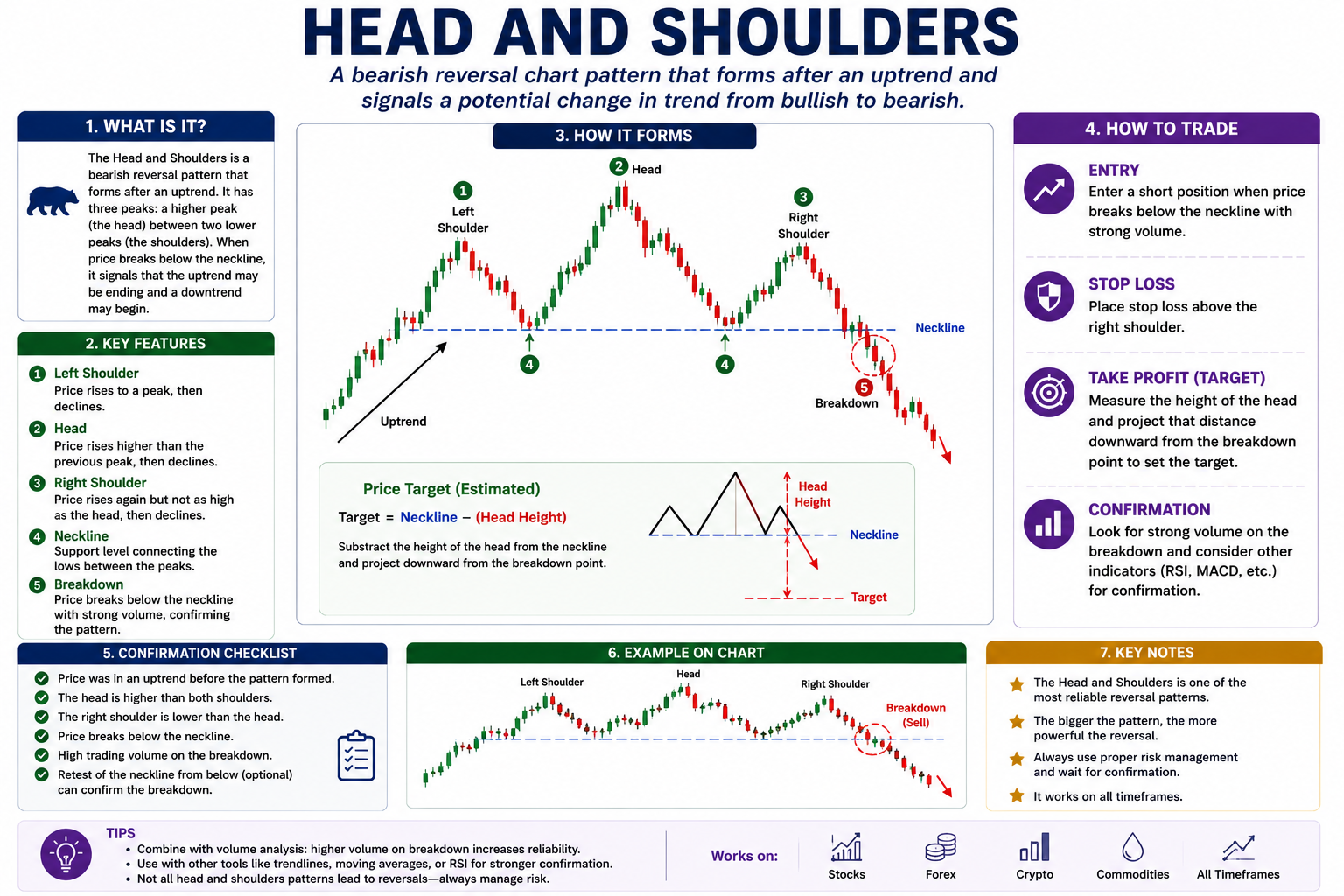
The Head and Shoulders is a classic chart pattern that looks exactly like its name. It signals that a strong uptrend has run out of fuel, creating three peaks where the middle peak is the highest. It represents a total exhaustion of buyers.
🔴 The Red Zone (The Left Shoulder)
The Meaning: Price rallies sharply, hits a high point, and then pulls back down. At this stage, it looks like a normal, healthy part of an uptrend.
The Move: Wait. This is just the first peak of the pattern. You don't know it's a "shoulder" until the rest of the shape forms.
🟡 The Yellow Zone (The Head)
The Meaning: Buyers push the price up again, blasting past the first peak to create a new, higher high (the Head). However, sellers step in aggressively and drag the price all the way back down to the same level as the first pullback.
The Move: Watch closely. The low points between these peaks are connected to form a straight baseline called the Neckline. This is the ultimate line in the sand.
🟢 The Green Zone (The Right Shoulder & Break)
The Meaning: Buyers make one final, weak attempt to rally. The price goes up but fails to reach the height of the Head, peaking roughly level with the Left Shoulder. The price then rolls over and crashes straight down through the Neckline.
The Move: Go! Blasting down through the neckline is your confirmation signal to exit longs or enter a short trade. The buyers have officially surrendered.
🔍 Two Simple Signals to Watch
1. The Sloping Neckline
The "Neckline" baseline doesn't have to be perfectly horizontal; it can tilt slightly upward or downward.
- The Logic: If the neckline tilts downward, it means the sellers are exceptionally aggressive because they are pushing each consecutive pullback lower.
2. The Volume Fout
Watch the trading volume across the three peaks.
- The Logic: In a true Head and Shoulders pattern, volume is usually highest on the Left Shoulder and gets smaller (weaker) on the Head and Right Shoulder. This proves that fewer and fewer big players are willing to buy at higher prices.
💡 The Simple SecretThink of this pattern as a failed game of king of the hill. The Left Shoulder is the first try, the Head is the absolute peak, and the Right Shoulder proves the buyers no longer have the energy to climb back up. To estimate how far the price will drop after the breakout, measure the distance from the top of the Head down to the Neckline—the price will often drop that exact same distance on the way down.

You Planned the Entry… Then Winged the Exit

A lot of traders obsess over entries.
Perfect level.Perfect confirmation.Perfect timing.
They’ll spend two hours planning how to get INTO a trade…
…and about 12 seconds thinking about how to get OUT
That’s the Exit Vacuum.
You enter with structure.
Then once the trade is live?
Everything becomes emotional improvisation.
Price moves a little in profit:
“Maybe I should take it now.”
Price pulls back:
“Maybe I should hold longer.”
Price gets close to target:
“What if it reverses?”
Suddenly every candle feels personal
And now the MOST important part of the trade is being decided in real time by stress, fear, greed, and adrenaline.
Not by process.
That’s the crazy part:
Many traders don’t actually have an exit strategy.
They have exit feelings.
And feelings change every five minutes.
One day you hold too long.
The next day you cut too early.
The next day you panic-close because Twitter said the market looks weak.
No consistency.
Just emotional reactions disguised as “trade management.”
Here’s the truth nobody likes hearing:
A mediocre entry with a GREAT exit process can still make money.
A great entry with terrible exits?
Usually turns into chaos.
Because exits are where discipline gets tested hardest.
Anybody can feel confident BEFORE the trade.
The real psychological battle starts AFTER you’re in.
That’s when money becomes real.
Pressure becomes real.Fear becomes loud.
Professional traders reduce this chaos BEFORE the trade even starts.
They define:
- Target zones
- Invalidations
- Partial profit rules
- Conditions for holding or exiting
Not perfectly.
But intentionally.
Because once emotions enter the room, decision quality usually drops fast.
And honestly?
Most traders are trying to freestyle one of the highest-pressure decisions in finance while staring at flashing candles and unrealized P&L
Of course emotions take over.
So here’s something worth working on:
Before entering any trade, ask yourself:
“What specifically would make me EXIT this position?”
Not vaguely.
Clearly.
Write it down if you have to.
Because clarity before the trade creates calm during the trade.
And calm traders make far better decisions than emotional improvisers ever will.