Tech Stocks Push for Rally
....................................................................................................................


Good Morning,
The big tech rally has run into a wall, and Wall Street is waiting to see if AI still has its magic.
We’re starting Wednesday with a nervous pause. Nasdaq futures are up 0.5% and the S&P 500 is up 0.1%, trying to bounce back after two days of heavy selling. People are worried that tech stocks got too expensive too fast, and they're pulling money out.
Micron is tonight's big test. Everyone is watching microchip maker Micron (MU), which reports earnings after the closing bell. Their stock has been on fire this year, but it just crashed 13% yesterday. Because they make the memory chips needed for AI, their results will tell us if companies are still spending heavily on tech or if the boom is cooling down.
A new roadblock is hitting shipping lanes. On the political side, the U.S.-Iran peace talks hit a frustrating twist. President Trump promised that the crucial Strait of Hormuz shipping lane would be completely free to pass. Instead, Iran and Oman are now talking about charging a transit fee for ships. This uncertainty is already hurting business: shipping giant FedEx saw its stock slide after warning that rising transportation costs are hurting its profits.
Tech wants to bounce back, but everything depends on Micron's numbers tonight.

🛢️ Brent Crude Tumbles Below $76 as President Trump Demands Fuel Price Probe
International benchmark Brent crude futures dropped below $76 a barrel, mapping their lowest valuation since the day before the U.S.-Iran war erupted in February. Energy prices slid sharply as maritime bottlenecks through the Strait of Hormuz completely cleared, heavily amplified by President Trump calling for an immediate Department of Justice investigation into oil companies over alleged fuel price gouging.
💻 Micron Prepares for High-Stakes Earnings Amid 862% AI Memory Surge
Micron Technology (MU) is set to report its fiscal third-quarter results on Wednesday evening, serving as a critical litmus test for the red-hot artificial intelligence infrastructure trade. Driven by an absolute logjam of data center orders for high-bandwidth chips, Micron shares have skyrocketed a staggering 862% over the past 12 months, tracking a similarly explosive 1,035% surge from Asian rival SK Hynix.
🥇 Gold Plunges Below $4,100 as Tech Liquidity Demands Spark Massive Liquidations
Spot gold breached the critical $4,100-per-ounce baseline to set a fresh two-week low following intense global market volatility. Instead of drawing traditional safe-haven support, the precious metal fell victim to multi-market portfolio restructuring, as institutional desks aggressively sold down liquid gold holdings to generate cash and cover painful equity losses elsewhere.
📱 Alphabet Set to Displace Verizon in Landmark Dow Jones Industrial Average Reshuffle
Shares of Alphabet (GOOGL) edged higher in after-hours trading following the announcement that the search and cloud powerhouse will officially join the Dow Jones Industrial Average on June 29. The tech giant will replace telecom veteran Verizon Communications (VZ) to better reflect the modern economy's structural pivot toward interactive media, cloud infrastructure, and artificial intelligence.
🇰🇷 Samsung Triggers 6% Stock Surge on Rumored $59B Share Buyback Plan
Shares of Samsung Electronics jumped over 6% in regional trading following breaking local media reports that the electronics titan is finalizing a massive 90 trillion won ($58.61 billion) share buyback program. The blockbuster capital reallocation strategy follows recent corporate wage negotiations that awarded significant company stock bonuses to employees.
📉 SanDisk Slams Into First Major Semiconductor Correction of the AI Era
SanDisk and several prominent hardware peers suffered a aggressive selloff, marking the first structural downside test for memory stocks since their hot, AI-driven infrastructure runs began. The steep correction was heavily amplified by structural valuation anxieties and a sharp downturn across South Korea's KOSPI index, sparking institutional fears over the near-term sustainability of mega-cap data center spending.
🌏 Global Technology Hubs Stage Volatile Rebound Following Brutal Market Rout
Technology stocks across Asia and Europe stabilized on Wednesday, attempting to engineer a choppy recovery after a bruising multi-day global selloff rattled international tech platforms. The defensive market stabilization was spearheaded by South Korea's broader semiconductor index, where Samsung's individual 9% rebound single-handedly restored near-term confidence to the chip manufacturing pipeline.

The Edge Isn’t Always Worth the Price
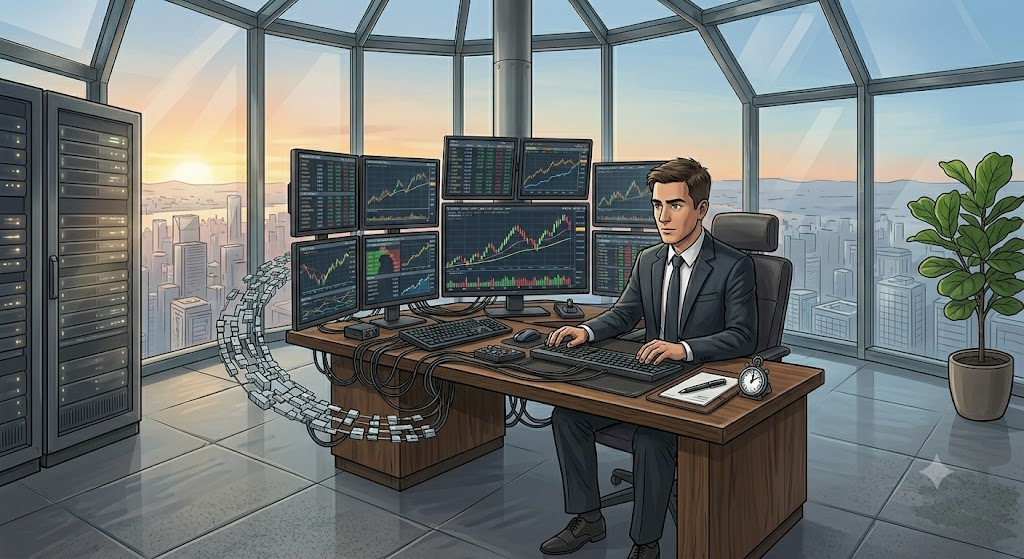
Every trader wants better information.
More data. Faster data. Smarter data.
So it's easy to believe that the next premium tool, exclusive dataset, or expensive subscription will unlock better results.
Sometimes it helps.
Often, it doesn't.
Many traders spend hundreds or even thousands chasing information they barely use. They collect data faster than they develop the skills needed to interpret it.
The result?
More complexity. More noise. More distractions.
Strong traders understand that information only becomes valuable when it improves decision-making. They focus on extracting more value from the data they already have before paying for more.
Because an expensive tool cannot fix a weak process.
The truth is, most trading problems aren't caused by a lack of information. They're caused by inconsistent execution, poor risk management, or unclear decision-making.
Before you buy another dataset, ask yourself a simple question:
Will this improve my decisions, or just make me feel more informed?
The answer matters more than the data.
Some traders enjoy exploring how technology, data, and market research influence trading decisions.
If that's you, you can explore a few market reads here:

Ichimoku Cloud
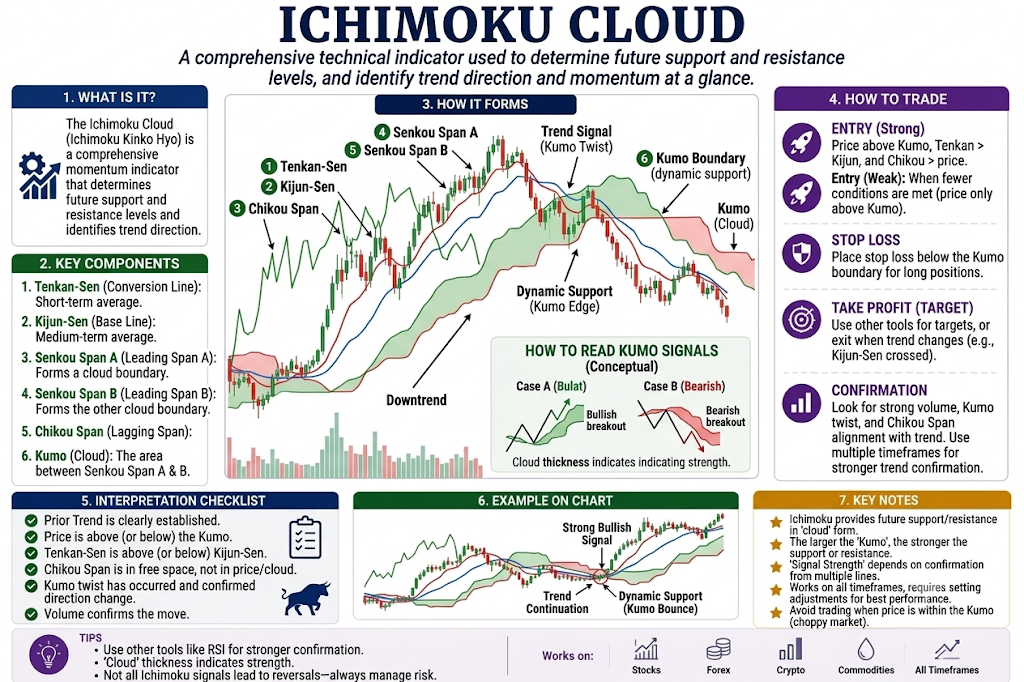
The Ichimoku Cloud (Ichimoku Kinko Hyo) is an all-in-one system designed to show you the market's trend, support floors, and speed at a single glance. Its most famous feature is the Cloud (Kumo)—a shifting, shaded block on your chart that represents a dynamic buffer zone for the price.
🔴 The Red Zone (Price Below the Cloud)
The Meaning: The price is trading completely below the shaded Cloud. The bottom of the Cloud now acts as a heavy ceiling, trapping the asset underneath it.
The Move: Look to exit or sell. The market is in a structural downtrend, and the bears have the upper hand. Avoid buying as long as the price stays trapped down here.
🟡 The Yellow Zone (Price Inside the Cloud)
The Meaning: The price is actively bouncing around inside the body of the Cloud.
The Move: Hold and wait. The Cloud is a thick, choppy cushion. When the price is inside it, the market is in a noisy, unpredictable tug-of-war. This is a "no-trade" zone where trends go to die until a clean breakout occurs.
🟢 The Green Zone (Price Above the Cloud)
The Meaning: The price breaks completely above the shaded Cloud. The top of the Cloud now transforms into a solid, supportive floor.
The Move: Go! The market has broken out into clear skies. This confirms a healthy upward trend, signaling that the bulls are fully in control.
🔍 Two Simple Signals to Watch
1. The Line Cross (TK Cross)
Inside the system, watch the two fast-moving trigger lines: the Conversion Line (Tenkan-sen, usually blue) and the Base Line (Kijun-sen, usually red).
- The Logic: Think of this like a mini-EMA cross. When the fast blue line crosses above the slower red line while the price is above the Cloud, it is a high-conviction buy signal. If it crosses below, momentum is dying.
2. The Cloud Color Shift
The Cloud itself changes color based on whether the boundaries are expanding or contracting.
- The Logic: A green, thickening Cloud ahead of the price shows that the support floor is getting stronger and deeper. A red, shrinking Cloud shows that upward energy is thinning out and the floor might easily crack.
💡 The Simple Secret
The unique superpower of the Ichimoku Cloud is that it is projected 26 periods into the future. It doesn't just show you where support and resistance were; it draws the expected support floor right onto the empty right side of your chart. If you see a thick, wide cloud stretching out ahead of the current price, you know exactly where the market is likely to find a trampoline if it pulls back later.

You Were Almost There. Then You Flinched.

One of the strangest moments in trading happens when you're winning.
Not when you're losing.
Not when you're entering.
When you're almost done.
The trade worked beautifully.
You identified the setup. Waited patiently. Managed the position well. Sat through pullbacks that would have shaken you out a few months ago.
Price keeps moving.
Closer.
Closer.
Now it's just a few ticks from your target.
And suddenly, your confidence disappears.
"What if it reverses?"
"I've made enough."
"I don't want to watch this turn around on me."
Click.
Trade closed.
You take the profit.
You feel relieved for about thirty seconds.
Then you watch price drift another few points...
Touch your original target...
And continue moving.
The frustration isn't really about the extra money.
It's about what you just learned about yourself.
You trusted your process enough to enter.
Trusted it enough to sit through uncertainty.
Trusted it enough to survive the hard middle part.
But when the finish line was in sight, you stopped trusting it.
It's almost like a marathon runner deciding to walk the last hundred meters because they're suddenly afraid of tripping.
And if we're being honest, this isn't always about greed.
It's usually about scar tissue.
At some point, you've probably watched a profitable trade reverse before hitting target.
Maybe several times.
That experience stays with you.
So the next time price gets close, your brain isn't looking at the current trade.
It's replaying old pain.
It whispers:
"Take it now. At least you'll leave with something."
The problem is that this habit quietly destroys expectancy.
One early exit won't matter.
Twenty early exits?
That's an entirely different equity curve.
The irony is painful.
Many traders spend years trying to find better entries.
Meanwhile, they're leaking performance at the exit because they can't tolerate the discomfort of letting a good trade finish its job.
Here's something worth trying.
The next time you're tempted to close a trade moments before your target, ask yourself:
Has the market invalidated my idea... or am I simply becoming uncomfortable because success is close?
They're not the same thing.
One is information.
The other is emotion.
And trading has a funny way of rewarding those who can endure both losing gracefully and winning patiently.
Sometimes the biggest threat to a good trade isn't bad analysis.
It's the fear that, after doing almost everything right, you'll somehow find a way to ruin the ending.
And occasionally, the best thing you can do is simply sit on your hands and allow the plan you trusted for two hours to be trusted for two more minutes.