Super Micro Surges 15%
....................................................................................................................


Good morning,
We’re starting the day in red territory. Nasdaq futures are leading the pullback, down 0.7%, while S&P 500 futures are down 0.3% and Dow futures are sliding 0.1%. Following a solid green day yesterday, the market is taking a cautious breather to digest new global trade taxes, rising energy costs, and the first major earnings drop from the "Magnificent Seven" tech giants.
Alphabet and Tesla take the stage tonight. The AI and tech recovery faces its ultimate test after the closing bell. Alphabet (GOOG) is under the microscope as investors demand proof that its massive spending on artificial intelligence is actually turning into solid revenue. Meanwhile, Tesla (TSLA) will be watched for how much money it's pouring into future automation and self-driving tech. Beyond the big two, server maker Supermicro (SMCI) is surging pre-market after reporting a record backlog, while IBM is reporting after a painful drop last week.
Permanent global tariffs are entering the picture. Adding to market jitters, new trade policy moves are shaking up expectations. President Trump appears ready to convert temporary 10% global tariffs into permanent duties, including a potential 100% tax on imported generic medicines. Plus, a brand-new 25% tariff targeting Brazil went into effect today, raising fresh worries about global supply chain costs.
An 11th night of strikes pushes oil higher. The war in the Middle East is continuing to exert pressure on energy markets. The U.S. launched its 11th straight night of military strikes against Iranian targets, keeping oil prices on an upward climb. Defense Secretary Pete Hegseth revealed to Congress that the U.S. has already spent $37.5 billion on the escalating conflict, making traders increasingly anxious about a prolonged disruption to global shipping.
It’s a tense, watchful Wednesday. The broad market is standing still, giving tech giants Alphabet and Tesla total control over where the market heads next.

🖥️ Super Micro Surges 15% on Margin Upgrade Driven by New AI Orders
Shares of Super Micro Computer (SMCI) jumped 15% on Tuesday after the server manufacturer raised its gross margin outlook for the June quarter to between 15% and 17%. The significant bump up from its previous 8.2% to 8.4% target is being driven by a surge in high-margin AI server orders, including key builds for Elon Musk's SpaceX.
🛢️ Oil Prices Jump 4% as U.S. Strikes Iran for 11th Consecutive Night
Crude benchmarks advanced 4% on Wednesday as military conflict in the Middle East continued to escalate without a near-term diplomatic breakthrough. U.S. forces carried out an 11th straight night of strikes against Iranian targets, while Secretary of State Marco Rubio noted that Tehran is "not serious" about peace negotiations, leaving the vital Strait of Hormuz effectively blocked.
🌏 Asian Shares Trade Mixed Despite Wall Street Rally as Crude Keeps Climbing
Bourses across Asia-Pacific mapped out divergent performance tracks on Wednesday, balancing an overnight Wall Street bounce against persistent energy-driven inflation fears. Japan's benchmark Nikkei 225 dipped 0.2% to close at 66,115.60, as a weakening yen pushed up the domestic value of both imports and exports.
🏭 Wistron Surges 9.7% in Taipei After Opening $700M Texas Factory for Nvidia
Shares of Taiwanese hardware provider Wistron Corporation surged 9.7% in Taipei following the grand opening of its $700 million smart manufacturing facility in Fort Worth, Texas. The new plant is already mass-producing Nvidia's GB300 Grace Blackwell Ultra Superchips and is scheduled to expand production to the next-generation Vera Rubin systems.
🤖 Nvidia Touts Vera Rubin Chips to Counter AMD's Advancing AI Event
Nvidia (NVDA) highlighted performance gains for its upcoming Vera Rubin platform ahead of competitor AMD's AI showcase. The company revealed that cloud provider CoreWeave is achieving 10 times greater power efficiency (tokens per watt) when running DeepSeek's R1 model on Vera Rubin hardware compared to the prior Grace Blackwell generation.
🥇 Gold Eases From Two-Week Peak as Rising Energy Prices Bolster Fed Hike Bets
Spot gold pulled back from a two-week high after approaching $4,150 per ounce, as rallying oil prices sparked renewed inflation anxieties. Strong follow-through buying driven by safe-haven demand was ultimately capped by a firmer greenback, as fixed-income traders increased their wagers on additional Federal Reserve interest rate hikes.
₿ Bitcoin ETFs Extend Inflow Streak to Six Days with $203M Net Influx
U.S. spot Bitcoin ETFs recorded their sixth consecutive session of net positive inflows on Tuesday, adding $203.1 million to bring their six-day total to approximately $930 million. The sustained buying streak marks the product class's longest run of inflows since April, providing price support as Bitcoin traded near $65,800.

Not Every Setup Deserves a Trade
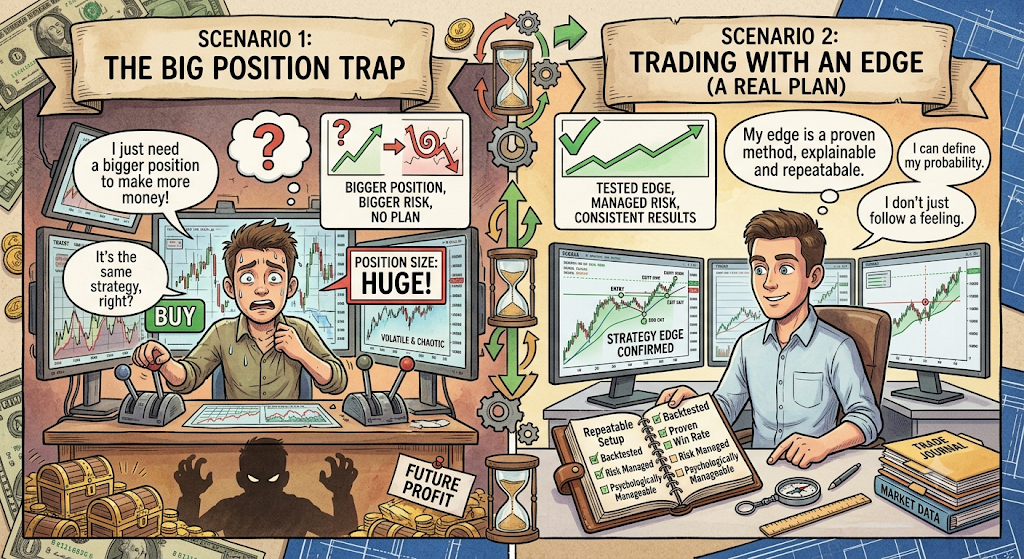
A chart starts moving.
It's not your ideal setup, but it looks close enough. You convince yourself it'll probably work. After all, you don't want to miss an opportunity.
So you take the trade.
This is how overtrading begins.
Many traders lower their standards after sitting on the sidelines for too long. Instead of waiting for high-quality setups, they start trading anything that looks "good enough."
The problem is that average setups usually produce average results.
Strong traders are patient. They know their edge, and they don't compromise on it just because the market is open. If a trade doesn't meet their criteria, they let it go without regret.
Because every unnecessary trade carries unnecessary risk.
The best traders aren't the ones who trade the most.
They're the ones who say "no" the most.
When you become more selective, your confidence grows. You spend less time managing bad trades and more time waiting for the opportunities that truly fit your plan.
Some of the best trading lessons come from seeing how experienced traders think through markets, risk, and execution.
If you'd like to explore more market perspectives, you can discover a few newsletters here:

Commodity Channel Index (CCI)
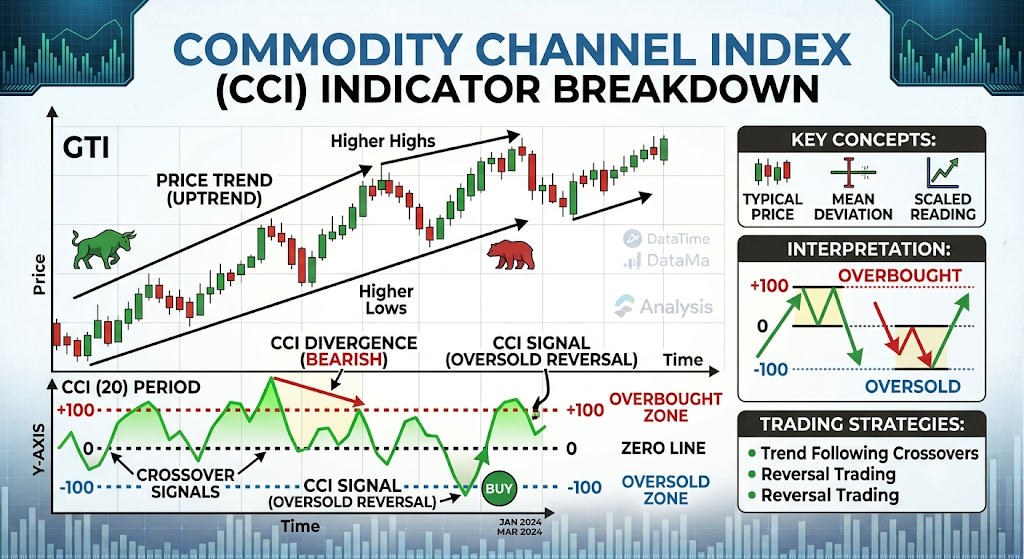
The Commodity Channel Index (CCI) is a versatile momentum oscillator created by Donald Lambert. It measures an asset’s current price level relative to its average price over a set period (usually 20 periods). By tracking how far the price deviates from its statistical average, the CCI highlights cyclical market turns, overextended conditions, and emerging trends.
🔴 The Red Zone (Above +100)
The Meaning: The CCI line rises above +100. This indicates that the price is trading well above its statistical average, placing it in overbought territory or confirming a strong upward trend.
The Move: Exercise caution. While a move above +100 confirms strong momentum, jumping in late increases your risk. Watch for the line to cross back below +100 as your cue to take profits or prepare for a pullback.
🟡 The Yellow Zone (-100 to +100)
The Meaning: The CCI line travels inside the baseline range between -100 and +100, oscillating around the central Zero Line.
The Move: Hold and wait. About 70-80% of CCI values naturally fall within this channel. The price is moving within normal statistical boundaries, meaning there is no major cyclical extreme to trade.
🟢 The Green Zone (Below -100)
The Meaning: The CCI line sinks below -100. This shows that the price has dropped significantly below its historical average, marking an oversold condition or extreme downward pressure.
The Move: Get ready. Panic selling has pushed the asset into deep value territory. Look for the CCI line to turn around and cross back above -100 to confirm a fresh upward bounce.
🔍 Two Simple Signals to Watch
1. The Threshold Crossover (Entry Trigger)
Don't trade simply because CCI enters the extreme zones—wait for it to exit them.
- The Logic: A Buy Signal occurs when CCI drops below -100 and then hooks back above -100 (as shown in the green callouts above). A Sell Signal trscopeiggers when CCI rises above +100 and then crosses back below +100 (the purple callouts).
2. The Zero-Line Rejection (Trend Continuation)
In a powerful, established trend, the Zero Line acts as a natural magnet and springboard.
- The Logic: During a strong uptrend, pullbacks will often cause the CCI line to drop toward zero without crossing into negative territory. When the CCI touches zero and bounces upward, it confirms that the main trend is resuming, giving you a low-risk continuation entry.
💡 The Simple Secret
Think of the CCI as a rubber band stretched from its center. Because it is unbounded (unlike RSI or Stochastic, which cap at 0-100), CCI can theoretically reach +200 or -200 during extreme market surges. The key is recognizing that when the rubber band stretches past +/-100, it is storing potential energy that will eventually snap the price back toward its statistical mean.

You're Protecting Your Trading Account More Than Your Future
Ask a trader what their goal is, and most will say the same thing:

"I want trading to pay for my life."
Freedom.
Security.
Options.
But something strange happens when they finally start making money.
They refuse to take any of it out.
Not because they need every dollar to grow the account.
Because withdrawing feels... wrong.
Almost scary.
They'll happily watch their account grow from $5,000 to $8,000.
But ask them to withdraw $1,000?
Suddenly they hesitate.
"What if I need that capital?"
"The account will grow slower."
"I'll wait until it's bigger."
Then the account grows.
And the excuse grows with it.
"I'll withdraw at $10,000."
Then it's $20,000.
Then $50,000.
The number keeps moving.
Sound familiar?
Here's the irony.
You started trading to make money...
...but somewhere along the way, growing the account became more important than benefiting from it.
Your account became a scoreboard.
Every withdrawal felt like watching your high score go down.
So you stopped treating profits as something to enjoy.
You started treating them as numbers that must never be touched.
Of course, this doesn't mean you should empty your account every month.
Compounding is real.
Keeping enough capital to execute your strategy matters.
But there's a difference between investing in growth and becoming emotionally attached to a number on a screen.
One trader admitted he'd been profitable for almost two years and had never withdrawn a single dollar.
When I asked why, he paused for a long time.
Finally he said,
"I guess... it doesn't feel real if I take it out."
That sentence says more than most trading books.
Because many traders secretly believe money is only "working" when it's inside the brokerage account.
Everything else feels like interrupting the journey.
But here's something worth thinking about:
If your trading has genuinely improved, shouldn't your real life improve too?
Shouldn't some of those profits pay for a holiday...
Help your family...
Build your savings...
Reduce debt...
Create a little more breathing room?
Otherwise, what exactly are you building?
An account...
Or a life?
Every profitable business pays its owner eventually.
Trading should be no different.
So the next time your account reaches a new high, don't just ask,
"How much bigger can I make it?"
Ask something equally important:
"At what point does this money start serving my life instead of simply sitting on a screen?"
Because the goal was never to become rich inside a trading platform.
The goal was to use trading to build a better life outside of it.