SK Hynix Reaches $1T
....................................................................................................................


Good Morning,
We are opening Wednesday with steady green lights across the board. The Nasdaq is leading the charge up 0.5%, while the S&P 500 and Dow are right behind it.
Following a historic Tuesday that saw both the S&P and Nasdaq close at brand new all-time records, the bulls are refusing to back down.
A diplomatic breakthrough is teasing Wall Street. The primary engine driving today's optimistic mood is the ongoing peace negotiations between the U.S. and Iran. While Secretary of State Marco Rubio warned that a final, signed deal is still a few days away—and the Strait of Hormuz remains largely blocked—the mere prospect of an end to the war is a huge relief.
As a sign of confidence, oil prices are continuing to drift lower, taking a massive amount of inflation pressure off the broader economy.
The AI boom is keeping the floor solid. Alongside peace talks, relentless investor confidence in the semiconductor and chip trade is keeping the growth engines humming.
This afternoon, we get a direct look at the health of that tech spend with heavy hitters Marvell Technology, Salesforce, and Snowflake all reporting earnings after the bell.
The market is betting on a peaceful resolution, and if the diplomats deliver, those yesterday records might just be the new baseline.

💻 SK Hynix Joins Micron and Samsung in Exclusive $1 Trillion Club
Shares of SK Hynix jumped over 12% on Wednesday, propelling the company to a historic $1 trillion valuation just hours after its U.S. rival Micron Technology crossed the same milestone. With Samsung Electronics clearing the mark earlier this month, all of the memory industry's "big three" now sit in the trillion-dollar club as the AI infrastructure buildout accelerates.
🛢️ Oil Dips Near $98 Despite Flaring U.S.-Iran Border Hostilities
International benchmark Brent crude edged down to near $98 a barrel, while WTI stabilized around $92. Despite escalating military friction—including U.S. defensive strikes near the Strait of Hormuz and Iranian forces firing at U.S. aircraft—energy traders are maintaining an optimistic outlook that a final peace pact remains structurally on track.
📱 Apple Eyes 'Agentic AI Moat' to Solve Long-Term Software Challenge
While critics often frame Apple as an AI laggard, Bank of America analysts argue that the upcoming pivot toward autonomous AI agents will play directly into the company's hands. Apple's absolute control over its integrated hardware, custom silicon, and operating systems creates a unique ecosystem barrier that could turn its proprietary ecosystem into the ultimate distribution channel.
₿ Bitwise: Historic Valuation Gap Between Tech and Bitcoin Favors BTC
Asset management firm Bitwise notes that the valuation divergence between Bitcoin and U.S. megacap tech has reached one of its widest points in market history. While Nasdaq-100 price-to-book ratios trade at extreme premiums, Bitcoin's market-value-to-realized-value (MVRV) ratio sits at a modest 1.42, pointing to significant medium-term structural undervaluation.
📊 U.S. Equities Defy Europe as Chip Stocks Drive Nasdaq Out Front
Wall Street climbed higher on Tuesday, separating itself from softer European bourses as a relentless bid for technology and semiconductor names lifted the Nasdaq. Equity investors actively faded the intraday geopolitical noise, choosing to prioritize long-term corporate earnings power over temporary shipping lane disruptions.
🥇 Gold Plummets 1% as Hawkish Fed Rate Bets Reinforce Treasury Yields
Spot gold slumped over 1% to $4,526.86 an ounce as fixed-income markets began aggressively pricing in an outright Federal Reserve interest rate hike rather than a cut. The combination of a resilient dollar and soaring long-term yields continues to hammer non-yielding bullion, as sticky energy overhead costs force a more hawkish macroeconomic consensus.
🇪🇺 European Stocks Erase Gains After U.S. Strikes Cool Peace Optimism
Exchanges across Europe fell on Tuesday as defensive U.S. military operations in southern Iran cooled investor assumptions of an immediate diplomatic breakthrough. With the region's energy architecture highly exposed to Middle Eastern supply lines since the war began in February, continental traders are taking profits while Secretary of State Marco Rubio cautions a deal could take a few more days.

One Headline Can Change the Entire Market
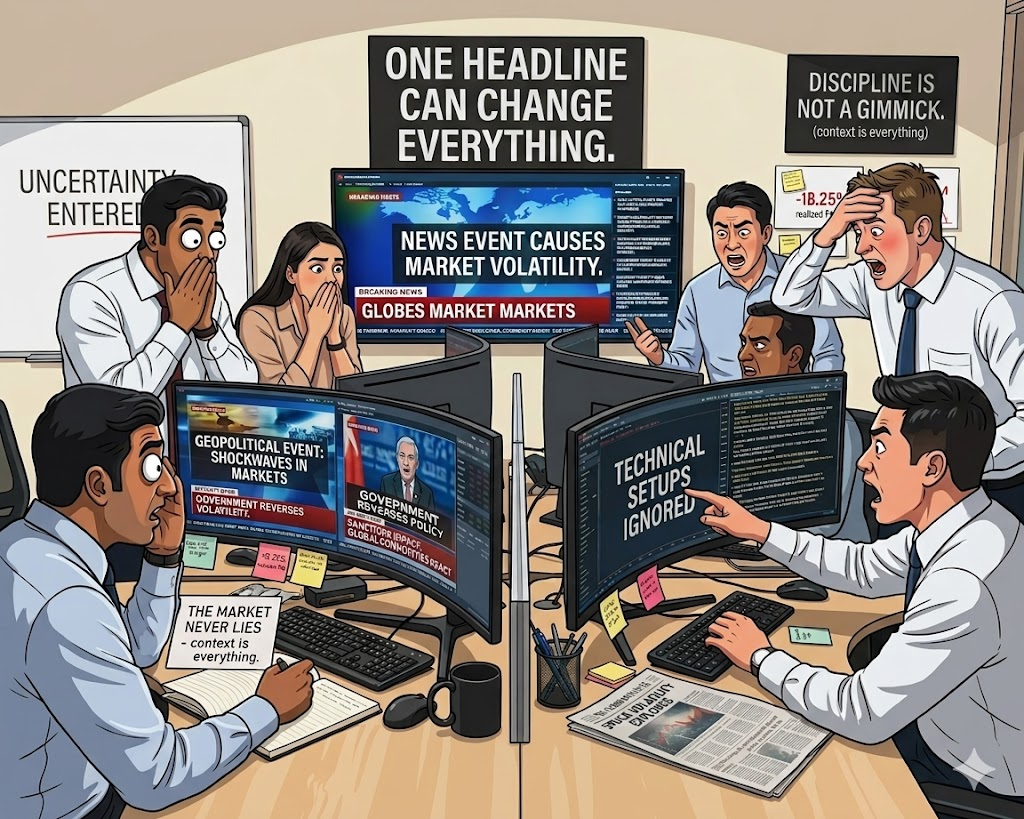
The chart looks normal… until it isn’t.
A geopolitical headline drops. Conflict escalates. A government announces sanctions, tariffs, or unexpected policy changes. Within minutes, markets react hard.
That’s the reality of modern trading.
Some moves have nothing to do with technical setups. Price can spike, reverse, or gap purely because uncertainty suddenly entered the market.
This is where traders get caught off guard.
They assume the market will behave normally in abnormal situations. Stops get skipped. Volatility explodes.
What looked like a controlled trade turns chaotic fast.
Strong traders respect geopolitical risk. They stay aware of major global events. They reduce exposure during uncertain periods and avoid pretending they can predict every reaction.
Because survival matters more than catching every move.
When you accept that headlines can override setups, your risk management becomes stronger. You stop treating every market condition the same way.
Awareness protects capital.
Some traders like exploring how global events shape markets and influence volatility.
If that’s you, you can explore a few market reads here:

The Exponential Moving Average (EMA)
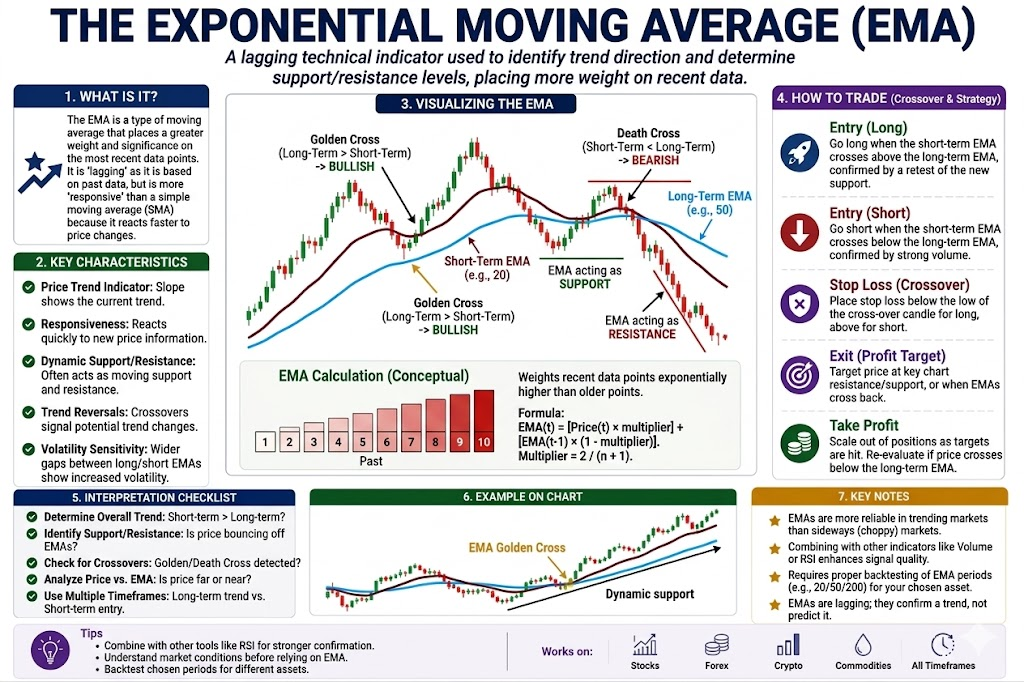
The EMA (Exponential Moving Average) is a trend tracker that acts like a "Fast-Response" version of the standard moving average. Unlike the SMA, the EMA places more weight on the most recent price action. This means it reacts much quicker to sudden market moves and trend changes.
🔴 The Red Zone (The Price Drops Below)
The Meaning: The current price breaks below the EMA line. Because the EMA tracks recent data heavily, this is an immediate warning that short-term momentum has turned weaker than the average trend.
The Move: Look to protect your positions or exit. The asset is cracking under recent selling pressure, and the bears are taking the upper hand.
🟡 The Yellow Zone (The Flatline/Touch)The Meaning: The price is actively riding along the EMA line, or the EMA line itself is twisting sideways.
The Move: Hold and wait. The market is testing the line. Because the EMA reacts so fast, a clean bounce off this line means the trend is ready to restart, while constant chopping through it means the trend has stalled.
🟢 The Green Zone (The Price Climbs Above)
The Meaning: The current price breaks above the EMA line. This proves that buyers are aggressively pushing the price up right now, lifting it well above its recent average baseline.
The Move: Get ready to buy. The asset has unlocked fresh upward speed, signaling that the bulls have successfully seized control of the near-term trend.
🔍 Two Simple Signals to Watch1. The EMA Cross (9 and 21)
A favorite trick for fast-moving markets is watching a short-term EMA (like the 9-period) cross a medium-term EMA (like the 21-period).
- The Logic: When the 9 EMA crosses completely above the 21 EMA, it means the immediate trend is accelerating upward rapidly. When the 9 EMA crosses below the 21 EMA, short-term momentum is collapsing.
2. The Trend Filter (The 200 EMA)
The 200-period EMA is tracked heavily by institutional traders to determine the ultimate market direction.
- The Logic: If the price is anywhere above the 200 EMA, you are in a long-term bull market—only look for buying opportunities. If the price is below the 200 EMA, you are in a structural bear market—avoid buying.
💡 The Simple Secret
Think of the EMA line as a "Magnet." In a powerful trend, the price will frequently shoot far away from the EMA line, but it eventually gets pulled back toward it to reset. The safest time to jump into a trend is never when the price is far away from the line, but rather right when it snaps back to touch the EMA and shows signs of a fresh bounce.

Watching Other Traders Have More Fun

Your chart is dead.
Slow candles.
No momentum.
Nothing exciting happening.
Meanwhile, someone on Twitter is posting:
- “+300 points on Nasdaq 🚀”
- “Gold absolutely exploded”
- “Crypto going vertical”
And suddenly your quiet setup starts feeling… stupid.
Now you’re irritated.
Not because your trade is bad.
Because somebody else’s market looks more exciting 😂
So you leave your plan.
You jump into the fast-moving chart late.
No preparation.
No context.
Just urgency.
And now your brain is operating on pure FOMO.
You start chasing candles that already moved.
Entering after the momentum peak.
Managing risk emotionally because you don’t fully understand the environment.
Meanwhile the original setup you abandoned?
It slowly plays out exactly as planned 😭
This happens ALL the time.
And it comes from a dangerous illusion:
MOVEMENT FEELS LIKE OPPORTUNITY.
But activity and edge are not the same thing.
Some traders see volatility and instantly assume:
“That’s where the money is.”
Not always.
Sometimes that’s where the chaos is.
Good traders understand that every market has its own rhythm.
Some days your setup moves beautifully.Some days it does nothing.
That doesn’t mean you abandon structure every time another market starts dancing louder.
Because once you build the habit of chasing action, patience disappears completely.
Now every quiet moment feels unbearable.
And that’s how traders slowly become addicted to stimulation instead of execution.
Let’s be honest:
A lot of traders don’t actually want GOOD trades.
They want exciting trades 🎢
Huge candles.Fast profits.Constant movement.
But excitement is expensive in this business.
Professional traders don’t switch markets emotionally because another chart is moving faster.
They stick to what they understand.
Because consistency usually looks boring while it’s happening.
And social media makes this worse.
You’re comparing your quiet reality to everybody else’s highlight reel.
Nobody posts:“Sat patiently for three hours and respected my plan.”
But that’s often the behavior that actually builds accounts.
So here’s a mindset shift worth remembering:
You do not get paid for trading the MOST exciting market.
You get paid for trading YOUR edge consistently.
And sometimes the hardest skill in trading…
Is staying loyal to a calm, well-planned setup while the internet screams about something shinier somewhere else.