Ryanair Stock Slides 6%
....................................................................................................................



Good morning,
We’re kicking off the week with a bit of relief. Nasdaq futures are leading the bounce, up 0.37%, the S&P 500 is gaining 0.24%, and the Dow is up a steady 75 points. Investors are attempting to look past a very messy geopolitical backdrop to focus on the massive corporate earnings dropping later this week, giving the market a tentative breath of fresh air after all three major indexes closed in the red last week.
The chip sector is trying to stabilize, but experts warn of more pain. This morning's positive turn comes after a brutal stretch for tech, where a relentless sell-off in microchips dragged the Nasdaq down 2.9% last week alone. While beaten-down names are enjoying a short-term bounce today, market technicians are warning it is likely premature to call a final bottom for the chip sector, suggesting the real "washout" hasn't fully happened yet.
A ninth night of airstrikes keeps the Middle East on a knife-edge. Geopolitical risks are refusing to fade. The U.S. military launched its ninth consecutive night of airstrikes against Iran on Sunday, trying to protect commercial shipping lanes in the critical Strait of Hormuz. Tensions surged further over the weekend after U.S. Central Command confirmed a third American service member was killed in the fighting. Despite the heavy military action, energy traders are staying relatively calm this morning, with Brent crude holding flat at $88 a barrel and U.S. crude dipping slightly to $82, keeping a lid on immediate inflation fears.
Global markets are deeply split. Overnight in Asia, the reaction to the weekend's events was wildly mixed. South Korea’s Kospi index crashed 4.5%, continuing its rough patch, while mainland China’s markets managed a 1.5% gain, and Japan was closed for a holiday. Over in Europe, markets managed to reverse their early morning losses to trade slightly positive.
The ultimate tech test arrives on Wednesday. The real reason investors are trying to push stocks higher today is the massive lineup of corporate earnings on deck. The high-flying "Magnificent Seven" trade faces a crucial moment on Wednesday evening when Alphabet and Tesla report their latest results. Plus, chip giant Intel—which was absolutely hammered with a 13% drop last week—gets its turn in the spotlight on Thursday.
The tech sector wants to stage a major comeback, but with active military strikes in the Gulf and massive earnings just 48 hours away, nobody is letting their guard down.

🛢️Brent Crude Nears $90 as Iran Vows Total Strait of Hormuz Blockade After U.S. Airstrikes
Global oil prices surged on Monday morning, pushing international benchmark Brent crude toward the $90-a-barrel threshold. The massive escalation follows a ninth consecutive night of targeted U.S. military strikes against Tehran, triggered after the Pentagon confirmed a third American service member was killed in recent regional operations. In response to the intensifying assaults, Iranian officials vowed that "not a single drop" of oil or gas would be permitted to transit the strategic Strait of Hormuz, igniting acute global energy supply panics.
📉 South Korea's KOSPI Drops 4.5% as Escalating Middle East War Sparks AI De-Risking
Bourses across the Asia-Pacific region trended sharply lower to open the trading week, led by a severe 4.5% capitulation in South Korea's benchmark KOSPI index. With Tokyo markets closed for a public holiday, international asset managers aggressively unloaded high-beta technology components linked to the artificial intelligence infrastructure trade, as localized portfolios brace for the real risk of an all-out regional war.
✈️ Ryanair Slides 6% as War-Driven Fuel Costs and Soft Summer Fares Dent Profit
Shares of Ryanair plunged 6% on Monday after the European budget carrier reported a bruising 34% drop in first-quarter profit after tax to 538 million euros ($615.3 million). The steep bottom-line contraction was driven by a combination of surging prices for its unhedged aviation fuel amid the ongoing U.S.-Iran war and a simultaneous decline in summer ticket fares, prompting CEO Michael O'Leary to warn that "unprofitable airlines face a difficult winter."
🌏 Asia Shares Shaky as Rising Energy Pressures Fan Broad Macro Inflation Fears
MSCI’s broadest index of Asia-Pacific shares outside Japan dipped 0.3% on Monday as the escalating conflict in the Persian Gulf injected severe friction into global risk assets. While mainland Chinese blue chips managed a defensive 1.4% gain, broader regional sentiment remains highly unstable as soaring crude benchmarks threaten to reignite systemic inflation, just as a packed calendar of corporate financial releases prepares to test investor faith.
🥇 Gold Slips to $4,014 as Rising Oil Revives Hawkish Fed Interest Rate Voices
Spot gold prices edged down 0.1% to trade at $4,014.53 an ounce on Monday morning, feeling the weight of shifting monetary policy expectations. Although geopolitical flare-ups historically fuel safe-haven bullion accumulation, the metal is being penalized as Brent crude’s climb above $90 a barrel reinforces warnings from several Federal Reserve policymakers that further interest rate hikes may be required to suppress renewed price pressures.
📊 Wall Street Braces for High-Stakes Big Tech Earnings to Test Broken Market Rotation
U.S. equity futures drifted into negative territory following a brutal week of trading where the tech-heavy Nasdaq Composite shed 2.9% and the S&P 500 lost 1.5% due to an intense global semiconductor sell-off. Market participants are stepping into a critical five-day stretch headlined by upcoming Wednesday earnings from Magnificent Seven stalwarts Alphabet (GOOG) and Tesla (TSLA), serving as a definitive test of institutional positioning.
💵 Dollar Snaps Three-Day Winning Streak as Currency Desks Consolidate Risks
The U.S. dollar index construct drifted 0.1% lower to 100.69 in Asian trading on Monday, snapping a powerful three-session rally that had been heavily fueled by defensive flight-to-safety capital allocations. Currency desks executed a minor, localized pause in greenback accumulation, balancing the intense military developments in the Middle East against a broader recalibration of risk parameters before the New York opening bell.

If You Can't Explain Your Edge, You Probably Don't Have One
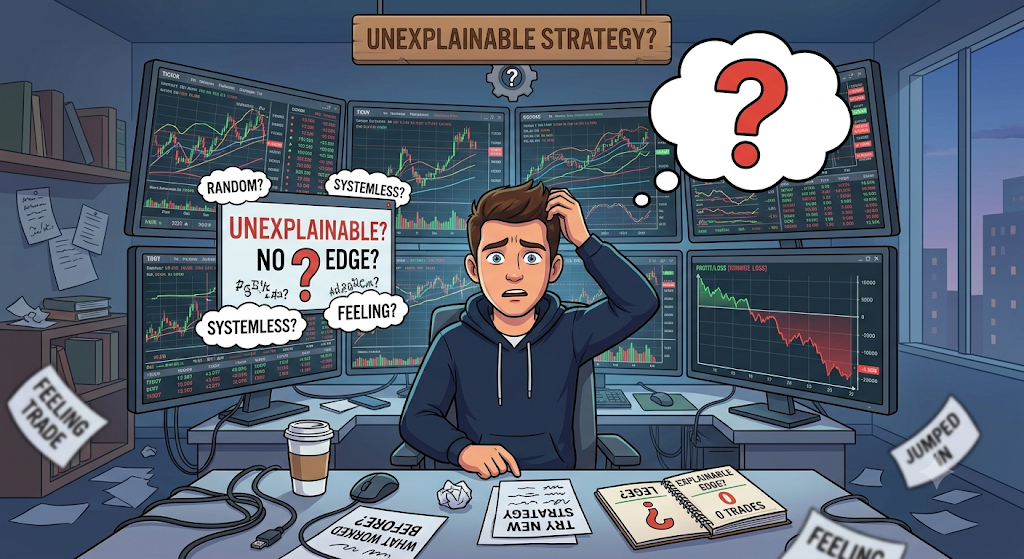
Ask a trader why they took a trade, and the answer is sometimes, "It just looked good."
That's not an edge.
An edge is a reason to believe that, over many trades, your approach has a higher probability of success. It's not a feeling. It's not a lucky streak. It's something you can explain, test, and repeat.
Many traders jump from one strategy to another without ever knowing what actually gives them an advantage. When results change, they have no idea why.
Strong traders know exactly what they're looking for. They can describe their setup, the conditions where it works best, and the risks they're willing to take. Their confidence comes from understanding their process, not hoping for a good outcome.
Because if you don't know what your edge is, you won't know when you've lost it—or when you've found it.
Great traders never stop learning. Reading different market perspectives can help you challenge your thinking and sharpen your own approach.
You can explore a few market newsletters here:

Rectangle
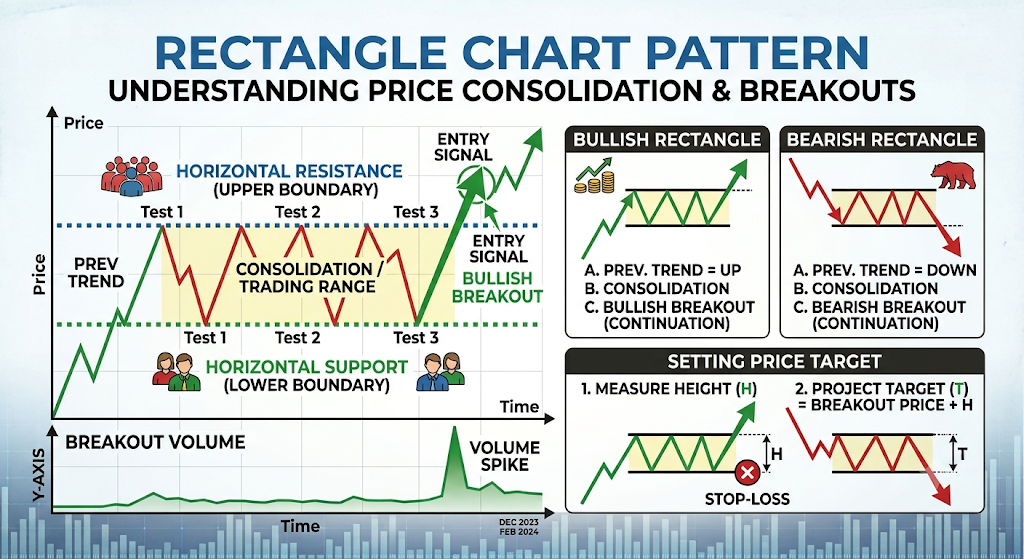
The Rectangle (often called a trading range or consolidation box) is a classic chart pattern that represents a prolonged deadlock in the market. It forms when the price bounces back and forth between two completely flat, horizontal parallel lines—a solid ceiling at the top and a firm floor at the bottom. It signals that buyers and sellers are matched dollar-for-dollar, trapping the market in a box until one side snaps.
🔴 The Red Zone (The Flat Horizontal Ceiling)
The Meaning: This is the top baseline of the box where a heavy wall of supply sits. Every time the price rallies to this exact price boundary, sellers aggressively step in to knock it back down.
The Move: Stop buying here. This ceiling is an unbreakable barrier for the time being. Avoid going long at the top of the box, as the market is highly likely to reject and head back down.
🟡 The Yellow Zone (Inside the Box)
The Meaning: The price is bouncing back and forth smoothly between the ceiling and the floor, stuck in a sideways tug-of-war.
The Move: Watch closely or swing trade the boundaries. For trend traders, this is a strict "wait-and-see" zone because the market has no clear direction. For short-term traders, this zone offers predictable bounces from floor to ceiling.
🟢 The Green Zone (The Box Breakout)
The Meaning: The price accumulates enough explosive energy to violently blast through either the horizontal ceiling line or the floor line, closing cleanly outside the box.
The Move: Go! Whichever way the price breaks out of the rectangle is your official green light. A clean break above the ceiling means buy; a clean break below the floor means exit or short.
🔍 Two Simple Signals to Watch
1. The Volume Drought & Spike
Keep a very close eye on the trading volume bars while the price is trapped inside the yellow zone.
- The Logic: Inside the rectangle, volume should steadily dry up and get incredibly quiet, showing that big players are waiting on the sidelines. The very second the price breaks out of the box, you must see a massive surge in volume to confirm the move is real and backed by major institutional cash.
2. The Role Reversal Test
Once the price cleanly breaks out of a rectangle, the broken boundary line will almost always undergo a structural shift.
- The Logic: If the price breaks above the ceiling, look for it to eventually pull back and test that exact same line from above. The old ceiling should now act as a fresh, solid support floor. A successful bounce off this line provides an incredibly safe, high-probability entry point.
💡 The Simple Secret
Think of a Rectangle pattern as a pressure cooker with two locked valves. The longer the price stays trapped bouncing inside the box, the more pressure builds up. To find your target profit area after the green light triggers, measure the exact vertical height of the box from floor to ceiling—the price will very often sprint that exact same distance on its next major run once it escapes the rectangle.

Pretending Nothing's Wrong Won't Stop the Bleeding

Nobody likes admitting they're in a drawdown.
It feels like failure.
So instead, many traders do something much easier.
They pretend it's business as usual.
Same position size.
Same number of trades.
Same confidence.
At least... that's what they tell themselves.
But beneath the surface, everything has changed.
Every loss hurts a little more.
Every setup feels heavier.
Every winning trade feels like it has to work because the account "needs it."
The funny thing about drawdowns is that they don't just shrink your balance.
They quietly change the way you think.
And if you ignore that, they tend to get worse.
I once knew a trader who had six losing trades in a row.
Nothing unusual. Losing streaks happen.
But instead of slowing down to ask, "What's going on here?" he doubled down on normality.
He kept trading full size because reducing risk felt like admitting something was wrong.
His thinking was simple:
"If I cut my size now, I'm trading scared."
It sounded brave.
It was actually denial.
A week later, the drawdown had nearly doubled.
Not because his strategy suddenly stopped working...
But because his ego refused to acknowledge reality.
Here's the mistake many traders make:
They treat a drawdown like bad luck instead of useful information.
Sometimes it is just variance.
Sometimes the market has changed.
Sometimes you've drifted away from your rules without noticing.
You won't know which one it is if you never stop to investigate.
Professional traders don't see reducing risk as surrender.
They see it as creating space to think clearly again.
There's no shame in stepping back.
No shame in trading smaller for a while.
No shame in saying,
"Something feels off. Let me figure it out before I press harder."
In fact, that might be one of the most professional decisions you ever make.
Because a drawdown doesn't become dangerous the moment your equity starts falling.
It becomes dangerous the moment your pride takes over the decision-making.
The market isn't judging you.
It doesn't care that you've had a rough two weeks.
So stop trying to impress it.
When you're in a hole, your first job isn't to climb out as quickly as possible.
It's to stop digging.
Sometimes the fastest way back isn't trading bigger or trading harder.
It's having the humility to pause long enough to understand why you ended up there in the first place.