Oil Prices Jumps Over 3%
....................................................................................................................



Good morning,
The stock market is starting the final day of August on edge, forced to deal with sudden geopolitical turbulence right as it tries to put the finishing touches on a winning month.
Futures are slipping slightly into the red across the board: Dow contracts are down 64 points (0.12%), the S&P 500 is off by 0.1%, and the tech-heavy Nasdaq is hovering just below the flatline. The morning dip comes after the quiet period in the Middle East came to an abrupt halt over the weekend. On Sunday, U.S. Central Command confirmed strikes on two rocket launchers on Iran's Larak Island—the first acknowledged U.S. strike in a month, prompting Iranian state media to report retaliatory attacks on U.S. bases in Jordan.
The sudden flare-up brings fresh uncertainty back to energy markets and shipping routes just as investors were getting comfortable with the Federal Reserve's policy signals from Jackson Hole.
Despite the rocky start to the morning, the broader market is still in a great position to lock in a solid August. Traders are now watching closely to see if dip-buyers step in to protect monthly gains, or if escalating headlines in the Gulf will force Wall Street to end the month on defense.

📉 Stock Futures Slip as U.S. Strikes Iranian Launchers
U.S. stock index futures edged lower early Monday after direct combat between the U.S. and Iran resumed for the first time in a month. U.S. Central Command confirmed strikes against two Iranian rocket launchers on Larak Island, pushing Dow futures down 64 points alongside mild declines across S&P 500 and Nasdaq-100 contracts.
🌍 Global Equities Turn Cautious as Sovereign Bond Yields Spike
World bourses opened the final session of August on the back foot as renewed Middle East hostilities and rising oil prices elevated inflation concerns. Government borrowing costs in Germany and Japan pushed to fresh multi-year highs following hawkish policy remarks from Federal Reserve Chairman Kevin Warsh at Jackson Hole.
🛢️ Brent Tops $90 After U.S. Military Hits Targets in Hormuz
Crude oil prices surged at the weekly open, with Brent crude pushing above $90 a barrel and WTI trading near $86. Upward pressure followed U.S. strikes on Iranian rocket sites preparing to lay naval mines in the Strait of Hormuz, ending weeks of relative shipping stability.
🚗 BYD Slides on Fierce Domestic EV Pricing Wars
Shares of Chinese EV giant BYD dropped on Monday after the automaker cited sluggish domestic demand and intense domestic price competition in its first-half report. Despite local market margin compression, second-quarter net profit managed a 30% year-over-year rise to 8.2 billion yuan, supported by international export strength.
💄 K-Beauty Firm APR Up 100% Ahead of U.S. Costco Rollout
Shares of South Korean beauty brand APR have doubled year-to-date as its flagship Medicube lineup prepares to launch across U.S. Costco stores in September. The international push follows a second quarter in which overseas markets accounted for nearly 92% of company revenue, with North America representing 49%.
⚠️ September Macro Risks Mount Around Debt Loads and Hawkish Fed
Global markets face a complex macroeconomic backdrop heading into September, with investors tracking elevated government debt burdens and sticky inflation prints. Market participants are preparing for high-stakes central bank communications as Chairman Warsh faces his first major FOMC policy test.
₿ Bitcoin Dips Below $79K After Warsh Downplays Softer Inflation
Bitcoin pulled back to $78,400 after failing to maintain technical support above the $80,000 threshold. The retreat followed Federal Reserve Chair Kevin Warsh's Jackson Hole speech, which downplayed recent cool inflation prints and reiterated a cautious stance toward persistent underlying price pressures.

That Profit Isn't Yours Yet
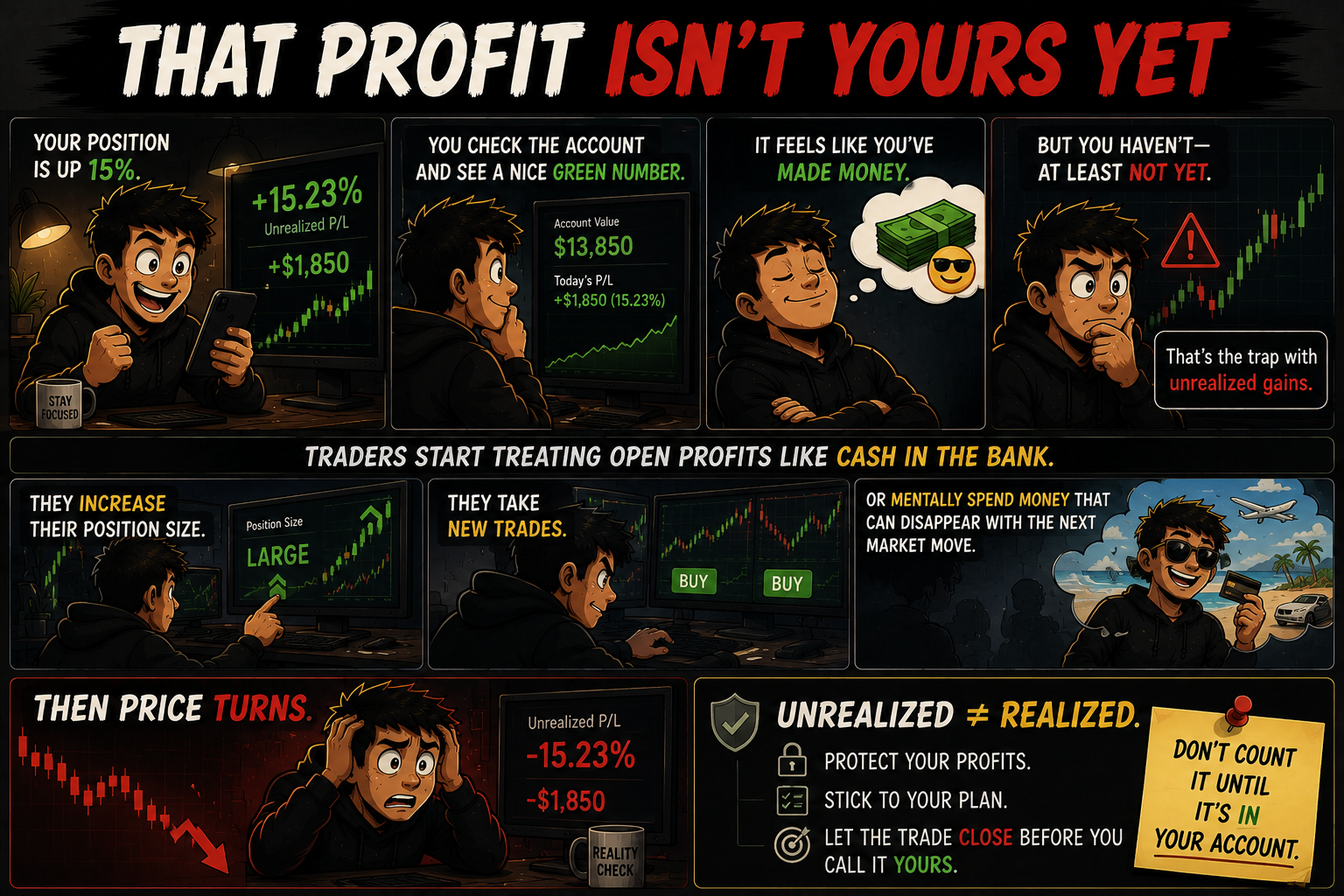
Your position is up 15%.
You check the account and see a nice green number.
It feels like you've made money.
But you haven't—at least not yet.
That's the trap with unrealized gains.
Traders start treating open profits like cash in the bank. They increase their position size, take new trades, or mentally spend money that can disappear with the next market move.
Then price turns.
The profit shrinks. Sometimes it disappears completely.
And suddenly, a trade that felt like easy money becomes a loss.
Strong traders know the difference between an unrealized gain and money they've actually locked in. They don't change their risk simply because an open position is showing a profit.
An open trade is still exposed to the market.
Until you close it, the outcome can change.
That doesn't mean you should rush to take profits. It means you should keep treating the position according to your plan, whether it's up, down, or somewhere in between.
Because a green number isn't the same as realized profit.
Don't spend money the market hasn't given you yet.
Trading becomes easier when you separate what you hope to make from what you've actually secured. Reading different market perspectives can also help you think more clearly about risk and decision-making.
If you'd like to explore more thoughtful market perspectives, you can discover a few market newsletters here:

The Morning Star
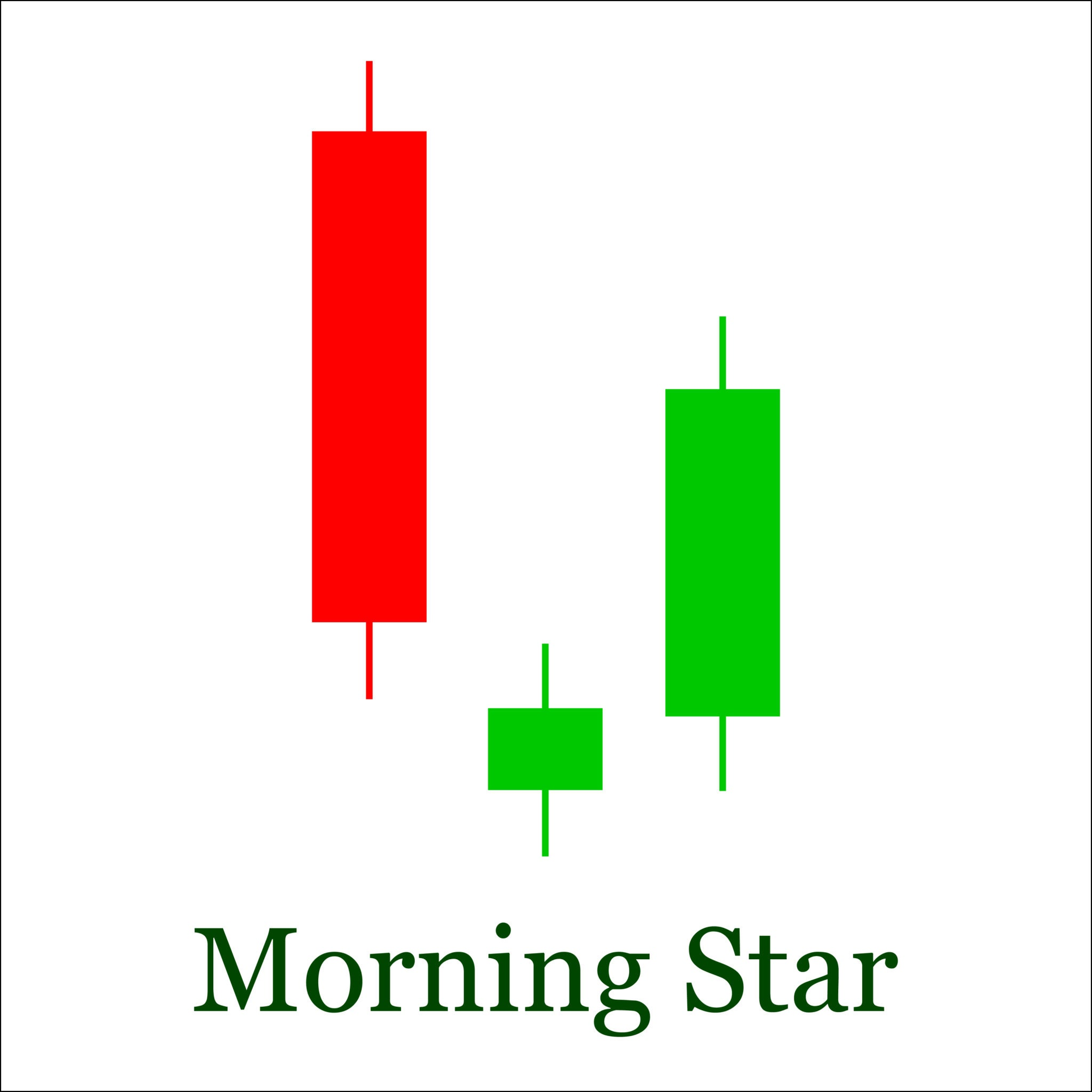
Morning Star Three-Candle Reversal Structure. Source: Pavlo Stavnichuk / Getty Images
The Morning Star is a premier three-candle bullish reversal pattern that forms at the base of an extended downtrend. It marks the transition from heavy selling to market equilibrium, followed by an aggressive surge in buyer dominance. Just as the morning star heralds the sunrise, this pattern signals that the dark downtrend is ending and a new upward trend is dawning.
🔴 The Red Zone (Candle 1: The Bearish Momentum)
The Meaning: A long, decisive red (bearish) candle forms in the direction of the active downtrend. Sellers are fully in control, driving prices downward with strong momentum.
The Move: Wait. Do not step in to buy yet. The downward trend is fully intact, and seller volume is dominating the tape.
🟡 The Yellow Zone (Candle 2: The "Star" of Indecision)
The Meaning: A small-bodied candle (red, green, or a Doji) gaps or prints lower than the first candle. The tiny body reveals that seller momentum has suddenly ground to a halt and supply and demand are deadlocked.
The Move: Watch closely. The bears have lost their ability to push prices lower, but buyers haven't taken the wheel yet. This is your alert that a potential bottom is forming.
🟢 The Green Zone (Candle 3: The Bullish Confirmation)
The Meaning: A large green (bullish) candle surges upward, closing deeply into—and usually past the 50% midpoint of—the first red candle's body.
The Move: Go! A confirmed close on the third candle is your official green light to enter a long position. Place your stop-loss just beneath the lowest wick of the middle "Star" candle to manage risk.
🔍 Two Simple Signals to Watch
1. Depth of the 50% Body Penetration
Examine how far the third green candle climbs into the first red candle's territory.
- The Logic: For a valid Morning Star, the third candle must close past at least 50% of the first candle's real body. The higher it closes above that halfway mark (or if it engulfs the first candle entirely), the stronger the institutional conviction behind the reversal.
2. The Volume U-Turn
Compare trading volume across all three candles in the sequence.
- The Logic: Volume should be high on Candle 1 (panic selling), noticeably dry up on Candle 2 (exhaustion of sellers), and aggressively explode on Candle 3 (institutional accumulation). A volume surge on the third candle confirms that smart money is driving the bounce.
💡 The Simple Secret
Think of the Morning Star as a three-act play: Panic, Hesitation, and Power Shift. The first day belongs to the sellers, the second day marks a complete stalemate, and the third day is a decisive buyer takeover. When this three-candle sequence prints at a major support floor, key moving average, or oversold oscillator reading, it provides one of the most reliable bottom-reversal entries in price action trading.

You Made the Money. So Why Are You Afraid to Take It?
Imagine your account finally crosses a number you've been chasing for months.
You stare at it.
$10k.
$20k.
$50k.
Whatever your milestone is, it feels good.
Then someone says:
"Why don't you withdraw some?"
And suddenly the confidence disappears.
"Not yet."
"I want to compound first."
"I'll take some out when I hit the next level."
Then the next level arrives.
And the goalpost moves again.
This is where things get interesting.
Because sometimes the reason you're not withdrawing isn't really about strategy.
It's emotional attachment to the account balance.
You've spent so long watching that number grow that taking money out feels like going backwards.
Your account drops from $20,000 to $17,000 after a withdrawal...
...even though $3,000 is now sitting in your bank account.
Technically, you're richer.
Emotionally?
It feels like you lost something.
That's the trap.
At some point, the trading account stops being a tool and becomes a scoreboard.
And now you're protecting the score instead of enjoying the result.
I've heard traders say things like:
"I don't want to take money out because it kills the compounding."
Fair.
Compounding matters.
Capital matters.
But there's a difference between keeping enough capital to grow...
...and being so afraid of shrinking the number that you never let your trading improve your actual life.
What's the point of spending years building a profitable account if every dollar has to stay trapped behind your broker login?
You're not building a life.
You're building a museum.
And here's another uncomfortable layer:
Sometimes traders refuse to withdraw because taking money out makes the profits feel real.
As long as the money stays on the screen, the achievement is abstract.
You can keep dreaming about the future.
The moment you withdraw it and use it?
Now you've actually done something.
You've paid a bill.
Funded a holiday.
Built savings.
Bought something meaningful for your family.
The money crossed from "I might make it" to "I made it."
That can be surprisingly emotional.
So don't leave withdrawals to your mood.
Create a rule.
Maybe you withdraw a percentage above a certain equity high.
Maybe you pay yourself monthly.
Maybe you split profits between compounding and your real life.
The exact number matters less than having a predefined system.
Because otherwise, you'll always find one more reason to leave everything in the account.
And the next time you hesitate to withdraw, ask yourself:
"Am I protecting my future... or am I afraid to see my account balance go down?"
That answer matters.
Because trading is supposed to create freedom.
Not turn you into the full-time security guard of a number on a screen.
Make money. Grow the account. But remember why you wanted the money in the first place.