Oil Climbs to $100 Again
....................................................................................................................



Good morning,
We’re starting the morning with stock futures holding mostly flat. Nasdaq futures are down a slight 0.26%, Dow futures are down 20 points, and S&P 500 futures are hugging the baseline. This comes right on the heels of a painful Thursday session where the Dow plunged over 500 points, and both the S&P 500 and Nasdaq posted their worst single-day drops in over a month (down 1.2% and 2.2%, respectively).
Oil surges past $100 after Red Sea tanker strikes. The main catalyst behind Thursday’s market beatdown was a violent 7% spike in energy costs. Brent crude crossed $100 a barrel for the first time since late May following reports that two Saudi Arabian oil tankers were hit in the Red Sea. Because market sentiment was previously leaning bearish on energy, this sudden threat to global oil flow triggered a massive, outsized price surge that immediately re-ignited fears of stubborn inflation.
Tesla and Alphabet lead a megacap tech meltdown. Giving Wall Street a severe double-whammy, disappointing updates from two tech titans sent shockwaves through the market:
- Tesla (TSLA) plunged nearly 15%—its worst single-day drop since March 2025—after whiffing on second-quarter earnings.
- Alphabet (GOOGL) dropped 7% after announcing plans to significantly raise its full-year capital spending, alarming investors who are growing impatient with the soaring costs of the AI race.
Asia-Pacific markets face a total sea of red. The panic in New York spilled over into international trading overnight. Japan’s Nikkei sank 2.79%, while South Korea’s Kospi crashed over 5% as the tech sell-off ripped through Asian supply chains. Australia, Hong Kong, and mainland Chinese indexes all closed in negative territory as well.
It's a deeply bruised, highly cautious end to the week. With the Dow, S&P 500, and Nasdaq all on track to lock in weekly losses, investors are treading very lightly as energy shocks and tech worries combine.

🖥️ Super Micro Surges 15% on Margin Upgrade Driven by New AI Orders
Shares of Super Micro Computer (SMCI) jumped 15% on Tuesday after the server manufacturer raised its gross margin outlook for the June quarter to between 15% and 17%. The significant bump up from its previous 8.2% to 8.4% target is being driven by a surge in high-margin AI server orders, including key builds for Elon Musk's SpaceX.
🛢️ Oil Prices Jump 4% as U.S. Strikes Iran for 11th Consecutive Night
Crude benchmarks advanced 4% on Wednesday as military conflict in the Middle East continued to escalate without a near-term diplomatic breakthrough. U.S. forces carried out an 11th straight night of strikes against Iranian targets, while Secretary of State Marco Rubio noted that Tehran is "not serious" about peace negotiations, leaving the vital Strait of Hormuz effectively blocked.
🌏 Asian Shares Trade Mixed Despite Wall Street Rally as Crude Keeps Climbing
Bourses across Asia-Pacific mapped out divergent performance tracks on Wednesday, balancing an overnight Wall Street bounce against persistent energy-driven inflation fears. Japan's benchmark Nikkei 225 dipped 0.2% to close at 66,115.60, as a weakening yen pushed up the domestic value of both imports and exports.
🏭 Wistron Surges 9.7% in Taipei After Opening $700M Texas Factory for Nvidia
Shares of Taiwanese hardware provider Wistron Corporation surged 9.7% in Taipei following the grand opening of its $700 million smart manufacturing facility in Fort Worth, Texas. The new plant is already mass-producing Nvidia's GB300 Grace Blackwell Ultra Superchips and is scheduled to expand production to the next-generation Vera Rubin systems.
🤖 Nvidia Touts Vera Rubin Chips to Counter AMD's Advancing AI Event
Nvidia (NVDA) highlighted performance gains for its upcoming Vera Rubin platform ahead of competitor AMD's AI showcase. The company revealed that cloud provider CoreWeave is achieving 10 times greater power efficiency (tokens per watt) when running DeepSeek's R1 model on Vera Rubin hardware compared to the prior Grace Blackwell generation.
🥇 Gold Eases From Two-Week Peak as Rising Energy Prices Bolster Fed Hike Bets
Spot gold pulled back from a two-week high after approaching $4,150 per ounce, as rallying oil prices sparked renewed inflation anxieties. Strong follow-through buying driven by safe-haven demand was ultimately capped by a firmer greenback, as fixed-income traders increased their wagers on additional Federal Reserve interest rate hikes.
₿ Bitcoin ETFs Extend Inflow Streak to Six Days with $203M Net Influx
U.S. spot Bitcoin ETFs recorded their sixth consecutive session of net positive inflows on Tuesday, adding $203.1 million to bring their six-day total to approximately $930 million. The sustained buying streak marks the product class's longest run of inflows since April, providing price support as Bitcoin traded near $65,800.

Missing One Trade Won't Ruin Your Trading
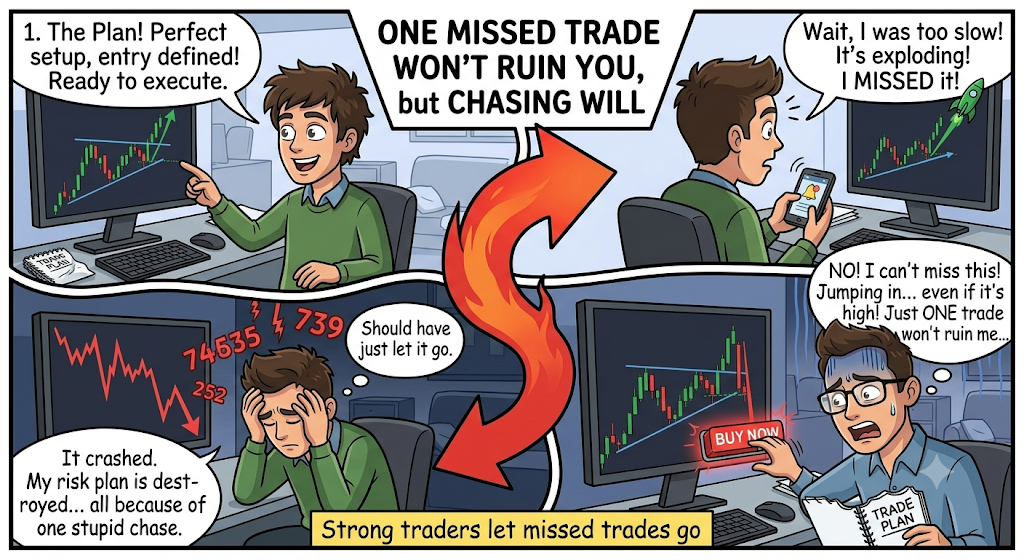
You had the perfect entry.
You saw it. You planned it.
But for whatever reason, you didn't take it.
Then the market takes off without you.
That's when the temptation starts.
You tell yourself, "I'll just jump in now." Even though the price is far from your planned entry. Even though the risk has changed.
Now you're chasing.
The fear of missing out makes a bad entry feel like a good decision. But once you abandon your plan, you're no longer trading your strategy—you're trading your emotions.
Strong traders let missed trades go.
They know the market will always create another opportunity. They'd rather miss one good trade than force one bad trade.
Because protecting your discipline is more valuable than catching every move.
The market isn't running out of opportunities.
You just need the patience to wait for the next one.
Patience pays better than chasing.
Every trader benefits from seeing how different people interpret the markets. Fresh perspectives can sharpen your thinking without replacing your own.
Explore a few market newsletters here:

The Rounding Bottom
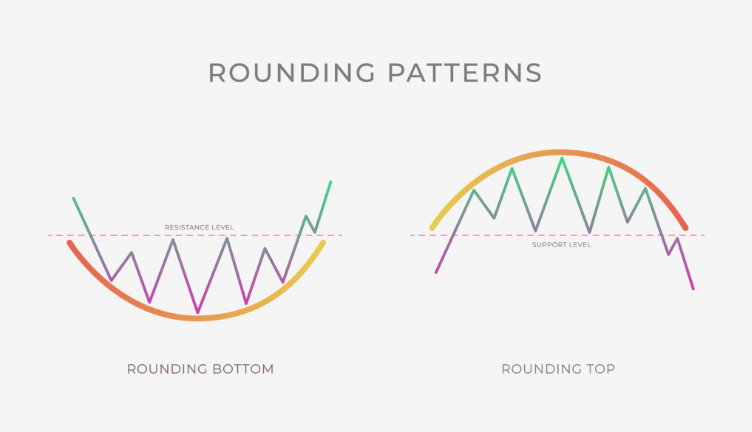
The Rounding Bottom (often called a Saucer Bottom) is a long-term reversal chart pattern that resembles a wide "U" shape. It signals a gradual shift from a prolonged downward trend to a sustained upward trend. Unlike sharp V-shaped bottoms where the market turns on a dime, a Rounding Bottom represents a slow, calm transition where sellers slowly lose momentum and buyers gradually take control.
🔴 The Red Zone (The Downward Slope)
The Meaning: The price steadily declines as sellers maintain control, forming the high left edge of the bowl.
The Move: Wait. Do not try to catch the falling knife. At this stage, the downtrend is still active, and there is no confirmation of a floor forming yet.
🟡 The Yellow Zone (The Bowl Floor)
The Meaning: The downward momentum slows down and price trades sideways in a flat, curved trajectory. The market enters a period of quiet consolidation where supply and demand reach balance.
The Move: Watch closely. The selling pressure has dried up, and buyers are quietly accumulating shares at low prices. The curved bowl bottom shows that control is shifting without creating dramatic price spikes.
🟢 The Green Zone (The Neckline Breakout)
The Meaning: Price climbs up the right side of the bowl to reach the horizontal ceiling level (the Neckline) established at the start of the pattern, then breaks cleanly above it.
The Move: Go! A clean break and close above the resistance ceiling provides your entry signal. It confirms that the accumulation phase is complete and a fresh upward trend is underway.
🔍 Two Simple Signals to Watch
1. The Volume U-Shape
Volume typically mirrors the shape of the price chart during a valid Rounding Bottom.
- The Logic: Volume should be high during the initial price decline, dry up to near-zero levels along the flat bottom of the bowl, and steadily expand as price climbs up the right side toward the breakout.
2. The Pullback Retest
After breaking above the resistance ceiling, price frequently pulls back to test that broken level from above.
- The Logic: The old ceiling should now act as a solid support floor. A successful bounce off this level confirms the breakout and offers a lower-risk entry point.
💡 The Simple Secret
Think of the Rounding Bottom as a momentum shift on a bowl-shaped track. The market loses speed on the way down, glides across the flat bottom, and builds upward velocity on the opposite side. To estimate the potential price target after a breakout, measure the maximum vertical depth from the horizontal resistance line down to the lowest point of the bowl—the price often rallies that same vertical distance above the breakout point.

Your Profits Don't Count Until You Can Spend Them
A trader once said something that sounded impressive at first.

"I've never withdrawn a cent from my trading account."
He meant it as a badge of honor.
Like it proved he was committed.
Serious.
Focused on the long game.
But the more we talked, the clearer it became.
He wasn't building wealth.
He was collecting numbers.
Every time his account reached a new high, he felt proud.
Every time he thought about withdrawing some profit, he felt anxious.
What if the next opportunity needed more capital?
What if the account stopped growing?
What if taking money out slowed everything down?
So he left it all in.
Month after month.
Year after year.
Here's what's interesting.
If you owned a bakery, you wouldn't leave every dollar the business ever made in the cash register.
If you ran a consulting firm, you wouldn't refuse to pay yourself because the company account looked nicer.
Yet traders do this all the time.
Somewhere along the way, the account balance becomes an identity.
A scoreboard.
A bigger number feels like progress, even if your actual life hasn't changed.
But that's not what trading is for.
Trading isn't about building the biggest account you can stare at. It's about building a life that account can support.
Now, that doesn't mean you should withdraw profits every Friday and sabotage compounding.
There's a balance.
Your account needs capital to grow.
But your life deserves to benefit from your success too.
Otherwise, what are you really working for?
One of the healthiest habits profitable traders develop is creating rules around withdrawals.
Not emotional decisions.
Rules.
Maybe it's taking out a percentage every quarter.
Maybe it's withdrawing after hitting a major milestone.
Maybe it's paying yourself like a business owner.
Whatever the method, it turns profits into something real.
Because here's a question worth asking:
If you've been profitable for years but have never used that money to improve your actual life... have you really enjoyed the rewards of trading?
Or have you simply become the caretaker of a number on a screen?
The market can give.
The market can also take away.
That's its nature.
So don't wait for some magical account balance before allowing yourself to enjoy the results of your discipline.
At some point, your profits should stop living inside your broker...
...and start living in your life.
Because the best trade you'll ever make isn't the one that grows your account.
It's the one that reminds you why you wanted to grow it in the first place.