Netflix Goes Down 8%
....................................................................................................................



TGIF!
We’re opening Friday with a celebratory buzz. After the S&P 500 and Nasdaq smashed new closing records yesterday, futures are inching even higher this morning. The Dow is leading the nudge up 0.2%, as investors react to the news that Israel and Lebanon have agreed to a 10-day ceasefire. It’s a massive win because this was one of Iran's biggest "must-haves" before they agreed to stop the blockade of the Strait of Hormuz.
Is a "Good Deal" finally on the table? President Trump sounded more like a salesman than a general this morning, telling reporters that a permanent peace deal is "looking very good" ahead of weekend negotiations. The market has now officially clawed back every single cent lost since the Iran conflict began in February. We’re in "blue sky" territory now, but with the ceasefire officially kicking in at 5 p.m. ET today, everyone is watching the clock to see if the guns actually go silent.
Netflix just got a "thumbs down" from Wall Street. Despite beating expectations on the top and bottom lines for Q1, the streaming giant’s stock tanked over 9% in after-hours trading. The problem? A weak outlook for the second quarter that has investors worried the "subscriber party" might be winding down. It’s a sharp reminder that even in a record-breaking market, the "show me the growth" rule still applies.
The "Bank Parade" continues this morning. Before the opening bell, we’re getting the pulse of the regional economy from Truist, State Street, and Fifth Third. These results will be the final piece of the puzzle for a week that has shifted from "war panic" to "new all-time highs."
It’s a "victory lap" Friday. We’re at record levels, a ceasefire is on the clock, and the weekend could bring the biggest diplomatic breakthrough in years.

📈 S&P 500 and Nasdaq Hit Fresh Records on Ceasefire Hopes
The benchmark S&P 500 and Nasdaq closed at all-time highs for a second day as optimism grew over a 10-day Israel-Lebanon ceasefire. Sentiment was further bolstered by President Trump’s hints at a weekend summit with Iran and claims that Tehran offered to forgo nuclear weapons for 20 years, though analysts warn a full deal could still be six months away.
📉 Netflix Slides 8% as Guidance Eclipses Earnings Beat
Despite posting stronger-than-expected Q1 profits, Netflix shares tumbled in extended trading on disappointing Q2 guidance. The selling pressure was exacerbated by the announcement that co-founder Reed Hastings will exit the board in June, marking the end of an era for the streaming pioneer.
⛽ Oil Drops Toward $98 as War Nears 50-Day Mark
Brent crude fell back toward $98 a barrel as President Trump struck an upbeat tone on a permanent ceasefire. While Trump claimed Tehran has agreed to reopen the Strait of Hormuz—a concession Iran has not yet publicly confirmed—the market responded to the de-escalation rhetoric with a sharp pullback in prices.
☁️ Oracle Set for Best Week Since 1999 on AI Momentum
Shares of Oracle (ORCL) are up nearly 29% this week, marking their strongest performance in over 25 years. The rally was fueled by a landmark cloud partnership with AWS, reinforcing Oracle’s position as a critical infrastructure provider for the ongoing artificial intelligence boom.
🌏 Asia Markets Retreat Amid Ceasefire Skepticism
Asia-Pacific indices diverged from Wall Street’s record rally, closing mostly lower on Friday. Regional investors remain wary as the current U.S.-Iran ceasefire is set to expire on April 21, with many questioning if "rosy predictions" from Washington will translate into a lasting diplomatic resolution.
🥇 Gold Rally Stalls as Rate Cut Odds Plunge to 27%
Spot gold held flat near $4,788 as momentum faded ahead of key technical resistance levels. Bullish sentiment is being tested as the probability of a Federal Reserve rate cut has dropped to just 27%, fueled by sticky inflation and a resilient U.S. labor market.
🚲 Uber Expands Delivery Hero Stake in $318M Deal
Uber agreed to purchase an additional 4.5% stake in German food delivery firm Delivery Hero from Prosus. The $318 million deal represents a 22% premium to the one-month average share price, signaling Uber’s continued appetite for consolidation in the global delivery sector.

A Strategy That Works on Paper Can Still Fail Live
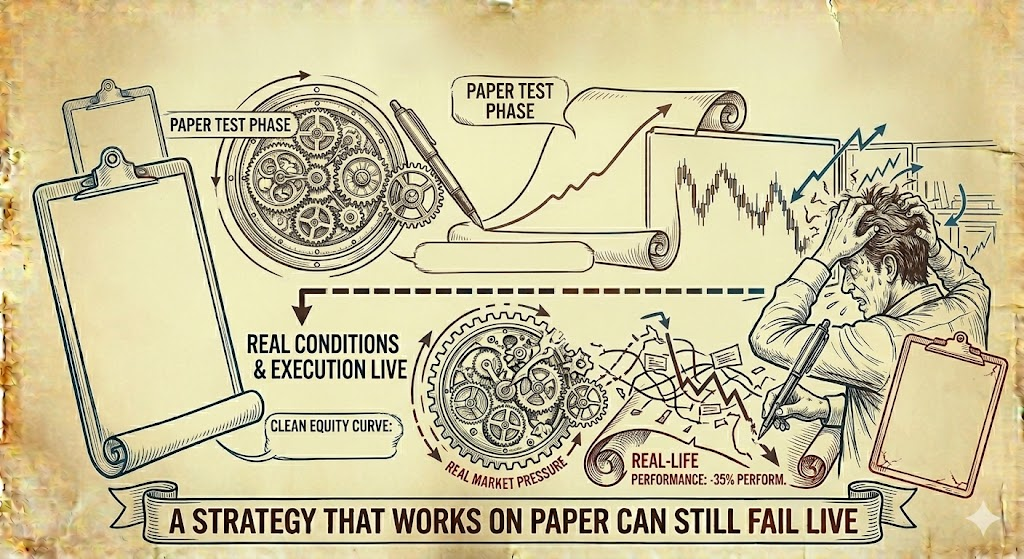
Backtests look clean. Smooth equity curves. Consistent results. Everything seems to work.
Then you go live… and it feels different.
Entries slip. Exits are worse. Price moves faster than expected. What looked precise in testing starts breaking in real conditions.
That’s where many traders get confused.
Backtests don’t capture everything. Slippage, liquidity, execution speed, and real market pressure all change the outcome. A strategy that fits past data perfectly can struggle the moment conditions shift.
Strong traders treat backtesting as a starting point, not proof. They test ideas, then validate them in live conditions with small risk. They focus on robustness, not perfection.
When you understand the gap between testing and reality, your expectations become more grounded. You build strategies that can survive real markets, not just look good on charts.
Some traders like exploring how different strategies perform in real markets and how others refine their edge.
If that’s you, you can check out a few market reads here:

Bullish Abandoned Baby
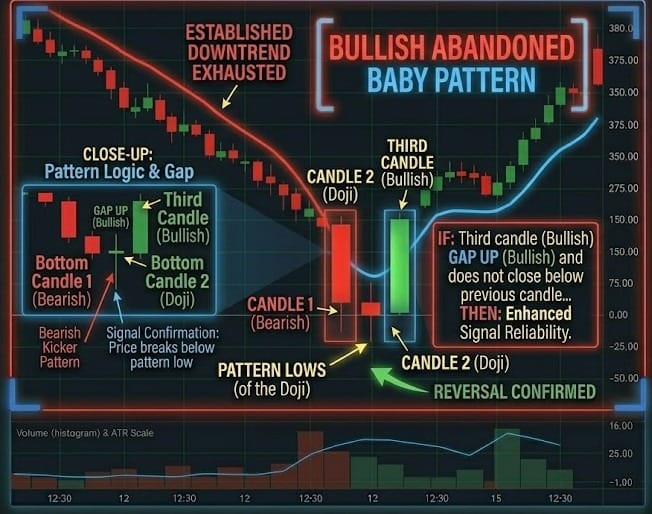
The Bullish Abandoned Baby is an extremely rare and highly reliable three-candle reversal pattern.
It is similar to a Morning Star, but with one critical difference: the middle candle (a Doji) must completely gap away from the candles on either side. There should be no overlap between the shadows of the Doji and the shadows of the first and third candles.
It represents a moment of total psychological exhaustion followed by a violent shift in the opposite direction.
🛠️ The Strategy Logic
Use these logical triggers to identify this "top-tier" reversal signal:
- IF: The first candle is a large bearish candle, followed by a Doji that gaps completely below the first candle’s low... * THEN: The "abandonment" has begun. This gap shows that the bears pushed price to an extreme where no one was willing to sell anymore, leaving the Doji "stranded" in no-man's-land.
- IF: The third candle is a strong bullish candle that gaps higher, leaving the Doji isolated at the bottom... * THEN: The pattern is confirmed. This "Island Reversal" at the micro-level shows that the bulls have completely hijacked the momentum, leaving the shorts trapped at the absolute bottom.
- IF: The pattern forms after a long, multi-week downtrend or at a "historical" support level... * THEN: You are likely looking at the Major Bottom. Because this pattern is so rare, it usually only appears when a trend is completely "broken" and ready for a long-term recovery.
- IF: The third (bullish) candle closes deep within or above the body of the first candle... * THEN: Conviction is very high. The further the third candle rallies, the more "abandoned" the sellers at the bottom become, fueling a short-covering rally.
- IF: The volume on the third candle is significantly higher than the first two... * THEN: The reversal is backed by "Smart Money." High volume on the gap-up confirmation proves that institutional buyers are aggressively entering the position.
💡 Pro Tip
The "Shadow Gap" Rule: The "Abandoned Baby" is only valid if there is zero overlap between the wicks (shadows) of the Doji and the other two candles.
If the wicks overlap even by one cent, it is just a standard Morning Star. Why does this matter? The lack of overlap proves a total lack of liquidity at that price point—it shows the market literally "skipped" over the Doji, creating a massive psychological void that sellers will be terrified to re-enter.
Place your stop-loss 1-2 ticks below the low of the Doji.

You Didn’t Need That Second Trade
First loss? Normal.
Setup didn’t work.
You took it. You lost.
Move on.
But you didn’t move on.
You felt it.
Not just the loss… the sting of it.
So you stayed on the charts a little longer 👀
Started scanning faster.Looking for something — anything — to “fix it.”
Then a setup appears.
Not as clean. Not really your A+.
But you take it anyway.
This time, it’s not about the trade.
It’s about getting back to even.
And that changes everything.
You enter faster.
You size a bit bigger.
You don’t think as clearly.
Because now there’s pressure.
“This one needs to work.”
It doesn’t.
Second loss.
Now it’s worse.
Not because of the money — but because of what it means.
You were wrong… twice.
So you go again.
And again.
THAT’S THE SPIRAL 🔁
The first loss came from the market.
The second? That was you.
Third? Pure emotion.
At that point, you’re not trading setups anymore.
You’re reacting.
Trying to undo something that already happened.
But trading doesn’t work like that.
You can’t fix a past trade with a new one.
Each trade stands alone.
The moment you link them emotionally… you lose control.
Good traders lose all the time.
The difference?
They know when a loss is just a loss —and when it’s about to turn into a problem.
So they stop.
Not because they’re scared.
Because they’re aware.
Here’s the shift:
After a loss, don’t ask,“What’s the next trade?”
Ask,“Am I clear enough to take one?”
If the answer isn’t a clean yes…
Step away 🧠
Because the most expensive trades aren’t the first losses.
They’re the ones you take trying to get them back.