Harvard Dumps Ethereum
....................................................................................................................



TGIF,
Everyone is frozen in place this morning, waiting to see if the U.S. and Iran are finally going to make a deal.
We’re opening Friday with a very cautious step up. Futures are leaning a little green—the tech-heavy Nasdaq is up 0.5%, while the S&P 500 and Dow are both creeping up about 0.3%. After a stressful start to the week, stocks actually bounced back yesterday because Secretary of State Marco Rubio hinted that peace talks might finally be getting somewhere.
Is the "War Tax" on our wallets finally going to end? Investors are crossing their fingers. The main reason the market has been so rocky lately is that the war has been driving up the cost of everything, making people worry the Fed will have to raise interest rates again. If these peace talks actually work out, the biggest cloud hanging over the economy could suddenly vanish.
But right now, the American consumer is feeling completely beat up. At 10 a.m. ET, we’re getting the final consumer sentiment numbers from the University of Michigan, and the mood is grim. The preliminary data showed consumer confidence crashing to a record low of 48.2 because people are completely overwhelmed by high gas prices. Until energy costs actually drop, the average shopper isn't in a mood to celebrate.
Government contractors are also facing the music. Before the opening bell, big-time government consultant Booz Allen Hamilton reported its earnings. Since they handle massive military and tech contracts, their outlook will tell us a lot about how much money is flowing into defense and cybersecurity while these global standoffs play out.
It’s a "hold your breath" Friday. The market wants to rally, but everything hinges on whether the diplomats can finish the job over the weekend.

📊 Wall Street Eyes Winning Week as Dow Hits Record High
U.S. stock indexes are on pace to end the week in positive territory despite an incredibly volatile start. The Dow Jones Industrial Average achieved a fresh record close on Thursday as investors bet on a Middle East diplomatic resolution, even as President Trump postponed his planned AI executive order signing.
💻 IBM Shares Soar on $1B Government Award for Quantum Foundry
International Business Machines (IBM) shares jumped following an announcement that the Trump administration will award the company $1 billion in federal funding. The capital is designated to build a domestic foundry for manufacturing quantum computing chips, anchoring a $2 billion strategic push to secure U.S. leadership in the tech sector.
🌏 Asian Currencies Flash Oil Shock Alarm as Blockade Hits Growth
Policymakers across Asia are facing severe economic stress as regional currencies slide to historic lows against a firming greenback. Because Asian nations historically consume roughly 80% of the oil shipped through the shuttered Strait of Hormuz, surging energy costs are heavily squeezing margins and forcing defensive interest rate hikes.
🛢️ Oil Prices Gain as Investors Doubt Quick U.S.-Iran Resolution
Brent crude futures rose 2.3% to $104.96 a barrel, while West Texas Intermediate climbed to $98.08. Energy markets pushed higher as market participants voiced concerns over an immediate breakthrough, noting that Washington and Tehran remain fundamentally at loggerheads over uranium stockpiles and maritime sovereignty.
💵 Dollar Hovers Near Six-Week Top on Middle East Stalemate
The U.S. dollar index maintained its dominant positioning near a six-week high following a highly volatile overnight session. While international diplomats have indicated narrow gaps in peace negotiations, currency traders are flocking to the safe-haven greenback as long as the critical Persian Gulf shipping channels remain compromised.
📈 Lenovo Rockets 20% on Six-Fold Net Income Explosion
Shares of Lenovo Group skyrocketed 19.32% in Friday trading after the PC and electronics giant posted its fastest revenue growth in five years. March quarter revenue reached a robust $21.6 billion—up 27% year-on-year—while net income surged six-fold to $521 million on an explosive, near-doubling of artificial intelligence infrastructure revenue.
🎓 Harvard Management Dumps Entire $87M Ethereum Position
Harvard University's endowment fund manager completely exited its $87 million position in BlackRock’s iShares Ethereum Trust ETF (ETHA) during Q1 2026, just one quarter after initializing the trade. The university’s latest SEC filing shows a total liquidation of its ETH holdings alongside a lighter trimming of its Bitcoin allocations.

The Market Loves Hurting Crowded Positions

Everything looks obvious. Everyone is leaning the same way. The trade feels safe because so many traders agree with it.
Then the market moves hard in the opposite direction.
That’s how pain trades happen.
Short squeezes and crowded reversals force traders out fast. Stops get triggered. Positions get liquidated. Panic buying or selling pushes price even further, creating moves that feel irrational in the moment.
The market often moves where it causes the most discomfort.
Many traders get trapped because they focus only on being right. They forget to think about positioning, sentiment, and where pressure might build.
Strong traders stay aware of crowded trades. They respect volatility when positioning becomes extreme. They manage risk carefully instead of assuming consensus means safety.
Because crowded confidence can reverse violently.
When you understand how pain trades work, you stop chasing emotional extremes. You trade with more awareness of how markets actually behave under pressure.
Risk hides where everyone feels comfortable.
Some traders like exploring how positioning and market psychology drive unusual price moves.
If that’s you, you can explore a few market reads here:

Simple Moving Average (SMA)
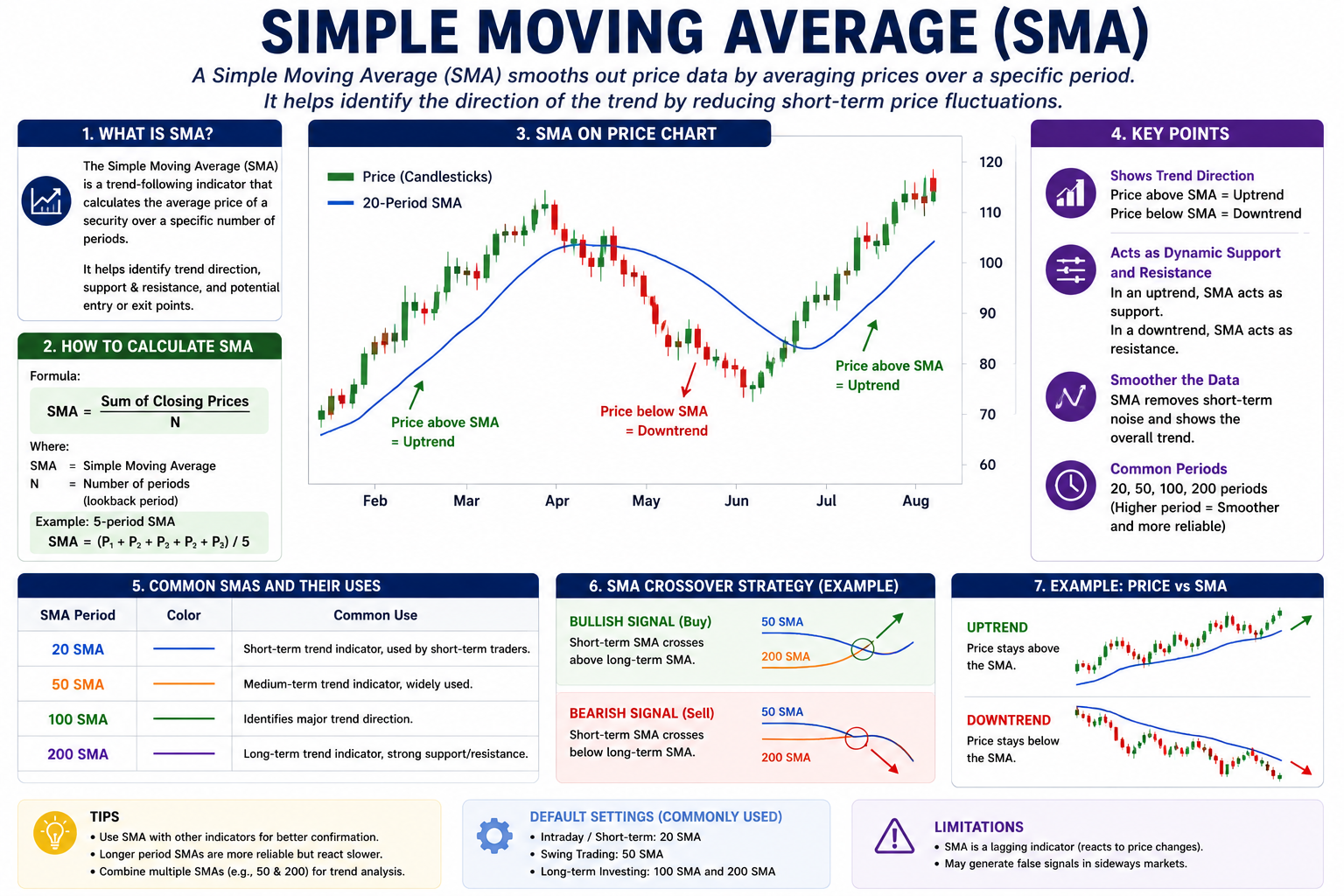
The SMA (Simple Moving Average) is a trend-smoothing tool. It takes the average closing price of an asset over a set number of days (like 50 or 200 days) to cut through the daily market "noise" and show you the true direction of the travel.
🔴 The Red Zone (The Price Drops Below)
The Meaning: The current price breaks below the moving average line. This shows that the short-term momentum has turned weaker than the longer-term average. The Move: Look to exit or be cautious. The asset is losing its support, and the bears are starting to pull the overall trend downward.
🟡 The Yellow Zone (The Flatline/Touch)
The Meaning: The price is riding right along the SMA line, or the SMA line itself is completely flat and horizontal. The Move: Hold and wait. This indicates a sideways market or a critical retest. The market is deciding whether the line will act as a trampoline to bounce back up, or a trapdoor to fall through.
🟢 The Green Zone (The Price Climbs Above)
The Meaning: The current price breaks above the moving average line. This proves that buyers are paying more for the asset now than they have on average over the past weeks or months. The Move: Get ready to buy. The asset has entered a healthy upward phase, signaling that the bulls have taken control of the trend.
🔍 Two Simple Signals to Watch
1. The Golden Cross
This happens when a fast-moving average (like the 50-day SMA) crosses completely above a slow-moving average (like the 200-day SMA).
- The Logic: This is a major long-term buy signal. It proves that short-term momentum is accelerating so fast that it is reversing the structural, long-term downtrend.
2. The Death Cross
The exact opposite of the Golden Cross. This occurs when the fast 50-day SMA crosses below the slow 200-day SMA.
- The Logic: This is a major warning signal to sell or get out of the way. It shows that the long-term trend has broken down completely and a major bear phase is starting.
💡 The Simple Secret
Think of the SMA line as a dynamic floor or ceiling. In a strong uptrend, the price will often drop down, touch the SMA line, and instantly bounce off it to go higher. If you see the price testing the line and refusing to break below it, that "floor" is your safest entry point to ride the trend.

You Won Big… But Learned Nothing
A huge trade hits 🎯
Clean move.Big payout.Best day you’ve had in weeks.
You feel unstoppable.
Naturally, your brain focuses on the result:
- The money
- The P&L screenshot
- The excitement
- The “finally, things are clicking” feeling
But almost nobody asks the important question afterward:
“What exactly did I do RIGHT here?”
Not vaguely.
Exactly.
Because this is where traders accidentally waste their biggest breakthroughs.
They celebrate the outcome…
…but never study the process that created it.
A week later, they try to recreate the magic.
And suddenly everything feels random again.
That’s Process Amnesia.
You remember the dopamine.
You forget the details.
Maybe the real reason the trade worked was:
- You waited patiently for confirmation
- You traded smaller and stayed calm
- You ignored social media noise that day
- You followed your plan without interference
But because the brain loves RESULTS more than PROCESS…
…those lessons never get locked in.
So instead of building consistency, the trader chases the emotional high of the win itself.
And that’s dangerous.
Because eventually you start thinking:“I need another big trade.”
Instead of:“I need to repeat the behavior that produced it.”
Huge difference.
Professional traders treat big wins carefully.
Not emotionally.
Scientifically.
They slow down and dissect them:
- Why did this setup work?
- What conditions existed?
- What mindset was I in?
- What did I avoid doing?
Because one intentional lesson from a big win can improve your trading more than the money from the trade itself 📈
But most people skip that part completely.
They celebrate.Post the screenshot.Feel amazing for 24 hours.
Then go right back to chaotic execution 😭
So here’s something practical:
After every major win, write down:
- What you did correctly BEFORE the trade
- What you did correctly DURING the trade
- What emotional mistake you avoided
Not the profit.
The BEHAVIOR.
Because if you can identify the process clearly…
You can repeat it deliberately.
And that’s where consistency actually begins 🧠