Intel Shares Soar 20%
....................................................................................................................


Good morning,
The tech bulls and the oil bears are locked in a high-stakes tug-of-war this morning.
We’re closing out the week with a split screen. While the Nasdaq is pushing up 0.5% on the back of some monster chip earnings, the rest of the market is feeling the weight of the world. The Dow is slipping 0.2% as investors realize that while Israel and Lebanon just extended their truce by three weeks, the U.S.-Iran standoff is only getting louder.
Trump just issued a "shoot and kill" warning. Over the weekend, the President ordered the U.S. Navy to take out any Iranian "smart-guy" boats seen mining the Strait of Hormuz. Tehran hasn't backed down, claiming their unity is "solider" than ever and dismissing the threats as media games. The result? Brent crude is knocking on the door of $103, and WTI is holding firm at $96. It’s a classic supply squeeze that’s keeping a lid on any broad market rally.
The "Old School" chips are saving the day. While Big Tech has been shaky, legacy names like Texas Instruments and Intel are proving the AI build-out is lifting all boats. Texas Instruments just had its best day in 25 years after a massive beat, and Intel is following suit this morning with a strong outlook. It turns out the data center boom needs more than just the "cool kids" to keep running.
Main Street is starting to sweat. All eyes are on the 10 a.m. ET release of the University of Michigan consumer sentiment index. Economists are bracing for a drop to 47.6, as high prices and war headlines finally start to eat into the "retail therapy" budget.
We’ve got strong tech earnings battling $100 oil and a naval standoff—it’s going to be a noisy ride to the closing bell.

🚀 Intel Rockets 20% on Blowout Data Center Sales
Intel (INTC) shares soared Friday after a Q1 earnings beat and a massive Q2 revenue forecast of up to $14.8 billion, far exceeding Wall Street’s $13.03 billion estimate. The surge is driven by explosive growth in AI-linked data center demand, providing a powerful tailwind for the broader chip sector.
📊 Futures Mixed as AI Optimism Clashes with War Impasse
U.S. stock futures struggled for direction Friday despite Intel's rally. While an extension of the Israel-Lebanon ceasefire provided some relief, the total deadlock in U.S.-Iran negotiations has kept investors on edge. Nasdaq futures gained 0.5% on tech strength, while the Dow and Russell 2000 dipped 0.1%.
🛢️ Oil Holds Gains for 5th Day on Failed Peace Talks
Brent crude held near $105 a barrel, on track for a staggering 17% weekly gain as U.S.-Iran negotiations reached a standstill. U.S. officials report that President Trump’s recent social media rhetoric and the continued naval blockade have significantly stalled mediated discussions in Pakistan.
📈 TSMC Hits Record High as Taiwan Eases Fund Caps
Shares in TSMC jumped 5% to a fresh all-time high after Taiwanese regulators announced plans to loosen investment limits. The revised framework will allow domestic funds and ETFs to allocate up to 25% of assets to single dominant stocks, clearing the way for massive inflows into the chip giant.
🌏 Asia Markets Mixed as Japan Inflation Accelerates
Regional exchanges diverged Friday as Japan’s core inflation rose to 1.8% in March, driven by war-related energy costs. While the Nikkei 225 managed a 0.97% gain to end near 59,716, broader sentiment remains dampened by the lack of progress on a permanent Middle East settlement.
🥇 Gold Set for Weekly Drop as Inflation Fears Mount
Spot gold fell to $4,685 an ounce, snapping a four-week winning streak with a 3% weekly decline. Persistent high oil prices have reignited fears that inflation will remain "sticky," prompting the market to price in a "higher-for-longer" interest rate environment from the Federal Reserve.
₿ Bitcoin Primed for $80K as Institutional Conviction Grows
Analysts expect Bitcoin to hit $80,000 "within days," citing a surge in high-conviction buying from institutional investors. Unlike previous retail-driven rallies, the current move is being supported by "deep-pocketed" players positioning for a long-term breakout despite geopolitical volatility.

Your Phone Is Not a Trading Desk
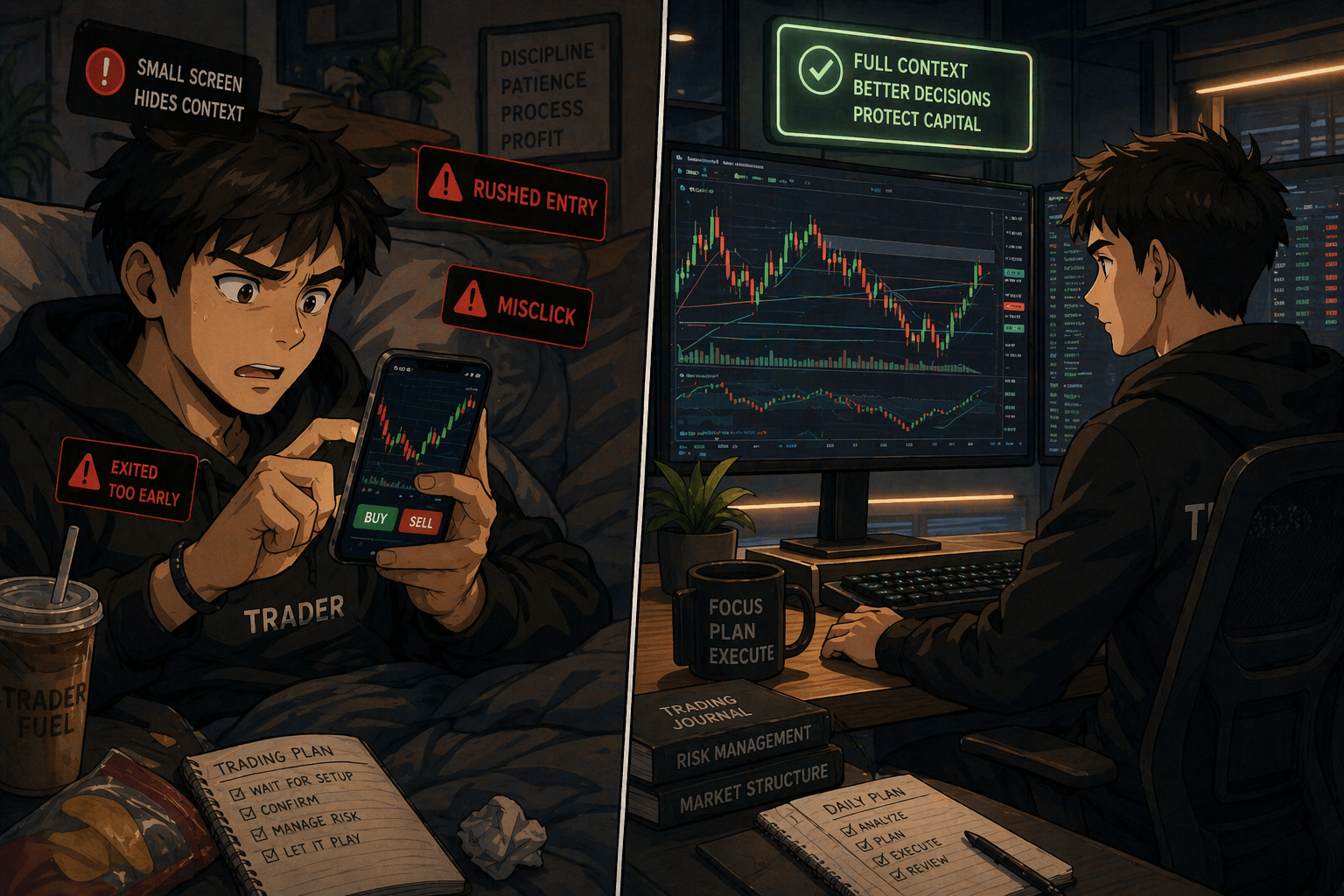
Trading on your phone feels convenient. Quick checks. Quick entries. Easy access anywhere.
But convenience comes with limits.
Small screens hide context. Levels are harder to see. It’s easier to misclick, rush entries, or exit too early. Decisions become quicker, but not better.
That’s where mistakes slip in.
Mobile trading often turns into reactive trading. You act on what you see in the moment, not on a full plan. Important details get missed because the view is compressed.
Strong traders use mobile phones for monitoring, not decision-making. They plan trades on a proper setup where they can see the full picture. When they execute, it’s based on clarity, not convenience.
When you separate planning from quick access, your decisions improve. You reduce errors.
You stay aligned with your strategy.
Some traders like exploring how small habits and setups impact performance more than they expect.
If that’s you, you can check out a few market reads here:

Schaff Trend Cycle (STC)
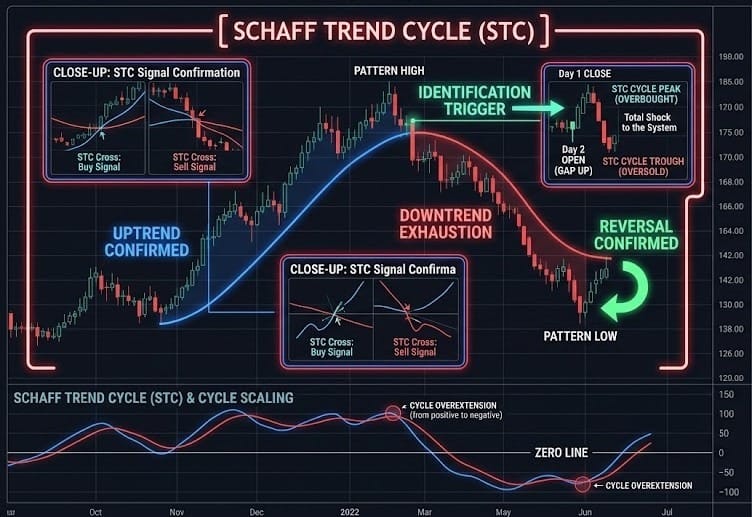
Developed by Doug Schaff, the STC is often called the "better MACD." It combines the benefits of MACD (trend following) with the benefits of Stochastics (speed and cycle detection).
It was designed to filter out the noise of price action by using a double-smoothed process, allowing it to identify trends much faster and more accurately than traditional oscillators.
🛠️ The Strategy Logic
Use these logical triggers to identify the exact start and end of a market cycle with minimal "lag":
- IF: The STC line crosses above the 25 level (from the bottom oversold zone)...
- THEN: A bullish cycle has begun. This is a high-probability "Buy" signal, indicating that the downward momentum has successfully bottomed out and the "new" trend is moving up.
- THEN: A bullish cycle has begun. This is a high-probability "Buy" signal, indicating that the downward momentum has successfully bottomed out and the "new" trend is moving up.
- IF: The STC line crosses below the 75 level (from the top overbought zone)...
- THEN: A bearish cycle is starting. The buying momentum has reached its peak and is now rolling over, signaling a "Sell" or an exit for long positions.
- THEN: A bearish cycle is starting. The buying momentum has reached its peak and is now rolling over, signaling a "Sell" or an exit for long positions.
- IF: The STC line stays flat at 100 for several candles while price is rising...
- THEN: The trend is in a Super-Bullish state. Do not sell yet! A flat line at 100 means the momentum is maxed out in the bulls' favor. Only exit when the line finally "breaks" and starts to drop below 75.
- THEN: The trend is in a Super-Bullish state. Do not sell yet! A flat line at 100 means the momentum is maxed out in the bulls' favor. Only exit when the line finally "breaks" and starts to drop below 75.
- IF: Price makes a new high, but the STC cycle peak is lower than the previous peak...
- THEN: You have a Bearish Divergence. Even if price is climbing, the "cyclical energy" is fading. This often precedes a sharp drop as the current market cycle exhausts itself.
- THEN: You have a Bearish Divergence. Even if price is climbing, the "cyclical energy" is fading. This often precedes a sharp drop as the current market cycle exhausts itself.
- IF: The STC line turns upward but fails to reach the 75 level before turning back down...
- THEN: The rally was a "Fake-out." This indicates a very weak bullish attempt that was immediately crushed by the dominant bearish trend.
💡 Pro Tip
The "Trend Alignment" Secret: Because the STC is very fast, it can occasionally give a "buy" signal during a major downtrend (a "relief bounce"). To avoid this, pair the STC with a 100-period Exponential Moving Average (EMA).
Only take Bullish STC crosses (above 25) when price is above the 100 EMA. Only take Bearish STC crosses (below 75) when price is below the 100 EMA.
This ensures you are trading the "cycle" in the same direction as the "Big Tide."

“It Almost Hit” Isn’t a Strategy
You close the trade early.
Price was close… but not quite there.
So you take profit.
Safe. Reasonable. Feels smart in the moment.
Then price keeps going.
Pushes higher…Hits your original target…Sometimes even goes beyond it.
And what do you say?
“Ah… it almost hit my target.”
Sounds harmless.

But that line hides the real issue.
YOU’RE TELLING A COMFORT STORY — NOT THE TRUTH.
Because the truth is simpler:
You didn’t let the trade finish.
Nothing was wrong with the setup.Nothing invalidated the idea.
You just stepped in too early.
But instead of examining that…
You soften it.
“It almost worked.”“I was basically right.”“Just unlucky.”
THIS IS HOW BAD HABITS SURVIVE.
You protect your ego instead of reviewing your execution.
So the pattern repeats.
Next trade — same thing.
You cut early.Price hits target.You say, “almost.”
Over and over again.
Until your results plateau.
Because you’re not fixing the real leak.
You’re explaining it away.
Professionals don’t use “almost” as feedback.
They ask better questions:
Why did I exit early?Was structure still valid?Did I follow my plan — or my feelings?
Because growth doesn’t come from being “close.”
IT COMES FROM BEING HONEST.
Let’s be clear:
Missing a full target is part of trading.
But consistently exiting early?
That’s behavior.
And behavior can be fixed.
So here’s the shift:
Next time price hits your target after you’ve exited, don’t say:
“It almost worked.”
Say:
“I didn’t hold my plan.”
Because that’s something you can actually improve.
And the trader who fixes that…
Stops being “almost profitable” — and starts being consistent.