Gold Edge Higher Near $4200
....................................................................................................................



Good morning, traders! ☕📈
Wall Street has a busy week ahead, and the market has two big questions: Can corporate America deliver strong earnings, and can it do so while oil prices and geopolitical tensions keep making life difficult?
US stock futures are starting Monday on a mostly positive note. S&P 500 futures are up 0.1%, while Dow futures have edged higher by 0.06%. Nasdaq-100 futures, however, have slipped 0.12% as investors weigh their next move after last week's tech-led rally.
First up: earnings season is kicking into gear. Major banks, including JPMorgan Chase, Goldman Sachs, Bank of America, Citigroup, Morgan Stanley and Wells Fargo, are due to report this week. Analysts expect S&P 500 earnings to grow 29.6% year over year in the third quarter, which would mark four consecutive quarters of growth above 25%.
But strong numbers alone may not be enough. Investors want to know whether companies can protect profit margins and keep growing while fuel and borrowing costs remain high.
Oil is adding another twist. Brent crude has climbed back above $105 a barrel amid fresh uncertainty surrounding Russia-Ukraine and Middle East tensions. Any further escalation could bring inflation concerns right back to the forefront.
And speaking of inflation, September's consumer and producer price reports arrive Wednesday and Thursday.
Earnings, oil, and inflation. That's the trio to watch this week. The numbers may look good, but what executives say about the months ahead could matter even more.

📈 U.S. Stock Futures Mixed at Week's Open Ahead of Q3 Earnings
Wall Street futures traded cautiously early Monday as institutional investors geared up for the official kickoff of third-quarter earnings season. Contracts across the Dow, S&P 500, and Nasdaq-100 held in narrow bands as market participants weighed corporate profit expectations against persistently elevated sovereign bond yields.
🏛️ U.S. Stock Exchanges Open for Columbus Day While Bond Markets Close
Major equity exchanges, including the New York Stock Exchange and Nasdaq, are operating during normal trading hours on Monday for Columbus Day / Indigenous Peoples' Day. The U.S. bond market is closed in observance of the federal holiday, resulting in muted fixed-income trading and lower liquidity across related cash desks.
🛢️ Oil Edges Lower as Middle East Truce Negotiations Continue
Crude prices slipped on Monday as ongoing diplomatic efforts between Washington and Tehran helped reduce near-term supply interruption fears across the Persian Gulf. Both Brent and West Texas Intermediate consolidated slightly lower as steady Saudi Arabian output and commercial shipments kept physical market flows supported.
🌏 Asian Stocks Mixed in Choppy Trade as Corporate Results Loom
Asia-Pacific equity markets experienced choppy sessions on Monday, mirroring uncertainty over the trajectory of global monetary policy. Pullbacks in energy prices provided minor relief to regional importers, but investors remained hesitant to take on large directional bets ahead of major tech and banking earnings releases.
🇰🇷 Foreign Capital Outflows Accelerate from South Korean Equities
International institutional investors continued to trim exposure to South Korean equities, extending heavy selling across domestic chipmakers and battery manufacturers. Persistent currency pressure on the won and anxieties over high capital expenditure requirements across key tech exporters drove the continued capital flight from the Kospi.
🪙 Bitcoin Recovers Toward $84,000 Following Early-Session Dip
Bitcoin rebounded toward the $84,000 level after absorbing an early wave of selling pressure over the weekend. Underlying liquidity across digital asset spot markets remained stable, supported by steady institutional ETF inflows that countered broader macro interest rate uncertainty.
🥇 Gold Steadies Near $4,150 an Ounce as Rate-Hike Fears Settle Spot gold edged higher to trade near $4,150 per ounce on Monday, finding support following last week's pullback to two-month lows. A pause in the dollar's multi-week winning streak and closed U.S. bond markets helped bullion stabilize as a long-term hedge against structural fiscal deficits.

Your Trades May Be Losing More Than Your Journal Shows
You backtest a strategy.
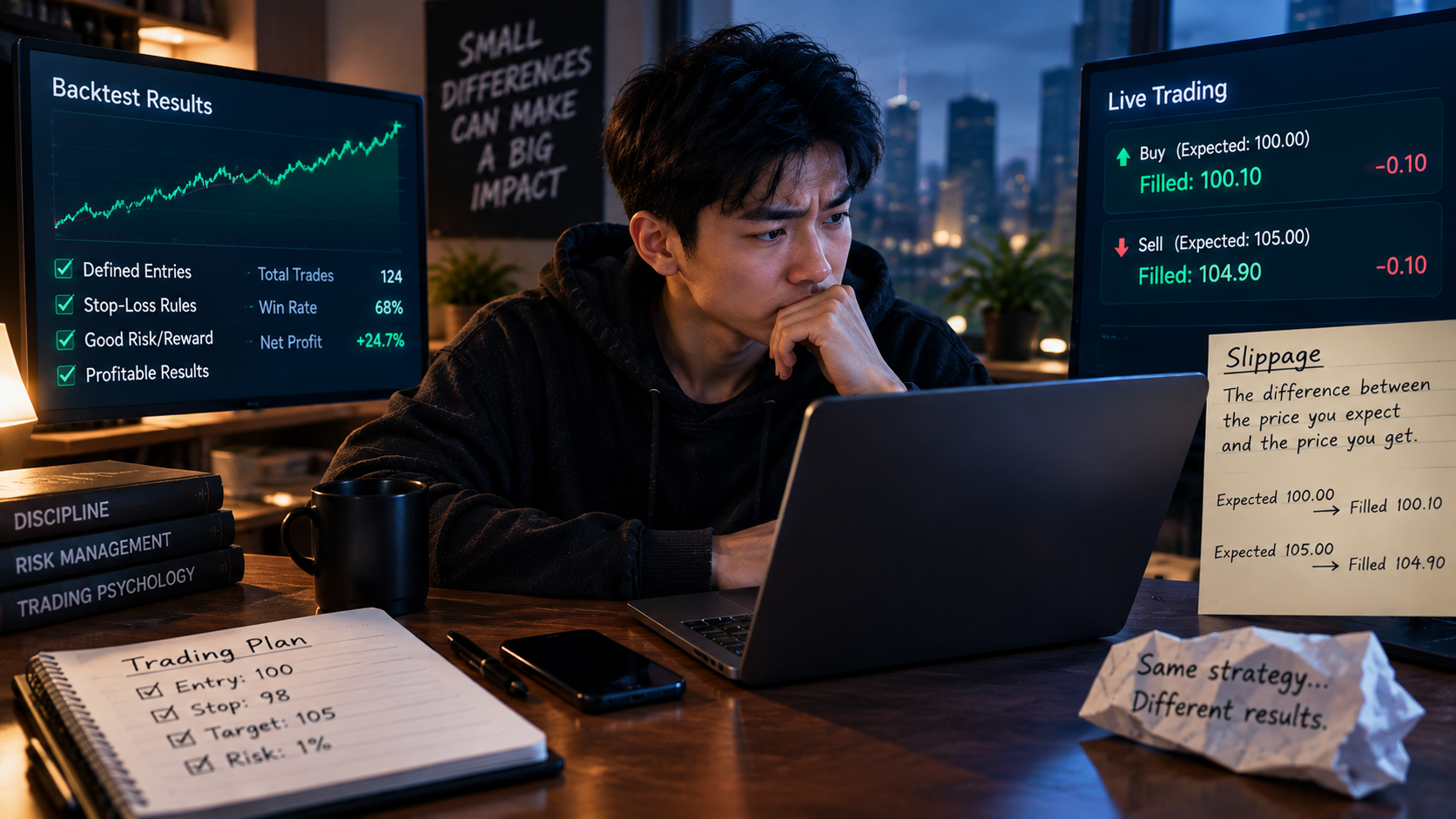
The results look profitable. Your entries are well defined, your stop-loss rules make sense, and the numbers suggest you have an edge.
Then you start trading live.
Your results are consistently worse than expected.
You check your entries. You review your exits. You follow your rules.
So what's missing?
Slippage.
Slippage is the difference between the price you expect when placing an order and the price at which it actually gets filled.
You plan to buy at $100, but your order fills at $100.10. You expect to sell at $105, but the execution comes through at $104.90.
Those differences may look small on individual trades. Across hundreds of trades, they can add up.
Slippage can also vary with market conditions. It may increase during major news releases, periods of low liquidity, or sudden price movements. Your order type, position size, and the market you're trading can affect it too.
The problem is that many traders don't track it.
They record their entry, exit, profit, and loss but overlook how much execution affected the outcome.
Without that information, you may overestimate your strategy's profitability or fail to notice that your execution is getting worse.
Start recording your expected entry and exit prices alongside your actual fills. Track the differences over time and look for patterns across markets, sessions, and order types.
Your backtest shows what your strategy might earn under its assumptions.
Your live trading data shows what happens when execution enters the picture.
An edge that disappears after trading costs and slippage may not be an edge worth trading.
The details behind each trade can reveal problems that profit-and-loss figures alone won't show. Learning more about execution, liquidity, and trading costs can help you evaluate your strategy more realistically.
Explore more market newsletters here:

Shooting Star
The Shooting Star is a classic single-candle bearish reversal pattern that appears at the peak of an extended uptrend or following a strong bullish surge. Structurally identical to the Inverted Hammer in shape, it features a small real body positioned near the bottom of the session's trading range, little to no lower shadow, and a long upper shadow that is at least two to three times the height of the real body. It marks a failed breakout where buyers aggressively pushed price into fresh highs intraday, only to be overwhelmed by intense selling pressure that dragged the market all the way back down to close near its open.
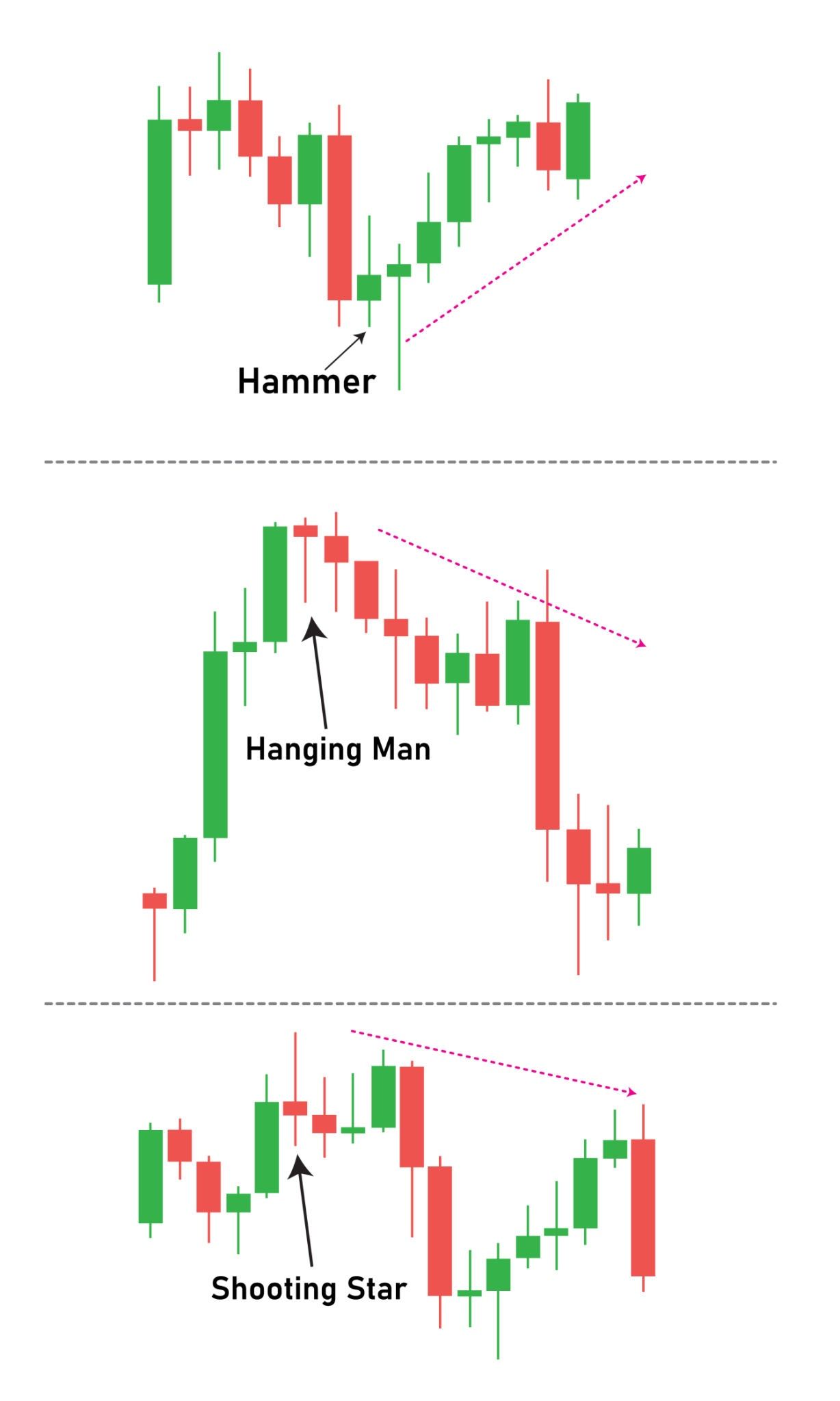
🔴 The Red Zone (The Prior Uptrend & Intraday Spike)
The Meaning: The market pushes into new highs within a strong bullish advance. Buyers drive prices aggressively higher early in the session, creating what looks like an explosive continuation breakout. The Move: Do not chase the breakout while the candle is forming. Chasing an unclosed candle leaves you vulnerable to getting trapped at the exact high of the day if sellers step in to reject the move before the close.
🟡 The Yellow Zone (The Shooting Star Print)
The Meaning: The candle closes near its lows, leaving behind a tall upper wick (at least double the body length) and confirming total rejection of higher prices. The Move: Watch closely and prepare your exit. The long upper tail proves that buyers have lost control and institutional supply has entered the market. Tighten stops on open long positions, but wait for the confirmation candle before entering an aggressive short trade.
🟢 The Green Zone (The Confirmation Close)
The Meaning: The candle immediately following the Shooting Star trades and closes decisively below the low of the Shooting Star’s real body. The Move: Go! A confirmed close below the pattern is your official green light to exit remaining long positions or initiate a short trade. Place your protective stop-loss just above the highest point of the upper wick.
🔍 Two Simple Signals to Watch
1. The 2:1 Upper Shadow Ratio & Red Body Edge
The candle's proportions and final color determine the strength of the reversal.
- The Logic: The upper shadow must be at least two times (ideally three times) the length of the real body, with little to no lower wick. While the body can be green or red, a red Shooting Star (close below open) carries significantly more bearish weight because sellers managed to push the price into negative territory by the close.
2. High-Volume Rejection at Key Resistance
A Shooting Star in the middle of a consolidation range has minimal reliability.
- The Logic: The highest-probability setups occur when the long upper wick sweeps and rejects a major technical level—such as an established horizontal resistance band, the upper boundary of a channel, or an overbought reading on RSI. An accompanying spike in volume signals a classic institutional "liquidity grab" where smart money offloaded inventory to trapped retail breakout buyers.
💡 The Simple Secret
Think of the Shooting Star as a rocket that ran out of fuel in the upper atmosphere. It blasts off with tremendous power, reaches the edge of space, but runs out of thrust and plunges right back down to Earth under the weight of gravity. The long upper tail is the smoke trail showing where the buyers completely burned out—leaving trapped bulls stuck at the top while sellers take full control of the next leg down.

Beating Yourself Up Won't Fix the Trade
You close a bad trade.
Then the real punishment begins.
"How could I be so stupid?"
"I knew I shouldn't have taken it."
"After all these years, I'm STILL making this mistake?"

You replay the entry. Revisit the chart. Mentally drag yourself through the entire trade, looking for fresh reasons to feel terrible about it.
By the end, you've spent an hour reviewing a five-minute mistake.
And somehow, you call that working on your psychology.
Here's the catch: feeling bad about a mistake can create the illusion that you're taking it seriously.
You tell yourself that if you regret it enough, you'll never do it again.
But regret isn't a trading rule.
And calling yourself an idiot doesn't magically improve your next entry. If it did, most trading accounts would be managed by geniuses by now.
The problem with constant self-criticism is that it shifts your attention away from the decision and onto your identity.
Instead of thinking, "I entered before confirmation," you think, "I'm terrible at this."
One statement identifies something you can fix.
The other turns a mistake into a verdict on who you are.
And once you start treating every loss as proof that you're incompetent, trading becomes even harder. You're not just trying to manage a position anymore. You're trying to prove to yourself that you're not a failure.
That's a lot of emotional baggage to carry into the next setup.
ACCOUNTABILITY ASKS WHAT WENT WRONG. SELF-PUNISHMENT ASKS WHAT'S WRONG WITH YOU.
Learn to recognise the difference.
When a trade goes badly, give yourself a proper review. Was the setup valid? Did you follow your rules? Was the loss simply part of the strategy's normal probabilities? What, specifically, would you change next time?
Answer those questions honestly.
If you broke a rule, write down the exact behaviour and decide how you'll prevent it from happening again.
If you followed your process and the trade still lost, accept the result without inventing a mistake just to give yourself someone to blame.
Then close the review.
You don't need to keep reopening the case until you feel sufficiently miserable.
The goal is to leave with a lesson, not a bruised ego.
And the next time that familiar voice starts calling you careless, useless, or incapable after a bad trade, try replacing the insult with a more useful question:
"What can I learn from this that will actually change my next decision?"
That's where improvement begins.
You can take your mistakes seriously without treating yourself like an enemy.
Because trading already gives you enough problems to solve.
You don't need to become another one.