Broadcom Stocks Down 13%
....................................................................................................................


Good Morning,
We're starting Friday on shaky ground, with Nasdaq futures sinking 1% and the S&P 500 slipping 0.5%. Only the Dow is managing to nudge slightly higher. After a historic run, the S&P 500 is at risk of snapping a 9-week winning streak—its longest since 1985—as a high-stakes labor report and a tech sell-off collide.
Broadcom's earnings just put a dent in the AI armor. Tech shares are leading the slide this morning, largely because Broadcom (AVGO) earnings sent shockwaves through the semiconductor sector. Their shares are poised to continue a sharp sell-off today, dragging the rest of the chipmakers down with them and forcing investors to re-evaluate how fast the AI trade is moving.
All eyes are on the 8:30 a.m. ET payroll numbers. Economists are looking for an uptick in payrolls and a steady unemployment rate. Investors desperately want a "Goldilocks" number: strong enough to prove the economy isn't breaking under sticky inflation, but cool enough to keep the Federal Reserve from getting aggressive with interest rates.
The ceasefire is still stuck in limbo. Adding to the morning jitters, the fragile truce between the U.S. and Iran remains a massive question mark. Despite President Trump’s regular social media assurances that peace talks are in their "final" stages, reports of stalled negotiations are keeping Wall Street incredibly nervous about the blockaded Strait of Hormuz.
It's a high-anxiety Friday. By noon, we'll know if the jobs data saves the S&P's historic winning streak or if the tech pullback deepens.

🌏 Asia-Pacific Stocks Tumble as U.S.-Iran Peace Talks Stall
Global stock markets dipped on Friday as investors assumed a defensive stance ahead of the weekend, spooked by stalled U.S.-Iran peace negotiations. MSCI's broadest index of Asia-Pacific shares outside Japan slumped 2.23%, with South Korea’s tech-heavy Kospi index bearing the brunt of the geopolitical gridlock with a steep 7% plunge.
🚀 SpaceX Upends Wall Street Convention by Fixing $135 IPO Price Early
Elon Musk has bypassed traditional investment banking book-building by unilaterally fixing a firm $135-per-share price for SpaceX's historic IPO, scheduled to debut on June 12. Publishing a firm price tag a full week ahead of the listing is virtually unprecedented for a mega-cap offering, underscoring Musk's leverage as he eyes a massive $1.75 trillion post-listing valuation.
🚀 How Retail Investors are Angling for Pre-IPO Access to SpaceX
With SpaceX (SPAX.PVT) slated to finalize its record-breaking $75 billion public raise on the night of June 11, secondary platforms are seeing high volumes from investors seeking early allocation. While institutional desks have locked up the bulk of the 555.6 million shares, fractional retail brokers are highlighting specialized paths to secure exposure before public trading begins on June 12.
📉 Broadcom Erases $280B in Historic Megacap Market Capitalization Blowout
Broadcom (AVGO) plummeted 12.6% on Thursday, marking one of the steepest single-day value wipeouts in equity market history. While the hardware giant edged past quarterly profit targets, its forward-looking AI processor sales guidance failed to satisfy lofty market expectations, triggering a brutal wave of profit-taking across the sector.
📈 Marvell Surges on Jensen Huang’s "Trillion-Dollar" Chipmaker Endorsement
Marvell Technology (MRVL) shares extended their blazing rally, climbing an additional 10% on top of an initial 32% single-session explosion. The aggressive buying comes after Nvidia CEO Jensen Huang publicly singled out the custom silicon provider, labeling Marvell as the market's next inevitable trillion-dollar semiconductor enterprise.
🤖 Broadcom’s Forecast Drags Down Heavyweight Asian Semiconductor Players
The disappointing tech revenue outlook out of the U.S. triggered a sharp domino effect across Asian electronics hubs on Friday. Regional hardware mainstays—including TSMC, SK Hynix, and Samsung—fell significantly as asset managers rotated out of highly priced AI infrastructure names into more defensive consumer and materials safe-havens.
🇪🇺 European Tech Selloff Deepens as ASML and Infineon Lead Market Retreat
The global semiconductor drawdown slammed into European bourses on Friday morning, dragging down continental benchmarks like the Stoxx 600. The index's specialized technology sector dropped 2% within minutes of the opening bell, heavily weighed down by deep individual declines in lithography giant ASML and German automotive chipmaker Infineon.

The Rules Can Change Faster Than Your Strategy
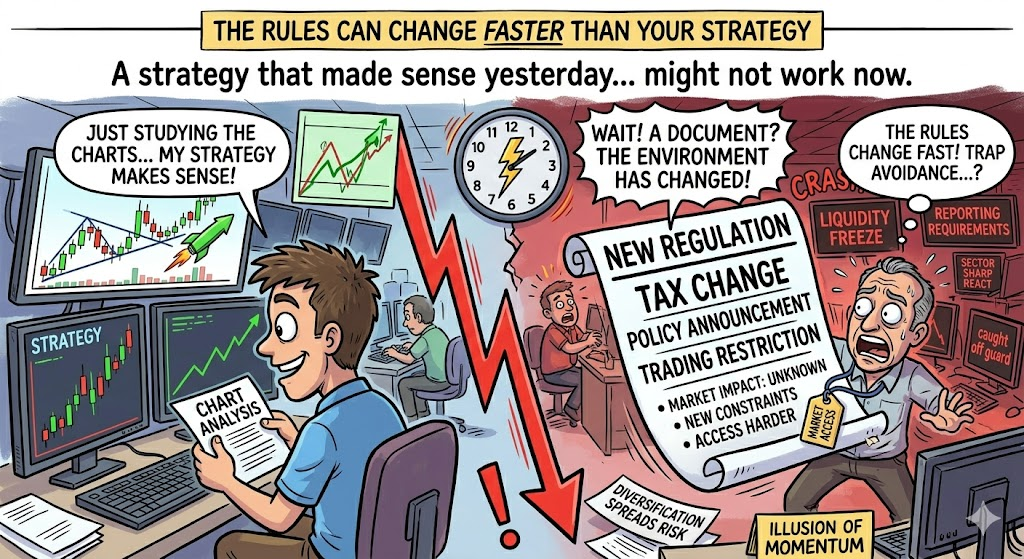
Most traders spend their time studying charts.
But sometimes the biggest market move starts with a document, not a candle.
A new regulation. A tax change. A trading restriction. A policy announcement.
Suddenly, the environment changes.
A strategy that made sense yesterday may face new constraints today. Certain products become harder to access. New reporting requirements appear. Entire sectors can react sharply to regulatory decisions.
That’s why ignoring regulation can be expensive.
Many traders assume the rules stay the same. Then they're caught off guard when a change impacts liquidity, volatility, or market access.
Strong traders pay attention to the broader landscape. They understand that markets don't operate in a vacuum. Policies, regulations, and legal frameworks influence how money moves.
Because sometimes the biggest risk isn't on the chart.
It's in the fine print.
When you stay aware of regulatory changes, your decisions become more informed. You adapt earlier and avoid unnecessary surprises.
Markets move on information. Rules are information too.
Some traders like understanding the forces behind market moves, not just the moves themselves.
If that’s you, you can explore a few market reads here:

Fibonacci Retracement
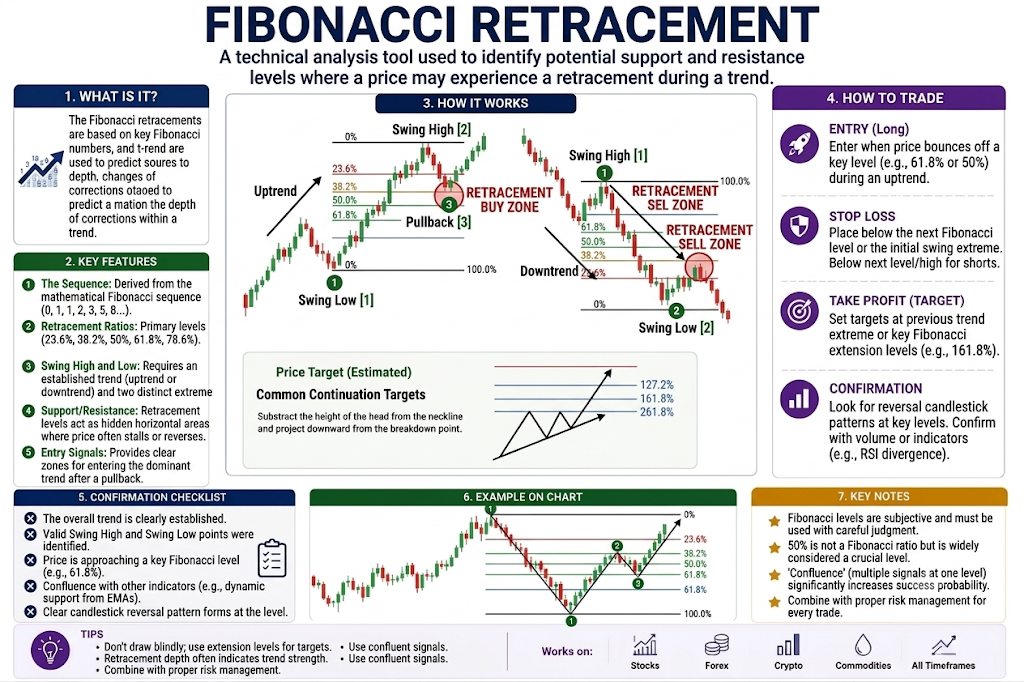
Fibonacci Retracement is a tool that acts like a market ruler. When a price makes a big move up or down, it never moves in a straight line—it pulls back to rest. This tool uses mathematical percentages to show you exactly where the price is likely to find a floor or a ceiling before continuing its main journey.
🔴 The Red Zone (The 23.6% and 38.2% Levels)
The Meaning: The price has made a minor pullback after a big rally. This indicates that the trend is incredibly hot and aggressive, barely stopping to catch its breath before rushing forward. The Move: Caution. While this shows immense strength, buying here is risky because the pullback is shallow. If the market suddenly decides to take a deeper rest, you could get caught in a drop.
🟡 The Yellow Zone (The 50.0% and 61.8% Levels)
The Meaning: This is the "Golden Target" zone. The price has pulled back a healthy amount—exactly half or nearly two-thirds of its original move. The Move: Watch closely. This is the most famous rest stop in trading. The 61.8% level is known as the "Golden Ratio." When a strong trend dips into this area and slows down, it is the prime location where buyers secretly step back in.
🟢 The Green Zone (The 78.6% Level)
The Meaning: The price has pulled back very deeply, almost erasing the entire original move. The Move: Get ready. This is the final line of defense for the original trend. If the price stabilizes here and starts to turn around, it offers a high-reward buying opportunity with a very tight protection point just below the starting line.
🔍 Two Simple Signals to Watch
1. The Line Confluence
Fibonacci lines work best when they line up perfectly with other tools on your chart.
- The Logic: If a 61.8% Fibonacci level sits at the exact same price as a major horizontal support floor or a moving average line, you have a high-conviction setup. Multiple indicators pointing to the same price level make that level much harder for the market to break.
2. The Golden Failure
Sometimes the price completely ignores the green zone and crashes straight past the 78.6% level and the 100% starting point.
- The Logic: This is a major warning signal. If the market completely erases the original move, the trend is not resting—it has died. You should immediately abandon any ideas of a bounce and prepare for a total trend reversal.
💡 The Simple Secret
Think of Fibonacci levels as staircases. A healthy trend needs to step down to a lower stair to gather the energy required to jump to a brand-new high. The absolute safest time to buy into a powerful uptrend is never when it is breaking out to new highs, but rather when it pulls back and rests smoothly on the 50% or 61.8% staircase.

The Exit Nobody Thinks About

A trader finally sizes up.
Bigger position. Bigger confidence. Bigger expectations.
Everything feels professional.
The setup looks clean.
Risk is calculated.
Position size makes sense on paper.
But there’s one thing almost nobody thinks about until it’s too late:
“How easy will it actually be to get OUT of this trade?”
That question sounds boring… right up until the market starts moving fast
Because exiting a position is very different from planning one.
In calm conditions, traders assume they can always click out cleanly at their price.
Then volatility hits.
Liquidity disappears.
Spreads widen.
Price jumps.
And suddenly the exit they imagined exists only in fantasy land
This is the Liquidity Blind Spot.
You planned the trade like the market owed you a smooth escape.
But markets don’t care about your spreadsheet risk calculations.
Size changes everything.
A position that feels manageable in theory can become psychologically heavy FAST when the market gets thin or aggressive.
Now every tick feels louder.
Decision-making speeds up.
And slippage quietly eats into the “perfect” risk management you thought you had.
This happens a lot with traders moving into larger size too quickly.
On smaller positions, exits feel easy. Flexible.
But as size increases, execution matters more than people realize.
And emotionally?
Most traders are completely unprepared for how different larger positions FEEL under pressure.
A tiny pullback suddenly looks enormous.
A delayed fill suddenly feels personal.
That pressure changes behavior.
You hesitate exiting.
You panic exit too late.Or worse… you freeze because the loss now feels “too real.”
Professional traders think beyond entries.
They think about:
- liquidity
- volatility
- spread conditions
- realistic execution
- worst-case exits during fast movement
Not because they’re pessimistic.
Because survival in trading often comes down to respecting practical reality instead of theoretical perfection.
And honestly?
A lot of traders are risking sizes built for calm markets… while trading instruments capable of turning into absolute chaos in seconds.
So here’s something worth asking before every larger position:
“If this trade moves aggressively against me… can I realistically exit the way I’m imagining?”
Not emotionally.
Practically.
Because good risk management is not just about where you plan to stop.
It’s about whether the market conditions can actually LET you stop there cleanly when things get ugly.