Brent Oil Surges to $95
....................................................................................................................



Good morning,
It’s Wednesday.
And this morning, Wall Street has found something else to worry about: oil, inflation, and those stubbornly high bond yields.
US stock futures are slipping, with Nasdaq futures down 0.6% and S&P 500 futures off 0.2%. The bigger problem is the bond market. The 10-year Treasury yield has climbed to 4.814% — its highest level since November 2023.
Why does that matter for stocks?
Higher yields make future corporate earnings less attractive today, which can put pressure on the valuations investors are willing to pay.
And oil isn’t helping.
West Texas Intermediate has pushed above $90 a barrel, its highest level since late July, as renewed US military strikes on Iran raise concerns that the conflict could escalate. Higher oil prices could mean more inflation — exactly what markets don't want to hear.
Traders are also waiting for August private payrolls data and the Fed’s Beige Book for clues about the economy.
Then after the bell, Hewlett Packard Enterprise, Snowflake, and Broadcom report earnings.
So, basically, stocks have three problems today:
Oil is rising. Yields are rising. And investors are getting nervous.

📈 Bessent's Bond Gains Wiped Out as Long Yields Jump
Initial bond market relief following Treasury Secretary Scott Bessent's stepped-up buybacks vanished as benchmark long-term borrowing costs surged again. Heavy government debt issuance combined with renewed oil-driven inflation fears sent sovereign bond yields to multi-decade peaks across the U.S., Europe, and the Asia-Pacific region.
🛢️ Brent Oil Nears $95 as U.S.-Iran Strikes Escalate
Global crude benchmarks surged nearly 1% Wednesday, pushing Brent futures to $95.52 and WTI above $91 a barrel. The spike followed an overnight exchange of direct military strikes between U.S. forces and Iran, dimming hopes for a diplomatic breakthrough and escalating maritime transit risks through the Strait of Hormuz.
💵 Dollar Holds Two-Week High on Safe-Haven and Inflation Bets
The U.S. dollar index held near 99.80 at a two-week peak as escalating Middle East hostilities pushed oil prices and Treasury yields higher. Greenback demand remained robust as currency desks factored in inflation risks ahead of key August employment data and the Federal Reserve's September rate decision.
🍵 Ito En Surges on Strong Overseas Green Tea Growth
Shares of Japanese beverage maker Ito En advanced after reporting solid international demand for its unsweetened green tea and matcha products. Robust double-digit revenue expansion across North America and ASEAN markets helped offset soaring raw material costs in its domestic business.
🇦🇺 Australia Q2 GDP Beats Forecasts, Keeping RBA Hike Active
Australia’s economy grew 0.4% quarter-on-quarter in Q2, beating consensus estimates of 0.3% and lifting annual growth to 2.1%. Resilient household consumption and net export growth prompted money markets to raise expectations for a potential Reserve Bank of Australia interest rate hike.
💻 Dell Blows Away Estimates with $95B AI Server Backlog
Dell Technologies reported blowout fiscal Q2 results, with revenue jumping 58% year-over-year to $47 billion and EPS surging 203%. Infrastructure Solutions operating margins expanded to 15%, while AI server demand pushed the total order backlog to a record $95 billion, leading management to raise full-year revenue guidance to $192 billion.
₿ Bitcoin Logs 25% August Surge as ETF Inflows Accelerate
Bitcoin capped off its best-performing month of 2026 with an approximate 25% gain in August, defying typical late-summer seasonality. The rally was powered by over $2.8 billion in net inflows into spot Bitcoin ETFs alongside sovereign debt hedging demand.

Recovering From a Drawdown Is Harder Than Taking the Loss
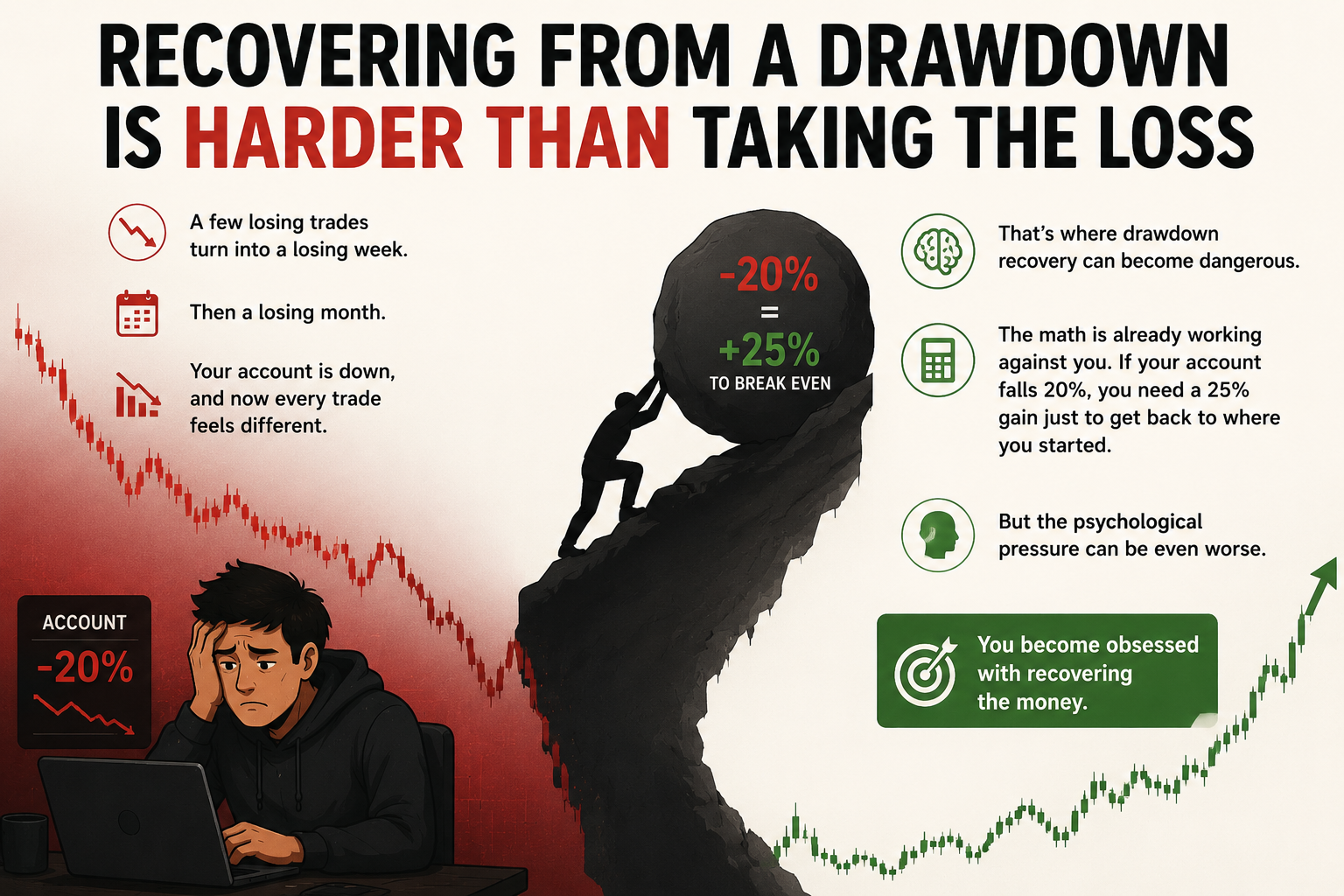
A few losing trades turn into a losing week.
Then a losing month.
Your account is down, and now every trade feels different.
You start thinking about getting back to where you were.
That's where drawdown recovery can become dangerous.
The math is already working against you. If your account falls 20%, you need a 25% gain just to get back to where you started. But the psychological pressure can be even worse.
You become obsessed with recovering the money.
You increase your position size. You take setups you would normally ignore. You move stops. You trade more often because you want to get back to breakeven faster.
Now you're not trading your strategy.
You're trading your drawdown.
Strong traders understand that recovery requires patience. They reduce the pressure to make everything back immediately and focus on executing their process one trade at a time.
Sometimes that means reducing risk.
Sometimes it means taking a break.
Sometimes it means accepting that recovery may take longer than you'd like.
Because the fastest way back isn't always the safest way back.
Your goal after a drawdown shouldn't be to recover the money as quickly as possible.
It should be to recover your discipline first.
The account can follow.
Good trading isn't just about finding strategies that work. It's about understanding where they can fail and preparing before those conditions arrive.
If you'd like to explore more thoughtful market perspectives, you can discover a few market newsletters here:

Triple Exponential Moving Average (TEMA)
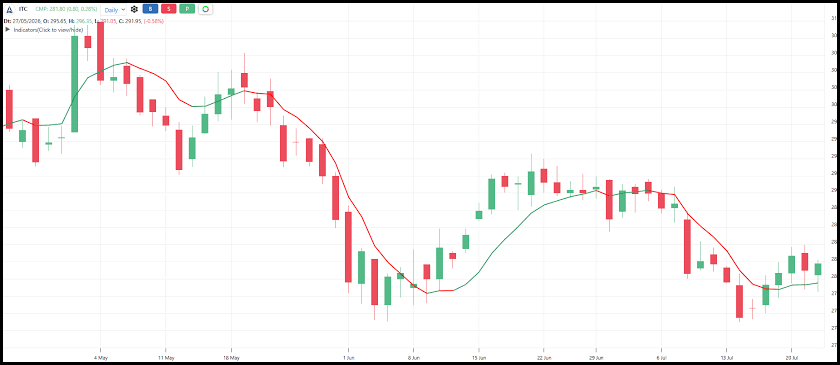
TEMA Responsiveness and Trend Color Tracking. Source: Definedge
Developed by Patrick Mulloy, the Triple Exponential Moving Average (TEMA) is designed to virtually eliminate the lag associated with traditional moving averages. Rather than just applying an exponential smoothing three times (which would increase lag), the TEMA formula subtracts the lagged portions using a combination of single, double, and triple EMAs.
The result is a line that hugs current price action tightly, providing rapid trend-change signals without producing the erratic whipsaws common to raw prices.
🔴 The Red Zone (TEMA Sloping Down / Price Below Line)
The Meaning: The TEMA line curves downward and the price trades below it. Downside momentum is actively accelerating, and recent price drops are heavily registered.
The Move: Protect capital. Exit long positions or initiate short setups. Because TEMA reacts quickly, a downward hook warns that the prior rally has lost structural momentum.
🟡 The Yellow Zone (The Flattening Inflection / Consolidation)
The Meaning: The TEMA line flattens out as candles cross back and forth through the curve.
The Move: Hold and wait. The market is consolidating in a neutral range. Do not jump into aggressive breakout trades while the TEMA is horizontal, as the ultra-fast formula can trigger minor false crosses in sideways conditions.
🟢 The Green Zone (TEMA Sloping Up / Price Above Line)
The Meaning: The TEMA line turns upward and price action sustains above the line. Short-term buyer volume and upward velocity have outpaced historical baselines.
The Move: Go! An upward-angled TEMA is your green light to ride the trend. Use the line as a dynamic trailing stop to ride the move until the slope begins to roll over.
🔍 Two Simple Signals to Watch
1. The Direct Price Crossover
Because TEMA drastically cuts out delay, price crossing the line is an immediate execution trigger.
- The Logic: A Buy Signal occurs when a candle crosses and closes above a rising TEMA line. A Sell/Exit Signal occurs when a candle breaks and closes below a declining TEMA line.
2. The Dual TEMA System (Fast vs. Slow)
Traders often smooth out false whipsaws by running a fast TEMA (e.g., 9-period or 20-period) alongside a slower baseline TEMA (e.g., 50-period).
- The Logic: When the faster TEMA crosses above the slower TEMA, it confirms that a sustained, high-momentum bull run has begun. When the fast TEMA crosses below the slow TEMA, it marks an official trend breakdown.
💡 The Simple Secret
Think of the TEMA as a moving average stripped of its weight penalty. Standard EMAs drag old historical price data behind them like a parachute, making them slow to react to abrupt trend reversals. By mathematically subtracting that internal delay, TEMA pivots at the exact moment market velocity flips—giving you the precision of short-term price action with the clarity of a smoothed trendline.

Your Bias Is Not a Marriage
At 7 AM, you decide:
Today is bearish.
You mark your levels.
You write down your reasons.
You feel prepared.
Then the market opens and does something incredibly rude.
It goes up.
At first, you don't panic.
"Probably just a retracement."
Then price breaks your first resistance.
"Liquidity grab."
Another level goes.
"They’re trapping buyers."
Then the market makes a higher high and holds it.
At this point, a reasonable trader might say:
"Okay. My idea isn't working."
But you?
You add another short.
Because now admitting you're wrong feels worse than losing another trade.
That is the Daily Bias Lock-In.
The problem isn't having a bias.
You should have one.
The problem is treating your morning prediction like a promise you made to yourself.
A BIAS IS A STARTING POINT. NOT A LIFE SENTENCE.
Your 7 AM analysis was based on the information available at 7 AM.
By 11 AM, you have new information.
Price has moved.
Structure has changed.
Levels have broken.
Maybe the market has completely invalidated the idea you started with.
And yet traders will keep defending the original thesis simply because they spent time creating it.
That's sunk-cost thinking creeping into trading.
"I've already done all this analysis."
Who cares?
The market doesn't give you extra points for effort.
You can spend three hours building the smartest bearish thesis on Earth.
If buyers take control, buyers take control.
Your job is not to make your morning analysis look correct.
Your job is to respond to the market that's actually in front of you.
Here's a simple habit worth stealing:
Write your bias in the morning.
Then, underneath it, write:
"What would make me change my mind?"
Be specific.
If price breaks this level...
If structure does this...
If momentum shifts here...
Then when the market reaches that point, you don't need to have an argument with yourself.
You already decided what evidence would matter.
That removes the ego from the equation.
Because changing your mind isn't weakness.
REFUSING TO CHANGE IT WHEN THE EVIDENCE CHANGES IS.
Some of your best trades will come after your original idea was wrong.
Not because you predicted perfectly.
Because you recognized the mistake quickly enough to adapt.
That's the real skill.
The market doesn't care what you thought at 7 AM.
It only cares what you're willing to do now.