Brent Crude Tops $100
....................................................................................................................



Good morning.
Wall Street is doing that awkward thing where nobody wants to make the first move.
US stock futures are mostly steady this morning after a rough Tuesday. Dow futures are down about 0.3%, S&P 500 futures 0.2%, and Nasdaq futures 0.4%.
But oil is getting much more attention.
Brent crude is hovering around $99 a barrel, with WTI near $94. Oil is creeping dangerously close to the $100 mark as fighting between the US and Iran escalates and concerns grow over disruptions around the Strait of Hormuz.
And that’s where things get uncomfortable for traders.
Higher oil prices can push inflation higher, which could give the Federal Reserve another reason to keep rates elevated. Traders are now pricing roughly a 60% chance of a 25-basis-point rate hike next week.
Meanwhile, earnings are taking a back seat today. Chewy and American Eagle report, giving investors another look at consumer spending.
And then there’s Apple.
John Ternus takes the stage for the first time at Apple’s annual iPhone event.
So, oil near $100, rate-hike bets rising, and a new face leading the iPhone show.
Just another quiet Wednesday.

🛢️ Brent Tops $100 as Middle East Strikes Threaten Supply
Brent crude crossed $100 per barrel for the first time since July as escalating military strikes between the U.S. and Iran increased risks to Middle East energy corridors. Goldman Sachs warned that intensifying shipping disruptions around the Strait of Hormuz could push prices above $120.
🛫 Adani Enterprises Jumps 5% on $1B Airport Unit Deal
Shares of Adani Enterprises gained 5% after its airport subsidiary secured a $1 billion investment, valuing Adani Airport Holdings at approximately $18 billion pre-money. The capital will fund ongoing airport expansions, commercial real estate developments, and related infrastructure projects.
💻 Marvell Surges 241% in One Year on Hyperscaler Demand
Marvell Technology shares have rallied 241% over the past twelve months, driven by deep enterprise customer relationships and custom chip demand. CEO Matt Murphy credited long-standing trust and execution with top cloud hyperscalers for the semiconductor firm’s sustained growth.
💵 Dollar Approaches Seven-Month Low on Treasury Buyback Focus
The U.S. dollar retreated toward seven-month lows as the Japanese yen extended its recent surge. Currency desks adopted a cautious stance ahead of upcoming U.S. Treasury debt buyback updates and key August inflation readings later this week.
👟 Nike Exits S&P 100 Following $200B Market-Cap Wipeout
Nike lost its place in the S&P 100 index after an 18-year tenure, marking a dramatic shift for the sportswear giant. The demotion follows an 80% valuation decline from its 2021 peak, erasing over $200 billion in market value amid prolonged retail headwinds and shifting consumer demand.
📉 European Shares Slide as Triple-Digit Oil Stokes Inflation Fears European equities fell on Wednesday, with the pan-European Stoxx 600 dropping 0.7% to 645.34 as Brent crude surged above $100 a barrel. Mounting Middle East geopolitical risks and renewed energy-driven inflation anxieties weighed heavily on investor sentiment across major regional bourses.

News Can Change Your Trading Costs
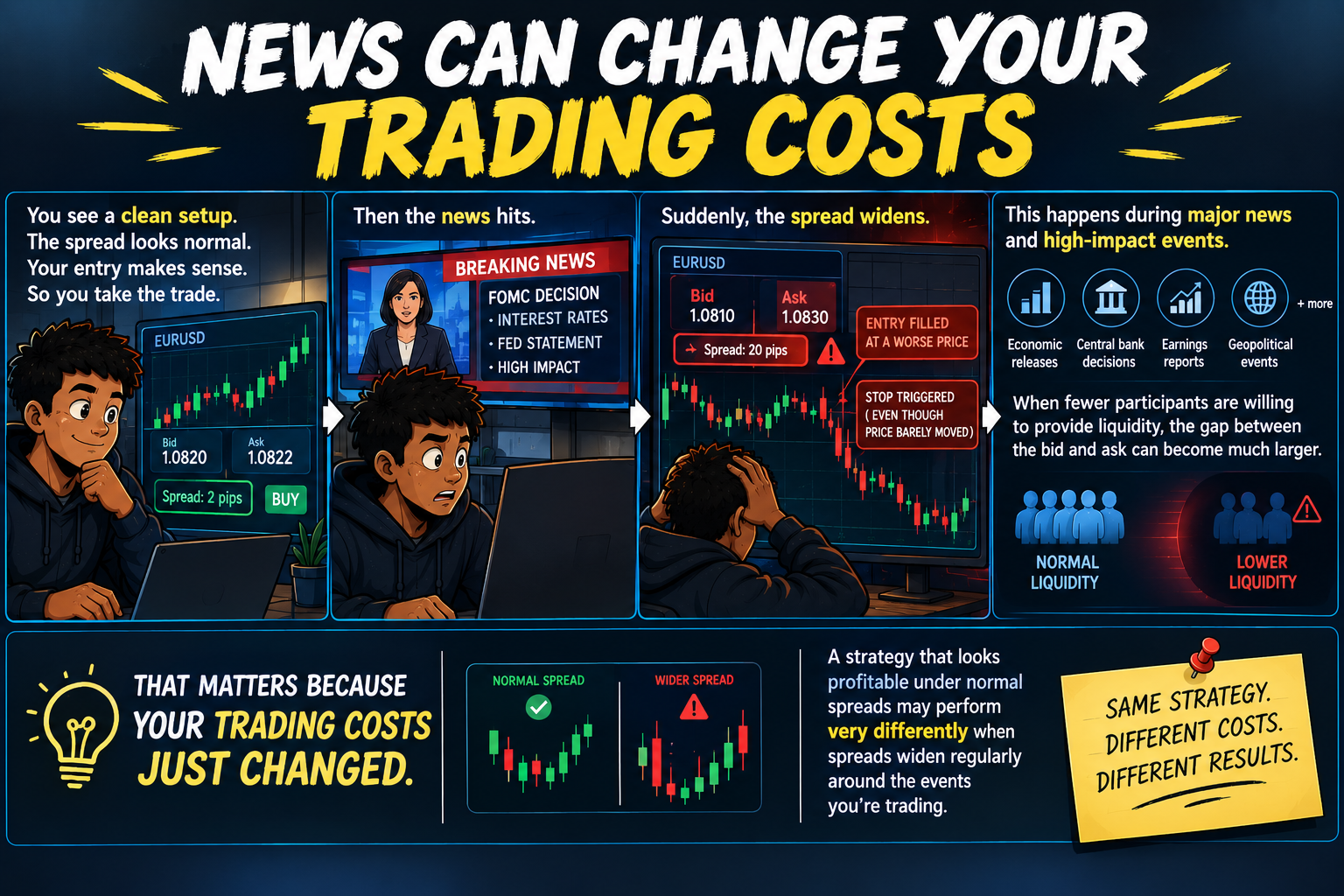
You see a clean setup.
The spread looks normal. Your entry makes sense. So you take the trade.
Then the news hits.
Suddenly, the spread widens. Your entry gets filled at a worse price than expected, or your stop gets triggered even though the market barely moved in the direction you expected.
This is one of the costs traders often overlook.
During major economic releases, central bank decisions, earnings, geopolitical events, and other high-impact news, liquidity can change quickly. When fewer participants are willing to provide liquidity, the gap between the bid and ask can become much larger.
That matters because your trading costs just changed.
A strategy that looks profitable under normal spreads may perform very differently when spreads widen regularly around the events you're trading.
And if you don't account for that in your testing, your backtest can give you a false sense of confidence.
Before trading through major news, know how your market and broker typically behave.
Check the usual spread conditions. Know when volatility tends to increase.
Consider whether your strategy actually needs to be exposed during the announcement.
Sometimes the best trade is simply waiting for conditions to normalize.
Your entry isn't the only thing that matters.
The cost of getting into the trade matters too.
Trading isn't just about finding setups. Small details around execution, liquidity, and market conditions can have a major impact on results.
Explore more market perspectives and newsletters here:

Three White Soldiers
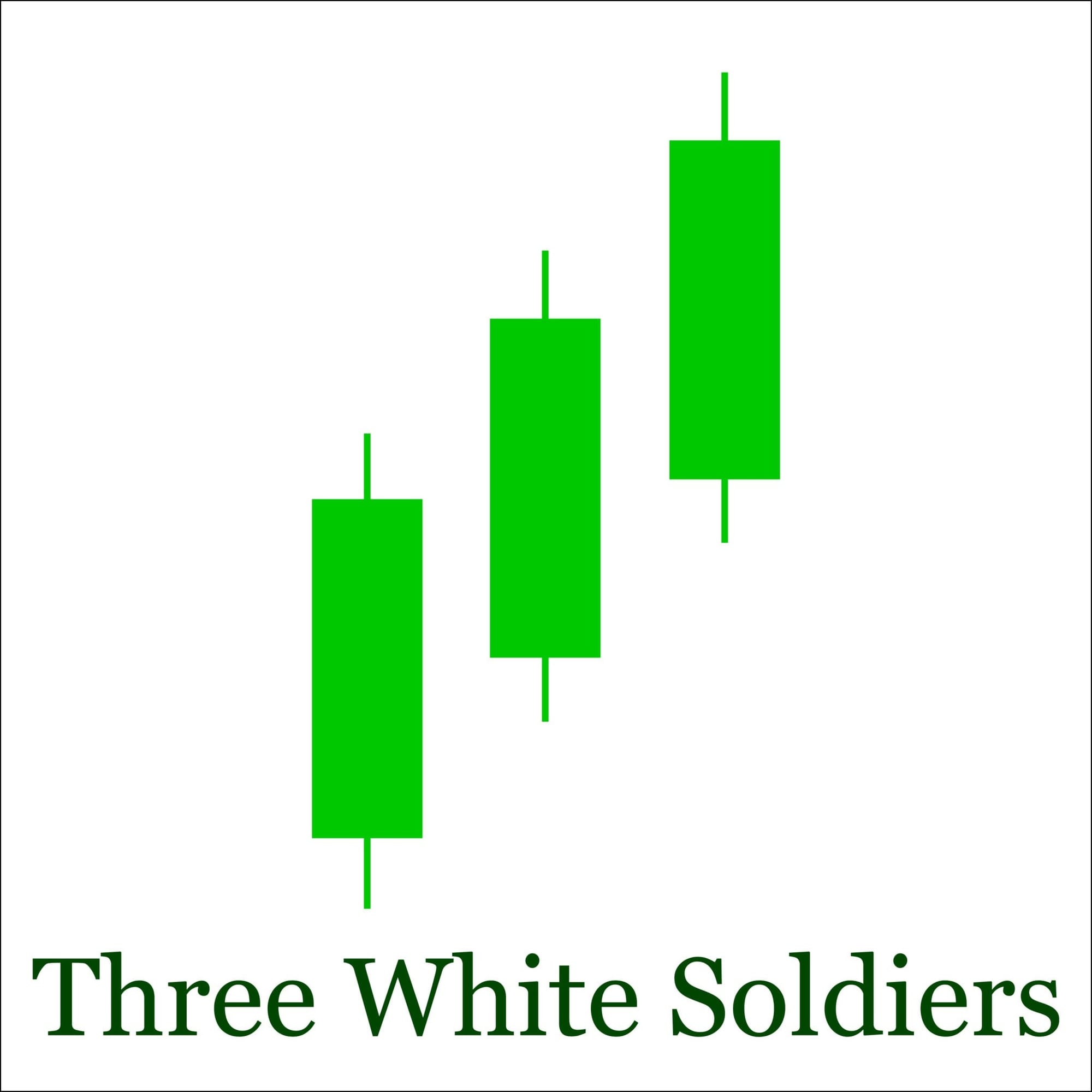
Three White Soldiers Bullish Reversal Structure. Source: Pavlo Stavnichuk / Getty Images
The Three White Soldiers is a powerful three-candle bullish reversal pattern that forms at the bottom of an extended downtrend or prolonged consolidation. It consists of three consecutive tall, green (traditionally white) candles that make progressively higher opens and higher closes with small or negligible upper wicks. It marks a relentless, multi-session takeover by buyers, indicating that institutional demand has completely crushed seller resistance.
🔴 The Red Zone (The Prior Downtrend & First Candle)
The Meaning: The market hits the floor of a downtrend, and the first strong bullish candle prints. While it breaks the string of red candles, a single green bar can often be a temporary dead-cat bounce or short covering. The Move: Exercise patience. Do not rush to buy off the first green candle alone. Acknowledge that the downtrend is weakening, but wait for follow-through before declaring the bottom secure.
🟡 The Yellow Zone (The Second Soldier Advances)
The Meaning: The second candle opens within the body of the first candle and rallies to close higher, printing another long green body with short wicks. The Move: Watch closely. A second consecutive strong push confirms that buyers are defending higher prices rather than selling into the initial bounce. Prepare your trade setup and set your risk levels.
🟢 The Green Zone (The Third Soldier Confirms)
The Meaning: The third candle opens within the body of the second candle and powers upward to close near its high, completing the three-step staircase. The Move: Go! The completion and close of the third candle is your official green light to enter a long position or buy the pullback. Place your protective stop-loss below the opening low of the first soldier.
🔍 Two Simple Signals to Watch
1. Wick Size (Advance Block Warning)
Examine the length of the upper shadows (wicks) across all three candles.
- The Logic: Textbook soldiers close near their highs with tiny or non-existent upper wicks, proving absolute buyer control into the close. If the second or third candle displays a long upper wick or shrinking real body, it forms an Advance Block pattern, warning that overhead resistance is heavy and buyers are losing steam.
2. The First Pullback (Retest of the Third Soldier)
Because three consecutive strong green candles can push short-term oscillators into overbought territory, price often pauses immediately after the pattern completes.
- The Logic: Rather than chasing the market at the top of candle three, patient traders look to buy the first shallow consolidation or retest back toward the midpoint of the second or third soldier, locking in a favorable risk-to-reward ratio.
💡 The Simple Secret
Think of Three White Soldiers as an infantry march reclaiming lost ground step-by-step. Each day opens inside the previous day’s territory, absorbs all available selling, and pushes past yesterday's front line to plant a new flag higher up the hill. When this three-day staircase appears at major support, key moving averages, or an oversold boundary, it signals one of the most decisive, sustained trend reversals in candlestick analysis.

Everyone Agrees. So You Feel Safe.
There’s a particular kind of confidence that only exists inside a group chat.
You post the chart.
One person replies, “Bullish.”
Another says, “Exactly what I’m seeing.”
Someone else drops a rocket emoji.
Then another trader sends a screenshot with the same level you marked.
Now you're sitting there thinking:
“Okay. This is definitely the trade.”
But what actually happened?
Did your analysis get better?
No.
You just found five people who already agreed with you.
And somehow, agreement started feeling like evidence.
That’s the trap.
The first person says they're bullish.
The next person sees the bullish idea and starts looking for reasons to support it.
Then everyone builds on everyone else's confidence.
Ten minutes later, the group has created this beautiful little bubble where nobody wants to be the person saying:
“Hold on... what if we're wrong?”
Because disagreeing with the group feels uncomfortable.
And when money is involved, comfort can become very expensive.
The most dangerous part is that this doesn't feel like groupthink.
It feels like research.
You're collecting opinions.
Comparing charts.
Gathering confirmation.
But if all ten opinions came from the same idea, you haven't really gathered ten independent views.
You've gathered one bias ten times.
That's a huge difference.
Imagine ten friends standing outside looking at a dark sky.
The first says, “I think it's going to rain.”
Everyone else agrees.
Does that make rain more likely?
Maybe.
But if none of them actually checked the forecast, you've just created a very confident group of people holding umbrellas they may not need.
Trading communities work the same way.
So before you let a crowded opinion strengthen your next trade, try something uncomfortable.
Form your own view BEFORE reading the room.
Write down:
What do I see?
What would make me wrong?
Where is my entry?
Where am I out?
Then open the group chat.
Not to borrow conviction.
To challenge your own.
Because a good trading community should make your thinking sharper, not make your thinking unnecessary.
And remember:
Consensus can validate a thesis. It cannot validate a trade.
The market gets the final vote.
Not your group chat.