Big Gains on Commodities
....................................................................................................................



Good morning,
We’re kicking off Wednesday with a solid green screen. After a nervous few days, futures are climbing—the Nasdaq is leading the way up 0.7%, while the S&P and Dow are tacking on 0.5% and 0.4% respectively. President Trump just removed the "ticking clock" by extending the truce with Iran indefinitely, which was exactly the shot of adrenaline the bulls needed to snap a losing streak.
But don't call it "peace" just yet. While the immediate threat of a bombing campaign has faded, the diplomatic vibe is still pretty toxic. Trump is calling the Iranian government "seriously fractured," while Tehran is dismissing the talks as a "waste of time." The result? The Strait of Hormuz is still effectively a ghost town. Oil is feeling the tension, with Brent crude breaking back above $100 on rumors that the U.S. might be looking for a way to "break" the blockade without starting a shooting war.
Tesla, Boeing, and AT&T are stepping into the spotlight. This morning isn't just about missiles and mandates—it’s about the numbers. Tesla is the main event, and everyone is watching to see if Elon Musk can talk the market higher despite the massive logistical headache of a global energy crisis. Meanwhile, Boeing will give us a direct look at how the "war fog" is impacting the aviation industry.
The immediate danger has been pushed back, but with oil back in triple digits and a monster day of earnings on deck, the volatility is far from over.

🛢️ Oil Falls as Iran Signals Readiness for Talks if Blockade Ends
Brent crude dropped 2% toward $97 a barrel after Tehran’s UN envoy suggested Iran is "ready" to find a political solution in Islamabad if the U.S. breaks its naval blockade. While President Trump indefinitely extended a ceasefire, he vowed to keep the Strait of Hormuz locked until a final deal is reached, even threatening "to blow up" the country if negotiations fail.
📊 Stocks Gain as Trump Indefinitely Extends Iran Ceasefire
U.S. stock futures rose Wednesday as investors cheered the unilateral extension of the two-week-old ceasefire. Despite the lack of an official deal and the continued closure of the Strait of Hormuz, markets took the de-escalation signal in stride, even as Iran remains hesitant to commit to a second round of formal negotiations.
🥇 Gold Firms as Weakening Oil Eases Inflation Fears
Spot gold rose 0.9% to $4,755 per ounce as a pullback in oil prices relieved pressure on global inflation expectations. The metal’s rebound follows a sharp dip on Tuesday, as traders now bet that lower energy costs could prevent the Federal Reserve from keeping interest rates "higher for longer."
📱 Apple Edges Up as Tim Cook Announces CEO Transition
Apple shares ticked higher after Tim Cook announced he will step down as CEO on Sept. 1, transitioning to Executive Chairman. Handing the reins to John Ternus, Cook received praise from peers at Google and Microsoft, signaling a smooth leadership succession for the world’s most valuable hardware company.
🌏 Nikkei Hits Record High on Hopes for Middle East Stability
Japan’s Nikkei 225 surged to an all-time high Wednesday as Asian traders reacted positively to the U.S. ceasefire extension. While regional markets remained mixed, the prospect of a pause in hostilities provided enough optimism to push Japanese equities past previous historic peaks.
💵 Dollar Hits 1-Week High Amid Ceasefire Skepticism
The U.S. dollar index climbed to 98.41 as traders questioned the durability of Trump's unilateral ceasefire. Strong U.S. retail sales data (+1.7%) and hawkish commentary from Fed nominee Kevin Warsh bolstered the greenback, as investors hedge against the possibility of peace talks collapsing.
💰 Commodity Giants Reap Billions from War-Driven Volatility
The world’s top energy traders are reporting their highest profits since 2022 as the Iran conflict triggers a "fresh bonanza" for middlemen. Unprecedented disruptions in oil flow and price swings have allowed major commodity houses to capitalize on the massive shifts in global energy arbitrage.

Your Strategy Won’t Matter If Your Account Isn’t Secure
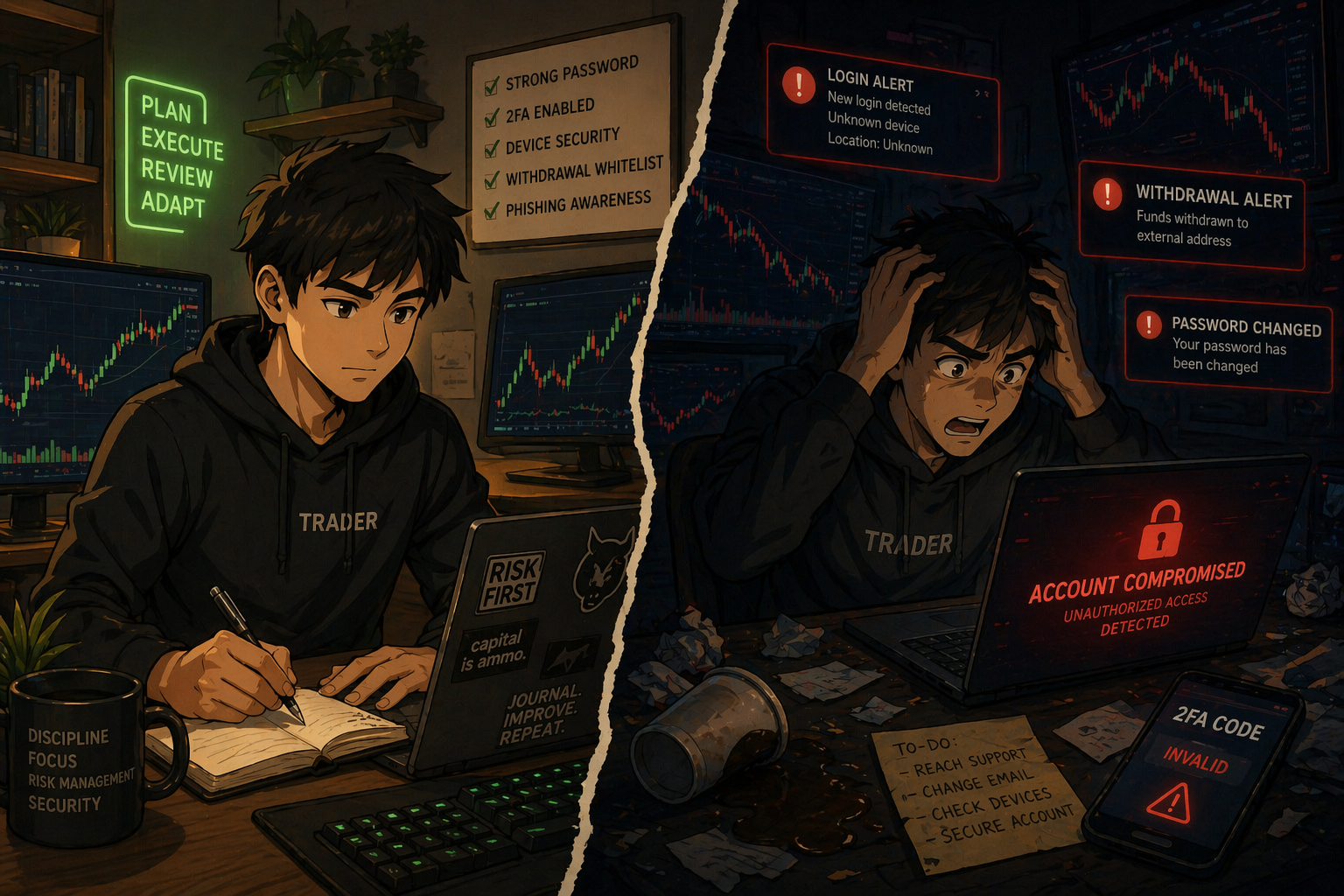
You can do everything right. Good setups. Clean execution. Solid discipline.
Then one small mistake wipes it out.
A weak password. Clicking the wrong link. Logging in on a random device. Suddenly, it’s not about trading anymore — it’s about damage control.
This part gets ignored because it’s not “exciting.” But it’s real.
Security isn’t separate from trading. It’s part of it.
Strong traders protect access the same way they protect capital. They lock accounts. They use two-factor authentication. They don’t take shortcuts with logins or devices.
Because if someone else gets access, your edge doesn’t matter.
Keep it simple: If it’s not secure, it’s not yours.
Protect the account. Then focus on the charts.
Some traders like staying aware of risks beyond charts — the kind that don’t show up on indicators but still impact results.
If that’s you, you can explore a few market reads here:

Bearish Abandoned Baby
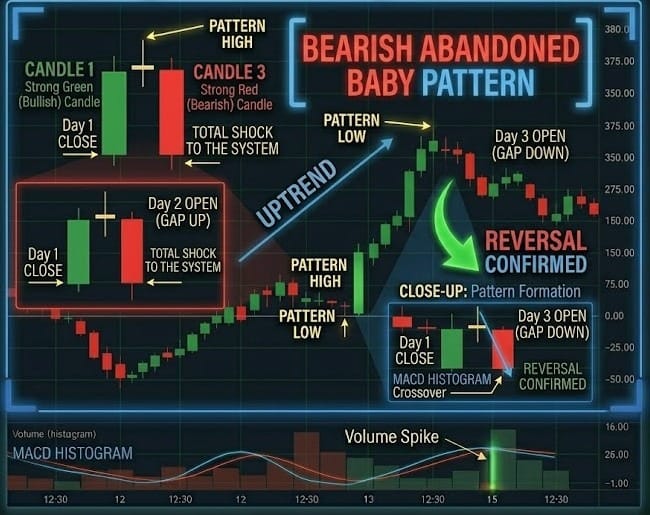
The Bearish Abandoned Baby is an elite, three-candle bearish reversal pattern. It is the exact mirror image of the Bullish Abandoned Baby.
It features a Doji that is completely "abandoned" at the top of a rally, separated by gaps on both sides. This creates an "Island Top" that signals a sudden and total collapse in buying conviction.
🛠️ The Strategy Logic
Use these logical triggers to identify when a rally has reached a terminal "exhaustion" point:
- IF: The first candle is a strong bullish candle, followed by a Doji that gaps completely above the first candle’s high...
- THEN: The market has hit a "Vacuum." The gap proves that buyers were so frantic they skipped price levels, but the resulting Doji shows that they found zero follow-through at those higher prices.
- THEN: The market has hit a "Vacuum." The gap proves that buyers were so frantic they skipped price levels, but the resulting Doji shows that they found zero follow-through at those higher prices.
- IF: The third candle is a strong red candle that gaps lower, leaving the Doji isolated at the peak...
- THEN: The pattern is confirmed. The second gap (the gap down) proves that the "abandoned" buyers at the top are now trapped. This is a high-probability "Short" entry signal.
- THEN: The pattern is confirmed. The second gap (the gap down) proves that the "abandoned" buyers at the top are now trapped. This is a high-probability "Short" entry signal.
- IF: The Bearish Abandoned Baby forms after a parabolic price spike or at the Upper Keltner Channel...
- THEN: You have a "Blow-off Top." The technical overextension combined with this specific gap pattern suggests the upward trend is not just pausing, but is finished.
- THEN: You have a "Blow-off Top." The technical overextension combined with this specific gap pattern suggests the upward trend is not just pausing, but is finished.
- IF: The third (red) candle closes below the midpoint of the first (green) candle...
- THEN: The bearish momentum is dominant. The deeper the third candle "pierces" the first candle's gains, the more likely a sustained downtrend will follow.
- THEN: The bearish momentum is dominant. The deeper the third candle "pierces" the first candle's gains, the more likely a sustained downtrend will follow.
- IF: Volume spikes on the third candle (the gap down)...
- THEN: Institutional "Exit" is confirmed. Big players are selling into the gap, ensuring that the price will likely continue to drop as the "trapped" bulls from the Doji day are forced to liquidate.
💡 Pro Tip
The "Island" Rule: To be a true Abandoned Baby, there must be visible daylight between the wicks of the Doji and the wicks of the candles on either side.
If the wicks overlap, the "Island" is broken, and it is just a standard Evening Star. This gap is a "Death Zone" for bulls; as long as the price stays below that upper gap, the bears are in total control.
Place your stop-loss just 1–2 ticks above the high of the Doji.

You Size Big When You Shouldn’t
Look at your last few trades honestly.
The random one you “felt good about”?
You sized up.
The clean, planned setup you waited hours for?
You went small.
That’s not strategy.
THAT’S EMOTION RUNNING YOUR RISK.
It usually happens quietly.
A trade feels right.
Momentum looks strong.
Something about it just clicks.
So you go heavier.
No deep analysis. Just instinct.
Then your actual A+ setup comes.
Clear levels.
Defined risk.
Everything aligns.
And somehow…
You hesitate.
“Let me play this one safe.”
“Smaller size just in case.”
Now flip the outcome.
The gut trade loses — bigger hit.
The clean trade wins — smaller gain.
YOU JUST PAID MORE FOR A WORSE DECISION.
That’s the real problem.
Your sizing isn’t tied to quality.
It’s tied to how you feel in the moment.
And feelings are inconsistent.
Some days you feel bold.
Some days you feel cautious.
So your risk jumps around.
No stability. No repeatability.
CONFIDENCE AND CONVICTION ARE OUT OF SYNC.
Professionals don’t size based on emotion.
They size based on criteria.
Predefined risk per trade.
Consistent exposure.
Adjustments only when there’s a clear, tested reason.
Not because a trade “feels strong.”
Because over time, consistency in sizing is what makes the edge work.
Not one big win.
Not one lucky trade.
REPEATABLE EXECUTION.
Here’s the shift:
Before entering any trade, ask:
“Is my size based on my plan — or my feeling?”
If it’s the second, you already know the problem.
Because the goal isn’t to bet bigger when you’re confident.
It’s to stay consistent so your best setups actually pay you properly.