ASML Rallies 4%
....................................................................................................................


Good morning,
The market is putting on a quiet but confident show this morning, building on some massive inflation relief.We’re seeing a steady, positive open on Wall Street. Nasdaq futures are up 0.5% as tech stocks try to build on yesterday's gains, while both S&P 500 and Dow futures are up a comfortable 0.2%. Investors are feeling a lot lighter after yesterday's big inflation report, and they are hoping today's wholesale data keeps the good news rolling.
We just got the biggest inflation relief since the pandemic. Yesterday’s Consumer Price Index (CPI) report was a massive deal, showing the largest single-month drop in inflation since April 2020. This cooler-than-expected number has completely flipped the script on Wall Street. Before the report, everyone was terrified the Fed would have to hike interest rates again. Now, traders are quickly scaling back those rate-hike bets, giving the stock market a major green light.
All eyes are on "Part Two" of the inflation story. At 8:30 a.m. ET, the government drops the Producer Price Index (PPI), which tracks inflation at the wholesale level—what businesses pay before passing costs on to us. If PPI confirms that wholesale prices are cooling off too, it will pretty much cement the idea that the worst of the recent inflation scare is behind us.
Kevin Warsh is back in the hot seat. This morning, new Fed Chairman Kevin Warsh is heading to Capitol Hill for day two of his congressional testimony, this time facing the Senate Banking Committee. Yesterday, Warsh made it clear that the Fed has "no tolerance" for high prices, but with yesterday's soft inflation numbers, senators will likely grill him on whether he still thinks a rate hike is necessary. We’ll also get the Fed's "Beige Book" this afternoon, which gives us a boots-on-the-ground look at how local businesses across the country are actually doing.
Earnings season is serving up some corporate strength. The big bank reports are rolling in, and the mood is highly optimistic. Today, we get results from Morgan Stanley and BlackRock, following JPMorgan CEO Jamie Dimon’s comment yesterday that banking conditions are "close to as good as it gets."
We'll also get crucial updates from tech equipment giant ASML, healthcare heavyweight Johnson & Johnson, and United Airlines to see how the broader economy is holding up.
It’s a hopeful Wednesday morning. If the wholesale inflation data cooperates and Kevin Warsh doesn't sound too aggressive, the bulls could have a very fun day.

💳 PayPal Rockets 16% Premarket on Rumored $53B Stripe and Advent Takeover
PayPal (PYPL) shares surged 16% in premarket trading on Wednesday following a breaking Reuters report that digital payments rival Stripe and private equity firm Advent International have submitted a joint takeover bid. The proposed cash offer of $60.50 per share values the fintech pioneer at more than $53 billion, offering a massive potential lifeline as PayPal struggles to defend its market share in an increasingly crowded and competitive global payment processing landscape.
🚀 SpaceX Shares Slide on Brink of Falling Below $135 IPO Price Baseline
Elon Musk’s SpaceX (SPCX) dropped 2.2% on Tuesday to close at $136.08, leaving the stock hanging just $1 above its initial $135 offering price. Following three consecutive sessions of heavy selling, the historic $75 billion public vehicle has officially surrendered one-third of its value from its post-listing peak, erasing nearly $850 billion in market capitalization as initial retail and institutional euphoria rapidly cools.
🖥️ IBM Suffers Worst Drop Since 1968 as AI Infrastructure Shifts Devastate Mainframe Sales
IBM shares plunged more than 25% on Tuesday to mark the tech giant’s worst single-session trading capitulation in 58 years. The historic selloff was triggered by a disappointing pre-announced financial package that fell significantly short of consensus expectations, a massive miss that management directly attributed to corporate clients aggressively diverting their legacy IT software and mainframe budgets toward high-density AI servers and memory hardware.
📊 Global Equities Edge Higher on Softer Inflation Data While Oil Trails Geopolitics
MSCI’s global index posted solid gains on Tuesday as market participants celebrated a softer-than-expected U.S. inflation reading and resilient bank earnings. The positive macroeconomic backdrop helped cushion broader risk assets, while global oil prices concurrently marched higher as traders priced in a rising supply premium from the renewed military escalations between Washington and Tehran.
🇳🇱 ASML Rallies 4% After Raising 2026 Guidance on "Extremely Strong" AI Orders
Advanced Semiconductor Materials Lithography (ASML) shares climbed 4% on Wednesday morning after the Dutch equipment giant raised its full-year sales guidance for the second time this year. ASML reported an absolute surge in first-half order bookings as key fabrication customers like TSMC aggressively accelerate their factory capacity expansions to keep pace with the ongoing global AI infrastructure race.
🛢️ Oil Retakes Ground as U.S. Navy Re-Establishes Iranian Maritime Blockade
Crude benchmarks advanced in highly volatile Wednesday trading, with international Brent pushing up to $85.31 a barrel and WTI rising to $79.70. Energy desks rushed to accumulate contracts after the Pentagon carried out another series of defensive airstrikes against Tehran, accompanied by Washington officially reinstating its tight naval blockade on Iranian commercial shipping ports surrounding the Strait of Hormuz.
🇨🇳 China Stocks Hold Steady as Investors Rotate Out of GDP Drags Into Value Plays
Mainland Chinese benchmarks preserved a highly stable baseline on Wednesday, with the blue-chip CSI 300 Index finishing flat and the Shanghai Composite Index easing just 0.1%. Institutional asset managers largely shrugged off a disappointing domestic GDP growth miss, opting to execute a defensive rotation out of growth-sensitive names and into stable, old-economy value plays.

Learning Randomly Slows Your Progress
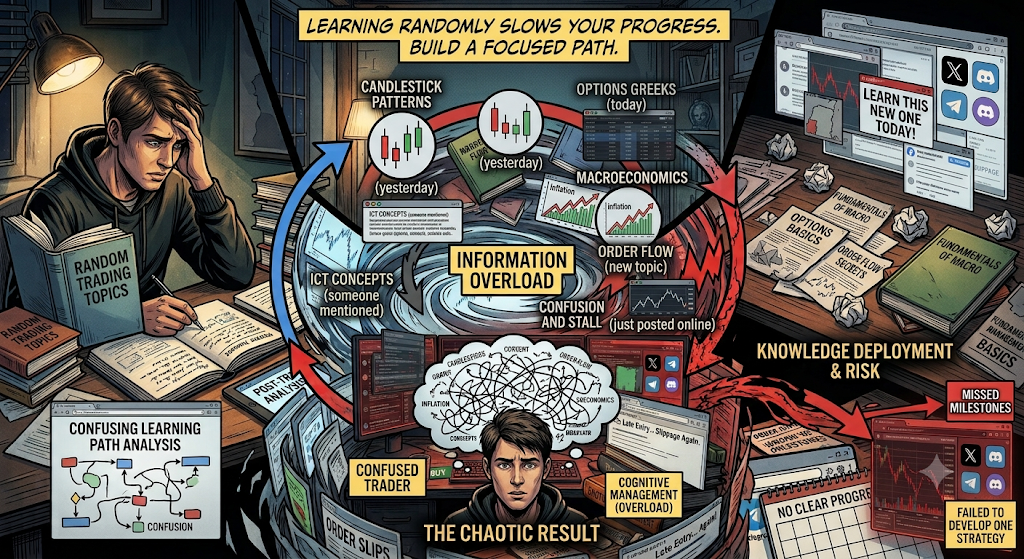
Most traders don't struggle because they aren't learning.
They struggle because they're learning everything at once.
One day it's candlestick patterns. The next it's options. Then ICT, macroeconomics, order flow, and a new indicator someone posted online.
It feels like progress.
But it's usually just information overload.
Without a clear path, it's hard to know what actually matters. You collect knowledge, but your trading doesn't improve because nothing connects.
Strong traders learn in stages. They build one skill before moving to the next. They master risk management before chasing advanced strategies. They create a foundation instead of constantly starting over.
Because trading isn't about knowing everything.
It's about knowing the right things in the right order.
When your learning has structure, your confidence grows. Each new concept builds on the last, and improvement becomes much easier to see.
Learn with purpose, not just curiosity.
One of the best ways to keep improving is to learn from different market thinkers and approaches.
If you'd like to explore more market perspectives, you can discover a few newsletters here:

The Triple Bottom
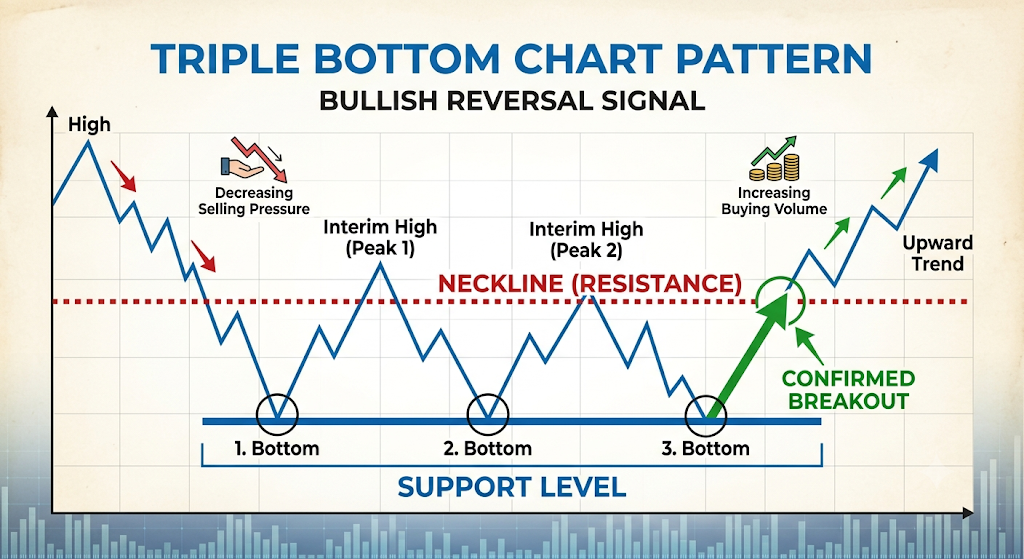
The Triple Bottom is a powerful chart pattern that looks like three distinct valleys sitting on the exact same floor line. It forms after a long downtrend and signals that sellers have attempted to push the price lower three separate times—and failed every single time. It represents a total structural shift from a bear market to a bull market.
🔴 The Red Zone (The Twin Lows)
The Meaning: The price drops, hits a low point, and bounces (Valley 1). It then drops again to the exact same spot and gets rejected a second time (Valley 2). At this point, it looks like a standard Double Bottom. The Move: Wait. This is a solid floor, but the sellers are preparing one final, desperate charge to break through it.
🟡 The Yellow Zone (The Third Valley)
The Meaning: Sellers launch a third attack, pushing the price back down to the exact same floor. Once again, they hit a brick wall of buyers and the price bounces back up. The Move: Watch closely. The high points between these three valleys form a horizontal baseline called the Neckline. The market is trapped in a tight squeeze between this floor and the ceiling line.
🟢 The Green Zone (The Neckline Breakout)
The Meaning: The price rallies away from the third valley and smashes straight up through the horizontal Neckline ceiling. The Move: Go! A clean close above the neckline is your official confirmation signal to buy. The sellers have completely run out of steam, and a massive upward trend has officially begun.
🔍 Two Simple Signals to Watch
1. The Volume Shift
Pay close attention to how much trading activity (Volume) happens on each consecutive valley.
- The Logic: In a valid Triple Bottom, volume should steadily decrease with each dip. Valley 1 has the highest selling volume, Valley 2 is quieter, and Valley 3 has very little volume. This proves that fewer and fewer players are willing to sell at these low prices, leaving the floor completely solid.
2. The Failed Breakout Tail
Watch the wicks (the thin lines at the bottom of the candles) when the price tests the floor for the third time.
- The Logic: If you see long lower wicks poking below the support line at Valley 3, it means the price briefly crossed the line but was instantly shoved back up by aggressive buyers. This "fake-out" is an early warning that the floor is holding and a massive rally is coming.
💡 The Simple Secret
Think of the Triple Bottom as a trampoline hitting a solid floor. The sellers drop the weight onto the floor three times. If the floor doesn't break on the third hit, the sellers lose all their momentum, and the trampoline sends the price flying upward. To estimate how far the price will rise after the breakout, measure the vertical distance from the valleys up to the neckline, the price will very often rally that exact same distance upward once it clears the ceiling.

The Trade Was Good Enough. You Just Weren't Ready.
Have you ever noticed how some traders are always waiting?
"This isn't quite it."
"I need one more confirmation."
"I'll enter if it pulls back a little."
"Let's see what the next candle does."
Tomorrow becomes next week.
Next week becomes next month.
And somehow, the "perfect setup" never arrives.
Not because the market failed to provide opportunities.
Because every time one got close...
...the standard quietly moved.
At first, it feels like discipline.
You're being selective.
Patient.
Professional.
But sometimes, selectivity is just fear wearing a very expensive suit.
Think about it.
You said you needed a pullback.
You got the pullback.
Then you wanted stronger volume.
Volume came.
Now you wanted one more confirmation candle.
It printed.
Then suddenly the risk-reward didn't look "ideal" anymore.
The market didn't keep changing.
Your comfort level did.
Without realizing it, you turned your trading plan into a moving target.
Why?
Because as long as no trade is "perfect," you never have to face the possibility of being wrong.
No entry.
No loss.
No emotional discomfort.
Your brain loves that deal.
The problem is, it also means...
No growth.
No experience.
No profits.
One trader admitted he'd been waiting for "the perfect breakout" for nearly three weeks.
When I asked what that actually looked like, he couldn't answer.
He just knew every breakout he'd seen wasn't quite it.
That's when it became obvious.
He wasn't waiting for a setup.
He was waiting for certainty.
And certainty doesn't exist in this business.
Professional traders don't wait for perfect.
They wait for enough.
Enough confirmation.
Enough probability.
Enough edge.
Because they understand something that takes many traders years to learn:
A setup doesn't have to feel perfect to be profitable.
It just has to fit the plan.
So here's a question to ask yourself the next time you reject another trade:
"Did this fail my rules... or did it fail my emotions?"
Those are very different things.
One protects your capital.
The other protects you from commitment.
The market will never hand you a trade wrapped in certainty.
At some point, you'll have to trust the work you've already done.
Because the traders who spend their careers waiting for the perfect setup often discover something painful:
The only thing they became experts at...
...was waiting.