US-Iran Deal Lifts Markets
....................................................................................................................


Good Morning,
The war is finally over, and Wall Street is throwing an absolute party to kick off the week.
We’re starting Monday with a massive surge in the futures market. Nasdaq futures are leading the rocket ride, jumping 1.9%, while the S&P 500 is up 1.2% and the Dow is climbing a solid 1%. Investors are celebrating a historic geopolitical breakthrough that completely changes the game for the global economy as we head into another holiday-shortened trading week.
The U.S. and Iran have officially agreed to a peace deal. Late Sunday night, the White House announced that a complete ceasefire has been reached. Pakistan’s Prime Minister, who helped broker the historic truce, confirmed that a formal signing ceremony is locked in for this Friday in Switzerland. While tricky details like Iran's nuclear program still need to be hammered out over the next 60 days, the immediate relief is massive: Iran gets its assets unfrozen and oil sanctions eased, while the world gets its supply chains back.
Oil prices are absolutely crashing. The market reaction was instant and violent. Brent crude futures plummeted 5% the second trading opened. With the threat of open conflict gone and the blockaded Strait of Hormuz set to fully reopen, the terrifying "war tax" that has been driving up global inflation for months is officially melting away. This gives the Federal Reserve a massive green light to stop talking about interest rate hikes and finally look toward rate cuts.
It’s a historic, euphoric Monday. The heavy cloud of war has lifted, energy costs are diving, and the bulls are running full speed into the summer.

🕊️ U.S. and Iran Sign Historic Peace Accord to End Four-Month War
The United States and Iran have officially finalized a peace treaty to bring an immediate end to their four-month-long conflict. Taking to Truth Social, President Donald Trump announced the total removal of the U.S. Naval blockade and authorized the completely toll-free reopening of the strategically vital Strait of Hormuz by this Friday, sparking a massive global relief rally across equity futures markets.
🚀 SpaceX Jumps Another 6% Premarket Following Blockbuster $2T IPO Debut
Shares of SpaceX (SPCX) advanced 6% in Monday's early premarket hours, building on a stunning 19% single-session surge during its historic Friday debut. The monster listing—the largest in financial market history—has propelled Elon Musk’s aerospace firm to a colossal $2 trillion valuation, igniting intense Wall Street debate over its long-term pricing multiple.
🌏 SoftBank Rockets 10% as Peace Deal Sends Asian Tech Heavyweights Soaring
Exchanges across Asia experienced an explosive wave of buying on Monday as global fund managers celebrated the formal end of Middle Eastern hostilities. Tokyo’s tech sector spearheaded the regional advance, with megacap tech investor SoftBank Group surging over 10% alongside powerful 7% rallies from semiconductor equipment mainstays Tokyo Electron and Advantest.
🛢️ Oil Plunges 5% to Three-Month Low as Gulf Supply Bottlenecks Evaporate
Crude benchmarks collapsed to their lowest trade thresholds since March 10 following confirmation that naval blockades will immediately lift. International benchmark Brent crude plummeted 4.2% to settle at $83.68 a barrel, while U.S. West Texas Intermediate dove 4.9% to trade at $80.75 as the immediate restoration of shipping traffic strips out the war's structural risk premium.
💵 Dollar Sinks to 10-Day Low as Currency Traders Exit Safe-Haven Positions
The U.S. dollar index retreated to a 10-day low in Asian trading sessions as the abrupt cessation of geopolitical hostilities curbed defensive safe-haven accumulation. As currency desks rapidly shifted capital back into riskier international assets, the euro strengthened 0.3% to hit $1.1601, while British sterling pushed up to $1.3434.
🥇 Gold Rallies 2% as Defused Energy Crunch Eases Long-Term Rate Pressures
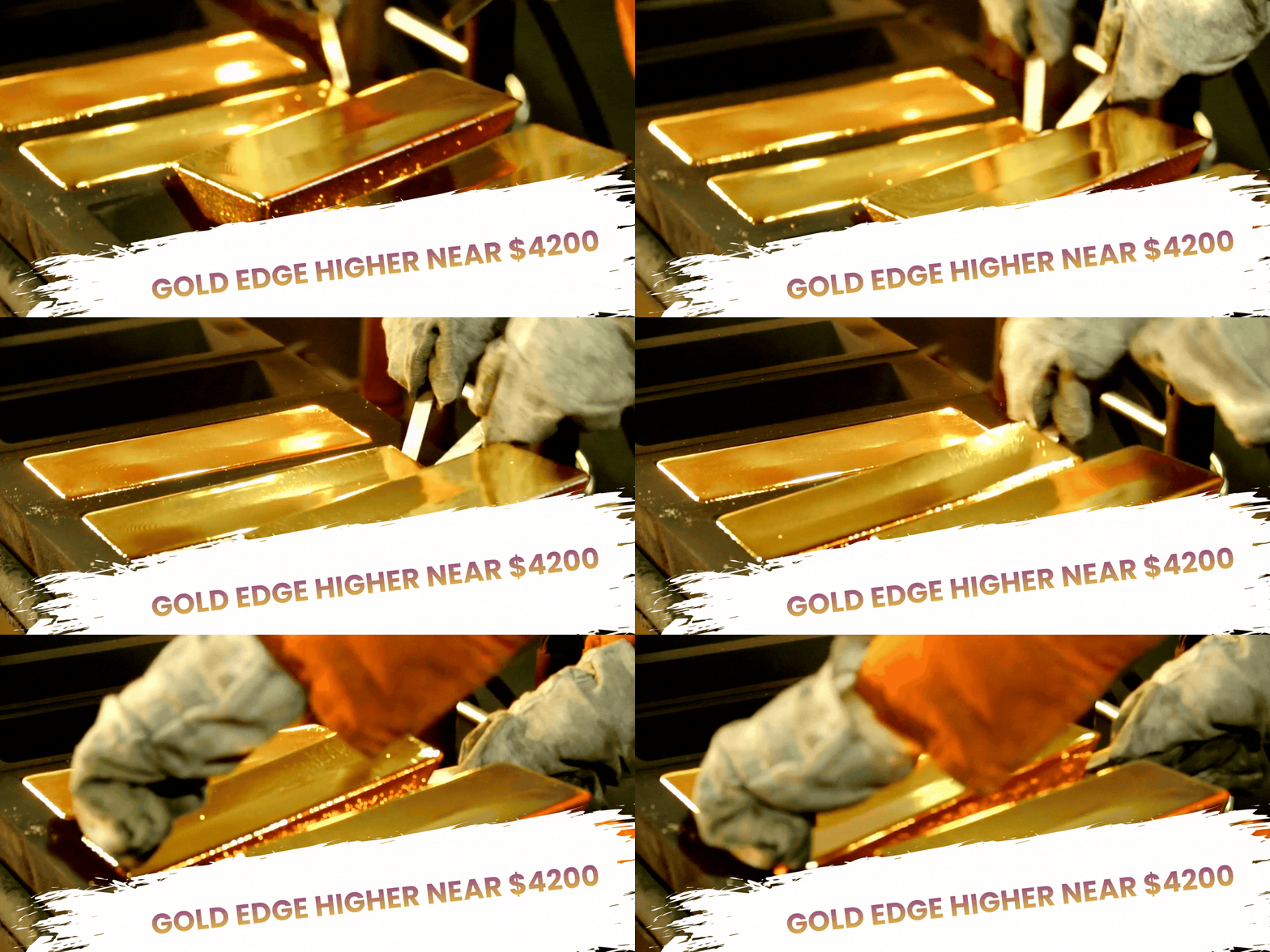
Spot gold advanced 2% on Monday, staging a sharp contrarian recovery as the formal signing of the bilateral peace treaty stabilized macro sentiment. Paradoxically, by instantly deflating crude oil benchmarks, the diplomatic resolution has significantly cooled global structural inflation anxieties and lowered the implied risk of further central bank interest rate hikes.
₿ Bitcoin Surges to Two-Week High Near $66K on Trade Normalization
Bitcoin rallied sharply on Monday, testing the $66,000 threshold to touch its strongest valuation in over two weeks. The token benefited directly from the alleviation of the pre-IPO liquidity crunch coupled with the removal of maritime bottlenecks, feeding a broader return of risk appetite across the decentralized digital asset ecosystem.

The Rules Outside the Rules Matter Too
Prop firms have become a popular path for traders who want access to more capital without risking large personal accounts.
But there’s a catch.
The industry is changing quickly.
Different firms operate under different structures. Rules vary. Regulations vary. What’s allowed in one place may not be allowed in another.
That uncertainty creates risk.
Many traders focus only on passing the challenge. They don’t ask important questions about how the firm operates, how payouts work, or what happens if policies change.
Then the rules shift.
Suddenly, a firm updates its terms. Payout processes change. Trading conditions change.
What looked straightforward becomes confusing.
Strong traders do their homework before committing time and money. They read the terms carefully. They understand how the business works. They avoid relying too heavily on any single firm.
Because access to capital means little if the structure behind it is unclear.
When you understand the environment you’re trading in, surprises become less costly. You make decisions based on facts, not assumptions.
Due diligence is part of risk management.
Some traders like exploring the changing landscape of prop firms, trading models, and market structure.
If that’s you, you can explore a few market reads here:

Cup and Handle
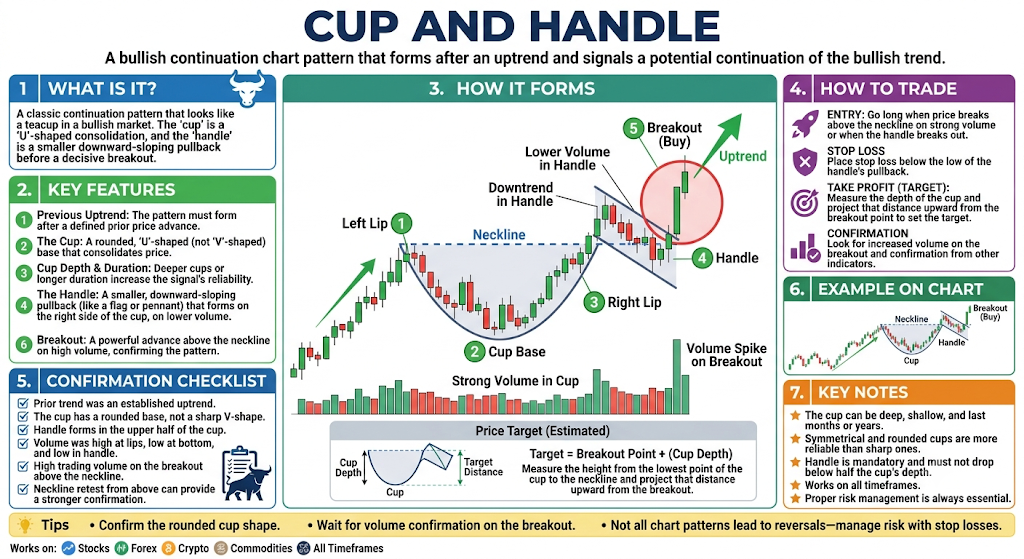
The Cup and Handle is a classic chart pattern that looks exactly like a teacup viewed from the side. It is a long-term bullish pattern that signals a temporary pause in a rising market, showing that buyers are quietly building up massive energy for a major breakout.
🔴 The Red Zone (The Left Lip & Drop)
The Meaning: Price hits a high point (the left lip of the cup) and then steadily slides downward into a long, smooth valley. At first glance, it looks like the uptrend is dying. The Move: Wait. This is just the beginning of the pattern. You are looking for the sellers to slowly lose their grip as the bottom of the valley forms a smooth, rounded bowl shape.
🟡 The Yellow Zone (The Right Lip & Handle)
The Meaning: Price climbs all the way back up to match the height of the left lip, completing the "Cup." Instead of breaking straight through, it gets rejected and drifts slightly downward in a tight, narrow channel (the Handle). The Move: Watch closely. The handle is a crucial test of strength. It represents a brief period of profit-taking. As long as this downward handle stays shallow, it shows that buyers are refusing to let the price drop too far.
🟢 The Green Zone (The Breakout)
The Meaning: The price reverses out of the handle and blasts straight up through the horizontal ceiling line connecting the two lips of the cup. The Move: Go! Blasting through the lip line is your official confirmation signal to buy. This proves that the minor pullback (the handle) is over and the main upward trend is ready to explode higher.
🔍 Two Simple Signals to Watch
1. The Handle Depth
Pay close attention to how deep the handle falls compared to the height of the cup.
- The Logic: A strong, healthy handle should stay within the top third of the cup's total depth. If the handle drops more than halfway down the cup, it means the sellers are still too powerful, and the pattern is much more likely to fail.
2. The Volume U-Shape
Watch how trading volume behaves across the entire pattern.
- The Logic: Volume should dry up and get very quiet at the bottom of the cup, showing a lack of selling interest. Crucially, volume should steadily increase as the price climbs up the right side of the cup and completely spike on the final green light breakout.
💡 The Simple Secret
Think of the Cup and Handle as a slingshot. The cup builds the structural framework, and the handle is the act of pulling the rubber band back just a tiny bit to gather tension. To estimate how far the price will rally after the breakout, measure the total depth from the lips of the cup down to the very bottom of the bowl—the price will often rally that exact same distance upward from the breakout point.

The Rules Change Once Money Is Involved
Have you ever noticed how disciplined you are before a trade?
It's honestly impressive.
You know exactly where your stop goes.
You know exactly how much you're risking.
You know exactly what would invalidate the setup.
Everything is clear.
Everything is logical.
Everything makes sense.
Then you enter the trade.
And suddenly you're a lawyer arguing a court case for why your own rules shouldn't apply anymore.
The stop loss?
"Maybe it needs a little more room."
The target?
"Maybe I should take profit early."
The risk limit?
"Well, this setup is different."
Amazing how quickly a rule turns into a discussion once real money is involved.
That's the Discipline Negotiation.
The rule was firm when it was theoretical.
The moment it became uncomfortable...
It became optional.
And that's where a lot of traders unknowingly lose consistency.
Not because they don't have rules.
Most traders have plenty of rules.
The problem is they treat them like opening offers in a negotiation.
Every time the market applies pressure, they start renegotiating the agreement.
A stop becomes a wider stop.
A daily loss limit becomes "just one more trade."
A planned exit becomes "let's see what happens."
Little by little, structure disappears.
And here's what makes this so dangerous:
The market will occasionally reward this behavior.
You'll widen a stop and the trade will recover.
You'll ignore a rule and make money.
You'll break the process and still get paid.
That's when the trap really sets.
Because now you don't just have a bad habit.
You have evidence that the bad habit "works."
At least sometimes.
But consistency isn't built on what works once.
It's built on what works repeatedly.
And discipline only matters when following it is uncomfortable.
Nobody deserves a medal for respecting a stop that's nowhere near getting hit.
The real test comes when every emotion in your body wants to do the opposite.
That's when you discover whether the rule was actually a rule...
...or just a preference.
One exercise that can change your trading is this:
The next time you catch yourself modifying a rule mid-trade, stop and ask:
"Would I make this exact same decision if this trade were still closed?"
It's a powerful question.
Because most trade-management mistakes only make sense after we're emotionally attached to the position.
Before the trade, the answer is usually obvious.
After the trade, emotions become very persuasive.
The best traders aren't people with perfect discipline.
They're people who stop negotiating with themselves once the plan is in motion.
Because every time you argue with your rules, you're really arguing with the version of yourself that was calm, objective, and thinking clearly.
And that's usually the person in the room you should trust most.