US-Iran Talks Fail
....................................................................................................................



Good morning.
Any hopes for an Easter peace deal evaporated over the weekend as talks in Islamabad completely collapsed. The fallout was immediate: Nasdaq futures are down 0.7%, and the Dow is sliding about 250 points after a stomach-churning 580-point drop overnight. The market is officially back in "crisis mode."
Trump just raised the stakes to an all-time high. Following the failed negotiations, the President ordered the U.S. Navy to start a total blockade of the Strait of Hormuz, effective at 10 a.m. ET today. This isn't just a "toll" or a "slowdown" anymore—it’s a complete halt of all maritime traffic in the world’s most important oil artery. Iran has already fired back, saying they "won't allow" the blockade, putting the world’s two biggest wildcards on a direct collision course by lunch.
Inflation fears are back with a vengeance. With the Strait effectively closed by the U.S. Navy, the "supply heart attack" we all feared is now the base case. Oil prices are surging again, threatening to undo all the cooling we saw during the two-week ceasefire. Investors are scrambling to figure out how the global economy can grow when the primary engine—energy—is being used as a military pawn.
It’s a "bracing for impact" Monday.
We’ve recouped some of the overnight panic, but with the 10 a.m. deadline looming, the market is one headline away from another leg down.

🛢️ Oil Rallies 9% as U.S. Announces 'Dangerous' Hormuz Blockade
Energy markets surged Monday after U.S. Central Command vowed to blockade all vessels tied to Iranian ports, deepening a global energy shock. Brent jumped near $104 a barrel while European gas futures spiked 18% as the blockade—set to begin at 10 a.m. ET—marks a major escalation following the collapse of weekend peace talks.
🥇 Gold Dips Below $4,650 as Inflation Risks Mount
Bullion prices fell 2.2% to trade below $4,650 as the new U.S. blockade heightened fears of a massive, energy-driven inflation spike. The decline comes as a six-week Middle East conflict fails to reach a lasting peace, with traders pivoting to cash and yields over the non-yielding metal.
📈 TSMC Eyeing 4th Straight Record Profit on AI Boom
Taiwan Semiconductor is projected to report a 50% surge in net profit for Q1, fueled by "insatiable" demand for 3nm chips and advanced packaging. Now valued at $1.6 trillion—double that of rival Samsung—TSMC remains the primary beneficiary of an AI infrastructure race that is currently outstripping production capacity.
💻 Strategists Call for "Buy the Dip" in Hammered Tech
Despite geopolitical volatility, Wall Street experts are urging investors to "jump in" on beaten-down tech names. While the software sector has plunged 12% over the last month, strategists argue that AI remains a structural catalyst powerful enough to overcome the current Middle East-driven market anxiety.
🚀 Intel Surges 51% in 8 Days Amid Turnaround Optimism
Intel (INTC) has staged a massive 51% rally over the last eight trading sessions, defying the broader sector's volatility. The surge reflects growing investor confidence in the company’s manufacturing roadmap and its ability to claw back market share as domestic chip production becomes a national security priority.
🌏 Asia-Pacific Markets Slump as Peace Talks Falter
Regional indices across Asia retreated Monday after weekend negotiations between the U.S. and Iran failed to secure a permanent ceasefire. The prospect of a prolonged blockade in the Strait of Hormuz weighed heavily on energy-importing economies, sending the Nikkei and Hang Seng into the red.
💵 Safe-Haven Dollar Gains as Geopolitical Risks Re-Ignite
The U.S. dollar index strengthened as risk appetite evaporated following the failure of the Islamabad summit. The greenback’s status as a primary haven asset was bolstered by the U.S. military's shift to a blockade strategy, putting renewed pressure on emerging market currencies.

You’re Not Competing on Speed — So Stop Trading Like You Are
Markets move fast. Really fast.
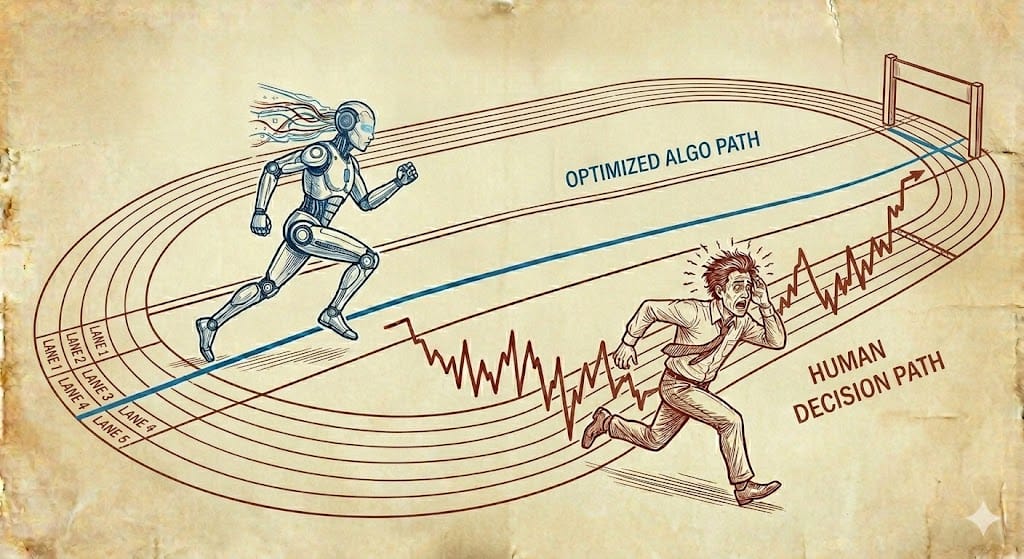
By the time you see a move, algorithms have already reacted. Orders are placed, filled, and adjusted in milliseconds. Trying to “beat” that speed manually is a losing game.
That’s where many traders get frustrated.
They chase moves that already happened. They react late. They feel like the market is always one step ahead.
Because it is.
But here’s the shift: you’re not supposed to compete on speed.
Strong traders don’t try to outclick machines. They focus on structure. They plan trades in advance. They wait for levels. They execute with patience, not reaction.
Algorithms thrive on chaos and speed. You win by staying calm and deliberate.
When you stop reacting and start planning, the market feels slower. Clearer. More manageable.
Patience becomes your advantage.
Some traders like exploring how markets are evolving and how different participants approach them.
If that’s you, you can check out a few market reads here:

Marubozu
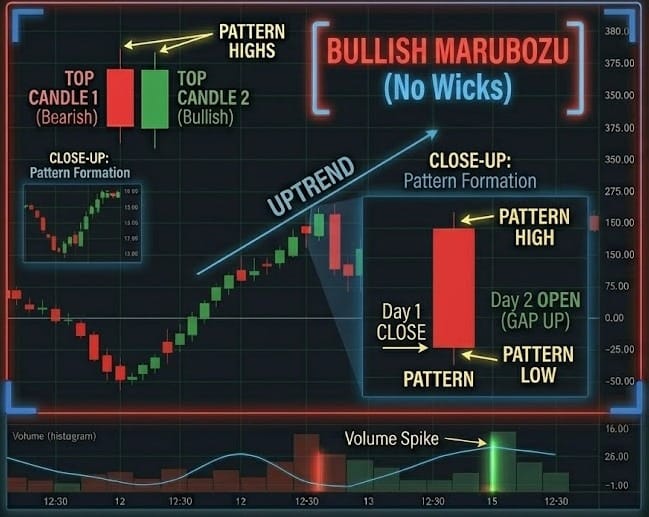
"Marubozu" is Japanese for "bald" or "shaved head," which refers to a candlestick that has no wicks (or incredibly tiny ones).
This means the candle opened at one extreme and closed at the absolute other extreme. It represents a session of total, undisputed dominance by one side from the opening bell to the final second of trading.
🛠️ The Strategy Logic
Use these logical triggers to identify high-conviction momentum and "unstoppable" trends:
- IF: A Bullish Marubozu (Long Green/White body, no wicks) appears...
- THEN: Buying pressure is absolute. The bulls were so aggressive they never allowed the price to dip below the open or retreat from the high. This is a strong continuation or breakout signal.
- THEN: Buying pressure is absolute. The bulls were so aggressive they never allowed the price to dip below the open or retreat from the high. This is a strong continuation or breakout signal.
- IF: A Bearish Marubozu (Long Red/Black body, no wicks) appears...
- THEN: Selling pressure is absolute. The bears controlled the entire session, pushing the price to the floor without a single meaningful bounce. This signals extreme weakness and further downside.
- THEN: Selling pressure is absolute. The bears controlled the entire session, pushing the price to the floor without a single meaningful bounce. This signals extreme weakness and further downside.
- IF: A Marubozu breaks through a major horizontal resistance or the Upper Keltner Channel...
- THEN: The breakout is high-conviction. Most breakouts feature a "rejection" wick; a Marubozu breakout suggests there is no supply left to stop the move, often leading to a multi-day rally.
- THEN: The breakout is high-conviction. Most breakouts feature a "rejection" wick; a Marubozu breakout suggests there is no supply left to stop the move, often leading to a multi-day rally.
- IF: A Marubozu appears after a long period of "Dojs" or small-bodied candles...
- THEN: The market has officially "chosen" a direction. The period of indecision has ended with a violent surge of conviction, making this the ideal time to enter in the direction of the Marubozu.
- THEN: The market has officially "chosen" a direction. The period of indecision has ended with a violent surge of conviction, making this the ideal time to enter in the direction of the Marubozu.
- IF: The Marubozu is exceptionally large (3x the size of previous candles)...
- THEN: Watch for "Exhaustion." While a Marubozu shows strength, an oversized one can signal a "blow-off" move where the last of the buyers/sellers are filled, potentially leading to a temporary pause or retracement.
💡 Pro Tip
The "Anchor" Secret: A Marubozu creates a powerful psychological anchor. Because it represents total dominance, the midpoint (50%) of a Marubozu body often acts as a massive support or resistance level in the future.
If the price pulls back and holds the 50% level of a Bullish Marubozu, the trend is still incredibly strong.
If the price closes below that midpoint, the "conviction" of that candle has been invalidated, and the move was likely a trap.

You’re Trading Last Week’s Setup

Last week, it worked perfectly.
Clean pattern.
Sharp entry.
Textbook move.
You remember it clearly.
So this week… you’re looking for it again.
Same shape.
Same structure.
Same “feel.”
And when something close enough appears?
You take it.
Confident.
Because you’ve “seen this before.”
BUT THE MARKET DOESN’T REPEAT — IT EVOLVES.
That’s the trap.
You’re not reading the current market.
YOU’RE PROJECTING A MEMORY ONTO IT.
Last week’s setup becomes your reference point.
So you start forcing similarities.
“This looks like that breakout.”
“This feels like that reversal.”
“This should move the same way.”
But context is different.
Liquidity is different.
Volatility is different.
Participants are different.
And small differences in structure?
They change everything.
PATTERN RECOGNITION WITHOUT CONTEXT IS GUESSWORK.
That’s why the trade fails.
Not because the pattern is useless.
But because it’s being applied blindly.
Professionals don’t memorize setups.
They understand conditions.
They ask:
What is price doing right now?
Where is liquidity sitting?
Is this environment trending or ranging?
Because the same pattern behaves differently under different conditions.
And trading is not about copying the past.
IT’S ABOUT RESPONDING TO THE PRESENT.
Let’s be real:
Your brain loves familiarity.
It wants to recognize something and act fast.
But in trading, that instinct can betray you.
Because what looks familiar… can still be wrong.
So here’s the shift:
Don’t ask,“Have I seen this before?”
Ask,
“Does this make sense in this market, right now?”
Because the edge isn’t in repeating patterns.
It’s in understanding when — and when not — they apply.