Apple Eyes 35% Surge
....................................................................................................................



Good morning,
US stock futures are sliding to start the week as Wall Street grapples with a shock few investors had on their 2026 bingo card: a direct threat to Federal Reserve independence.
Futures across the Dow, S&P 500, and Nasdaq are firmly lower after Chair Jerome Powell disclosed that the Trump administration’s Department of Justice has subpoenaed the Fed — raising the specter of a criminal probe tied to Powell’s prior Senate testimony.
Markets don’t like uncertainty. They really don’t like uncertainty around the institution that controls interest rates.
The escalation lands at a fragile moment. Investors were already bracing for fresh inflation data due Tuesday, coming just days after a jobs report confirmed the labor market is cooling — but not cracking.
That combination had reinforced expectations the Fed would stay put for now. Instead, attention has shifted from what the Fed will do to whether it can act freely at all.
Layer in rising geopolitical tension — from Iran, to Cuba, to renewed rhetoric on Greenland — and the tone is unmistakable: risk is back in the conversation.
As earnings season approaches and inflation data looms, Wall Street is learning quickly that 2026 isn’t easing in quietly.

📉 U.S. Stock Futures Slide as Powell Subpoena and Iran Risks Loom Over Earnings
U.S. stock futures fell late Sunday as investors headed into earnings season facing mounting uncertainty, with legal threats against Fed Chair Jerome Powell and renewed Iran risks overshadowing optimism around big-bank results due this week. S&P 500 futures slipped 0.5%, Nasdaq 100 futures fell 0.7%, and Dow futures eased 0.4%.
📱 Apple Could Surge 35% in 2026 on AI Push, Wedbush’s Dan Ives Says
Apple shares could rally as much as 35% in 2026 as the company leans deeper into artificial intelligence, with expectations of a major AI rollout this spring, a potential Google partnership powering Apple Intelligence, and CEO Tim Cook expected to remain in place through 2027.
🤖 TSMC Q4 Profit Seen Jumping 27% as AI Chip Demand Explodes
Taiwan Semiconductor Manufacturing Co. is expected to post a 27% surge in fourth-quarter profit, driven by relentless demand for advanced AI chips, underscoring the company’s central role in powering global AI infrastructure growth.
🥇 Gold Breaks $4,600 for First Time as Safe-Haven Demand Surges
Gold surged past $4,600 an ounce for the first time ever, fueled by strong safe-haven demand and expectations of interest-rate cuts, cementing bullion’s appeal amid rising geopolitical and economic uncertainty.
🛢️ Oil Steadies as Markets Weigh Iran Calm and Venezuela Export Talks
Oil prices edged lower as easing concerns over Iranian supply risks and efforts to restart Venezuelan exports tempered recent gains, with Brent at $63.25 a barrel and WTI at $59.02, keeping traders cautious in near-term direction.
🌏 Asian Shares Jump as Powell Subpoena Sinks U.S. Futures
Asian markets rallied while U.S. futures slid after Fed Chair Jerome Powell revealed the Justice Department had issued subpoenas tied to a federal building renovation, escalating tensions between the Federal Reserve and President Trump and unsettling Wall Street.
📊 Cracks Emerge in the Magnificent 7 as Earnings Growth Slows
The dominance of the “Magnificent 7” is showing signs of strain, with Big Tech earnings growth expected to slow to 18% in 2026, its weakest pace since 2022, as investors demand real returns instead of long-term AI promises.

Trading Still Works - Your Timing Is the Issue
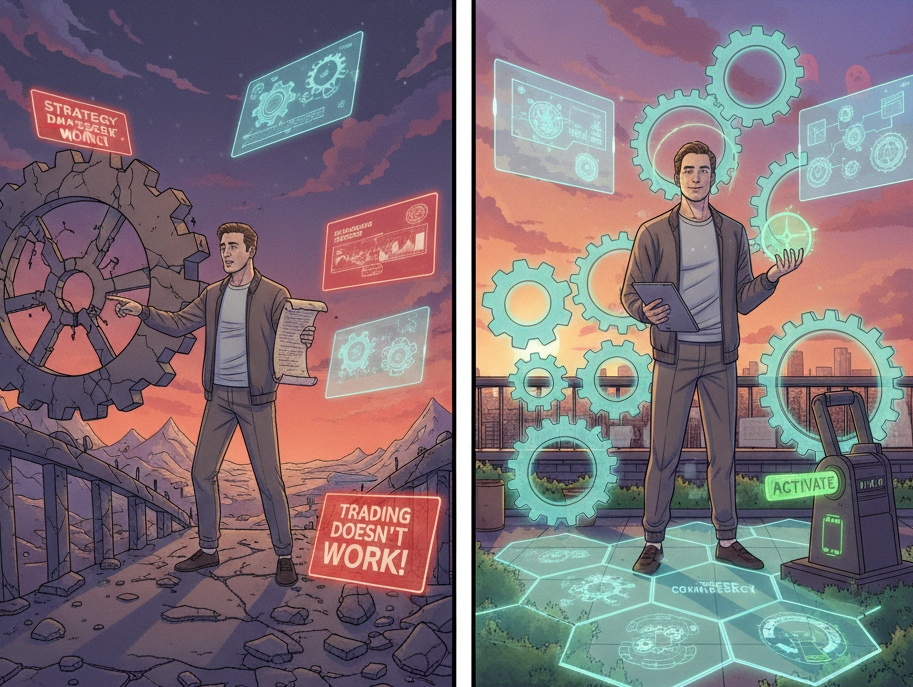
Markets change. That part is true. What doesn’t change is how price moves through fear, greed, patience, and impatience. Declaring that trading “doesn’t work anymore” is often a shortcut to avoiding the learning curve.
Most strategies don’t fail because the market broke. They fail because they were applied too early, without structure, or abandoned before consistency could develop. Assuming it’s the market shuts the door before skill has time to form.
Strong traders adapt, not quit. They study price behavior, adjust execution, and give themselves time to build timing. The edge isn’t gone—it just isn’t instant.
When you stop blaming the market, progress begins. Learning replaces frustration. Skill replaces excuses.
If you want guidance that shows how trading still works when approached with structure and patience, these newsletters help. They focus on timing, discipline, and process over hype.

Volume Oscillator
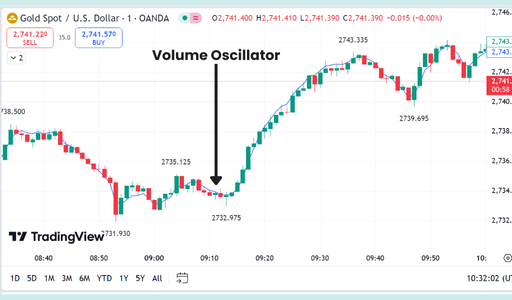
The Volume Oscillator measures the difference between two moving averages of volume (usually a fast 5-period and a slow 14-period). Unlike price oscillators, it doesn't look at price direction; instead, it identifies whether the "energy" or "conviction" in the market is increasing or decreasing.
🛠️ The Strategy Logic
Use these logical triggers to determine if a price move has the "fuel" to continue or if it is likely a trap:
- IF: The Volume Oscillator is rising and moves above the zero line...
- THEN: Conviction is increasing. Whether the price is going up or down, this rising line confirms that more participants are entering the trade, making the current trend more likely to persist.
- THEN: Conviction is increasing. Whether the price is going up or down, this rising line confirms that more participants are entering the trade, making the current trend more likely to persist.
- IF: The price breaks out of a pattern, but the Volume Oscillator is falling or below zero...
- THEN: The breakout is "hollow." This suggests a lack of interest from big institutional players, and there is a high probability that the move will fail (a "bull trap" or "bear trap").
- THEN: The breakout is "hollow." This suggests a lack of interest from big institutional players, and there is a high probability that the move will fail (a "bull trap" or "bear trap").
- IF: The Volume Oscillator reaches an extreme high peak and begins to turn down...
- THEN: The market has reached a point of "climax." This often happens during a blow-off top or a panic bottom where everyone has already placed their trades, leaving no one left to push the price further. Expect a reversal or consolidation.
- THEN: The market has reached a point of "climax." This often happens during a blow-off top or a panic bottom where everyone has already placed their trades, leaving no one left to push the price further. Expect a reversal or consolidation.
- IF: Price is hitting new highs, but the Volume Oscillator is making lower highs...
- THEN: You have a "Bearish Volume Divergence." The upward price move is losing its momentum and "fuel." This is a major warning that the uptrend is nearing its end.
- THEN: You have a "Bearish Volume Divergence." The upward price move is losing its momentum and "fuel." This is a major warning that the uptrend is nearing its end.
- IF: The Volume Oscillator is near the zero line and moving sideways...
- THEN: The market is in a "Dormant" phase. Interest is low, and volatility is likely quiet. This is often the quiet before a storm; wait for the oscillator to spike before committing to a new position.
💡 Pro Tip
The "Trend Confirmation" Rule: Never use the Volume Oscillator to pick a direction on its own. Instead, use it as a validator. If your Keltner Channels show a buy signal and your Hull Moving Average is green, look at the Volume Oscillator. If it is rising, the trade has "permission" to proceed. If it is falling, the trend is weak—stay on the sidelines.

When Confidence Turns on You
A few clean wins change how you think.
You start sizing a little bigger.
You stop waiting for full confirmation.
You assume the next trade will behave like the last ones.
That’s the overconfidence loop.
Early success creates the feeling of control.
The market starts to look orderly.
Patterns feel obvious.
Risk feels smaller than it is.
None of that is real.
Markets do not become predictable because you are winning.
They stay uncertain.
What changes is your tolerance for risk and your respect for randomness.
Overconfidence rarely shows up as arrogance. It shows up as shortcuts. Less patience. Faster decisions. Looser rules.
The danger is timing.
Overconfidence peaks right before conditions shift.
Volatility changes. Liquidity thins.
A normal loss suddenly hits oversized exposure.
Confidence should come from execution, not outcomes.
When your belief in the market grows faster than your discipline, drawdowns follow.
Winning days test traders more than losing ones.
Staying grounded after success is harder than staying calm after pain.