SpaceX Targets $2T IPO
....................................................................................................................


Good morning.
It’s Good Friday, and while the floors in New York are closed for the holiday, the news cycle clearly didn't get the memo.
If you were looking for a quiet Easter break, the headlines have other plans. We’re heading into the long weekend with a massive "wait-and-see" vibe as the market tries to digest a high-stakes address from President Trump that sent oil and crypto in completely opposite directions.
Trump is turning up the heat before cooling it down. In a national address last night, he vowed to hit Iran "extremely hard" over the next few weeks to finish the war. The "peace rally" we saw earlier this week hit a wall as Brent crude surged back over $100. Bitcoin isn't a fan of the saber-rattling either, tumbling toward the bottom of its range at $65,000. The only saving grace? Reports that a protocol is finally being drafted to reopen the Strait of Hormuz. If those tankers start moving, the "supply heart attack" might finally find a cure.
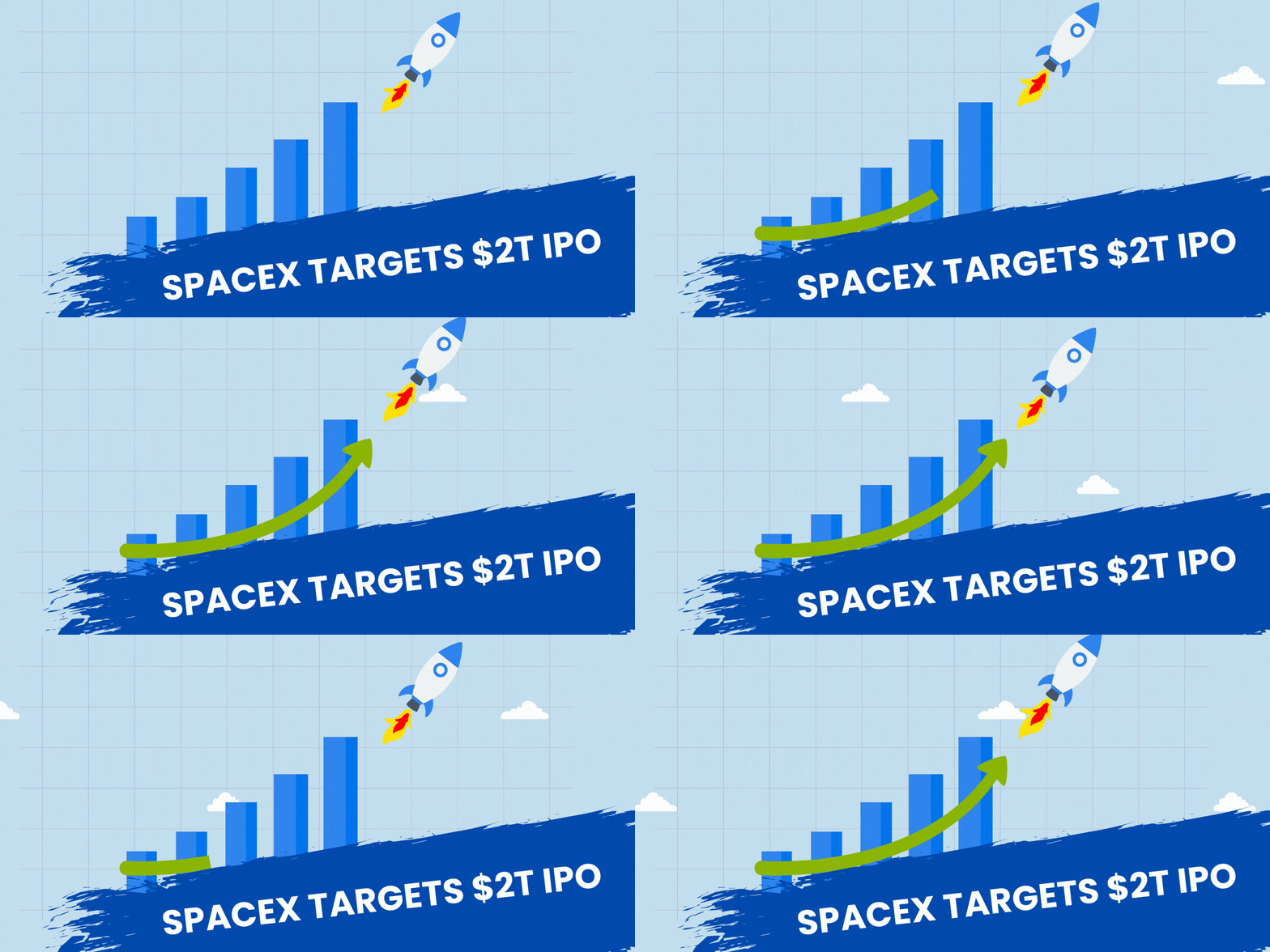
Elon is shooting for the moon—and a $2 trillion valuation. The hype for the SpaceX IPO just went interstellar. Reports are swirling that SpaceX is targeting a valuation north of $2 trillion, which would make it bigger than almost every tech giant except the top five. To top it off, Saudi Arabia’s PIF is reportedly in talks to drop a $5 billion anchor stake to keep their seat at the table. Between SpaceX, OpenAI, and Anthropic, the "IPO drought" is officially over.
Microsoft is making a massive $10 billion bet on Japan. While everyone is distracted by the war, Redmond is quietly planting a flag in Tokyo. They’re dropping 1.6 trillion yen to build out AI infrastructure and train a million engineers. It’s a clear signal: the AI arms race doesn't care about geopolitical borders.
It’s a "stay informed" Friday.
The markets are closed, but the world is still moving fast.
Enjoy the break—we're going to need the energy for whatever Monday brings.

🚀 SpaceX Targets $2 Trillion Valuation in Historic IPO
Elon Musk’s SpaceX is reportedly eyeing a valuation exceeding $2 trillion for its upcoming IPO, a figure that would make it larger than all but five S&P 500 giants. The offering is part of a blockbuster year for capital markets, with investors also bracing for highly anticipated debuts from AI leaders OpenAI and Anthropic.
📈 Tech Stocks Rebound as Tesla Dives on Delivery Miss
Broad tech shares recovered Thursday after a flight from risk eased following President Trump’s latest address. However, Tesla (TSLA) plunged 8% to $360.59—its worst performance in the "Mag 7" after reporting 358,023 Q1 deliveries, missing the 365,645 consensus and leaving a massive 50,000-vehicle inventory gap.
📈 Oil Surges as Trump Vows to Hit Iran "Extremely Hard"
Crude prices surged back over $100 a barrel following a national address where President Donald Trump pledged to intensify strikes over the next few weeks. While Trump claimed the military is "very close" to finishing the war, the hawkish rhetoric rattled energy markets and sent Bitcoin down 2%.
📊 Stocks Volatile as Traders Weigh Hormuz Reopening
U.S. indices staged a late-day recovery Thursday after initial 650-point losses for the Dow. Sentiment shifted following reports that Iran and Oman are drafting a protocol to facilitate traffic through the Strait of Hormuz, raising hopes that global oil supply disruptions could soon ease.
🌏 Asia-Pacific Markets Rise on Easter Trade Optimism
Regional markets traded mostly higher Friday as investors clung to reports of a potential "transit monitoring" deal for the Strait of Hormuz. The diplomatic progress between Iran and Oman provided a much-needed lift to sentiment across Asian exchanges during the holiday-shortened week.
🇯🇵 Microsoft Announces $10B AI and Cyber Expansion in Japan
Microsoft President Brad Smith unveiled a massive 1.6 trillion yen ($10 billion) investment in Japan to bolster AI infrastructure and cybersecurity. The four-year plan includes training 1 million developers and aligns with Tokyo's strategic goal of securing national security through advanced tech.
₿ Bitcoin Tumbles to $65K as Geopolitical Stress Mounts
Bitcoin dropped 3.6% to $65,709, lingering at the bottom of its month-long trading range as conflict uncertainty persists. The broader crypto market faced a sharp sell-off, with Ether and Solana both sliding nearly 6% in response to the escalating rhetoric from Washington.

You Don’t Lose Because of Bad Rules. You Lose Because You Don’t Follow Them
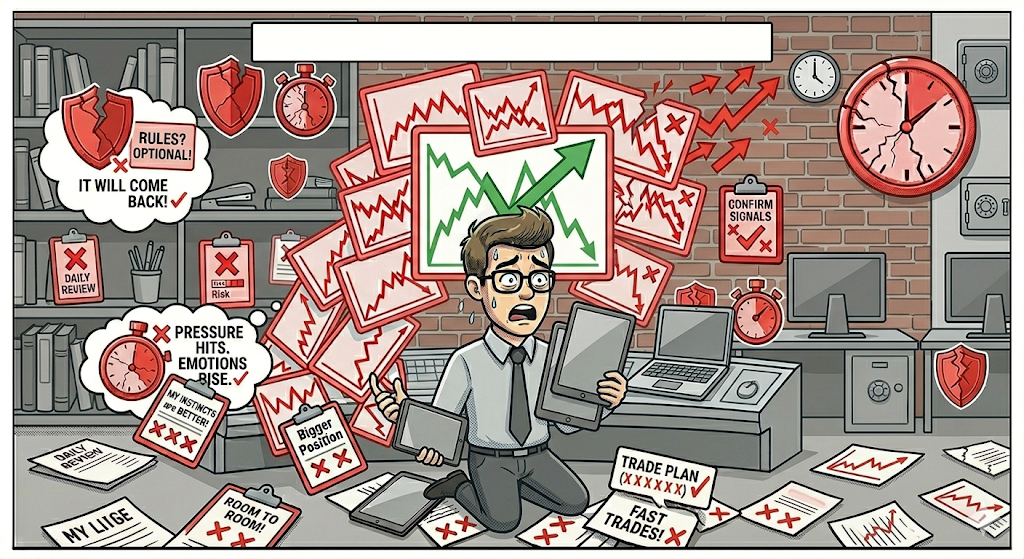
Most traders already have rules.
They know where to enter. Where to exit. How much to risk. Everything is clear before the trade starts.
Then pressure hits.
Price moves fast. Emotions rise. And suddenly the rules become optional. You hesitate. You adjust. You improvise.
That’s where consistency breaks.
In fast markets, small deviations get punished quickly. One moment of hesitation. One emotional decision. That’s all it takes to turn a good plan into a bad result.
This is not about knowledge. It’s about execution.
Strong traders respect their rules under pressure. They follow the same process in calm markets and fast markets. If they use discretion, it is defined and structured, not random.
When your rules stay consistent, your results become measurable. You know what works and what doesn’t. You build confidence because your actions don’t change with emotion.
Discipline turns strategy into results.
Different traders approach discipline and decision-making in different ways. Seeing how others structure their thinking can add useful perspective.
You can explore a few market viewpoints here:

Bullish Kicker
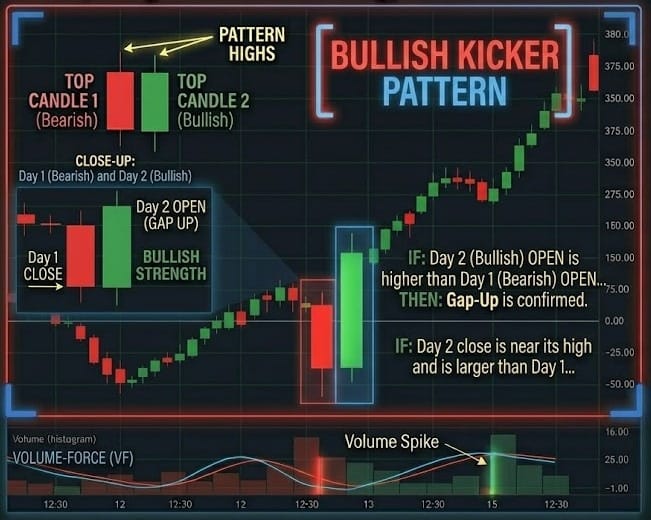
The Bullish Kicker is arguably the most powerful reversal pattern in technical analysis. It is a two-candle pattern that occurs when a strong downtrend is suddenly interrupted by a massive gap up.
The first candle is a long red candle, and the second is a long green candle that opens above the previous day’s open. It visualizes a total and instantaneous shift in market sentiment—usually caused by a massive surprise news event or earnings report.
🛠️ The Strategy Logic
Use these logical triggers to identify when a "sea change" in price has occurred:
- IF: The second (green) candle opens above the opening price of the first (red) candle...
- THEN: The pattern is a valid "Kicker." This massive gap shows that the bears were completely caught off guard and the bulls have seized control before the market even opened.
- IF: The second (green) candle has little to no lower wick (Marubozu style)...
- THEN: The signal is extreme. This means that from the very first second of the session, buyers were in control and never allowed the price to dip back toward the gap, signaling immense institutional demand.
- IF: The Bullish Kicker occurs after a long, grinding downtrend...
- THEN: This is a "Trend Killer." It isn't just a bounce; it is a violent reversal that often marks the absolute bottom of a move. The "downward" energy has been completely neutralized in a single session.
- IF: The Volume Oscillator shows a massive spike on the "Kicker" (green) day...
- THEN: The move is high-conviction. Large volume on a gap-up proves that the "Big Money" is behind the move, making it much less likely that the gap will be filled anytime soon.
- IF: The price stays above the gap for the next 2–3 sessions...
- THEN: The new uptrend is confirmed. The gap acts as a "Launchpad." If the price doesn't immediately fall back to "fill the gap," it shows the market has accepted the new higher valuation.
💡 Pro Tip
The "No-Fill" Secret: In most trading patterns, traders look for a "gap fill" (price returning to the gap area). Do not wait for a fill on a true Bullish Kicker. A Kicker is a "Breakaway Gap." If the price returns to fill the gap, the Kicker has actually failed and the strength is gone.
The most profitable way to trade this is to enter as soon as the green candle closes and place your stop-loss at the midpoint of the first (red) candle. If the bulls are truly "kicking," the price should never look back.

The Invisible Overtrading
You finish the day and look back.
“Not bad,” you think.“Every trade made sense.”
Each one had a level.Each one had a reason.Each one technically fit your system.
So why does the day feel messy?
Why is the P&L inconsistent… or worse, down?
Because this isn’t obvious overtrading.
This is the dangerous kind.
THE KIND YOU CAN JUSTIFY.
You didn’t take random trades.You didn’t gamble.
You followed your rules… loosely.
A setup was almost clean.Another was close enough.A third looked valid if you zoomed in.
Individually, each trade seems defensible.
Collectively?
They dilute your edge.
OVERTRADING ISN’T ALWAYS ABOUT BAD TRADES.IT’S ABOUT TOO MANY “OKAY” ONES.
That’s the trap.
Your system is designed for high-quality setups, not constant activity.
But when you lower the standard — even slightly — frequency increases.
And with more trades comes:
- More exposure
- More emotional swings
- More chances to make small mistakes
Those small leaks add up.
Professionals don’t just define what a valid setup is.
They define what a top-tier setup looks like.
And they wait for that.
Because one A+ trade often outperforms five B-level trades.
Let’s be honest:
Sometimes you’re not trading because the setup is great.
You’re trading because you want to be in the market.
And your brain is smart enough to find reasons.
That’s why it feels justified.
But trading isn’t about being right per trade.
It’s about protecting the quality of your decisions over time.
So here’s the shift:
Don’t just ask,“Does this fit my system?”
Ask,“Is this one of my best setups — or am I stretching the rules?”
Because the most expensive trades aren’t always the obvious mistakes.
They’re the ones that quietly pass your filter… but should’ve been ignored.