Oracle Stock Rallies
....................................................................................................................



Good morning.
Some people struggle to keep their houseplants alive, but the market is having the opposite problem today—everything is starting to wilt.
We’re looking at a sea of red this Wednesday as investors try to figure out if the fallout from the Iran conflict is a temporary glitch or the new normal.
Futures for the S&P and Nasdaq are down about 0.1%, while the Dow is leading the slide, off by 0.2%. It’s a jittery start to the day, and for good reason.
The Strait of Hormuz is acting up again. The UK Navy reported that three vessels came under fire this morning, which is basically the geopolitical equivalent of a heart attack for oil traders.
Even with the IEA talking about a record reserve release, crude is swinging wildly. Brent is sitting back above $90, and honestly, as long as that supply conduit is being choked, the "war fog" isn't lifting anytime soon.
But wait, there’s more. As if a war weren't enough, we have the February CPI report hitting at 8:30 a.m. ET. Everyone is holding their breath to see if inflation is actually cooling off or if the Fed is going to have to get aggressive again. With the labor market already looking a bit tired, this print is going to be the “make-or-break” moment for the week.
The only bright spot? Oracle.
They actually beat expectations and put out a solid outlook, which is probably the only thing keeping the tech sector from a total face-plant this morning.
It’s definitely a "stay light on your feet" kind of day. Between the fireworks in the Strait and the inflation numbers, things are about to get loud.

📈 Oracle Jumps 9% on Earnings Beat
Oracle surged in extended trading after beating forecasts and lifting its guidance, with cloud revenue climbing 44% as enterprise demand for AI infrastructure accelerates.
🎮 Nintendo Soars 10% on Pokémon Hit
Nintendo shares jumped 10.5% after the surprise success of its new Pokémon title sold out across major retailers, boosting sentiment around the Switch 2.
🪙 Dogecoin Outpaces Bitcoin in Crypto Rally
Dogecoin led gains among major tokens while Bitcoin struggled to hold $70,000 amid rising geopolitical tensions.
💱 Currency Markets on Edge as Iran War Weighs
The US Dollar wobbled as traders tracked escalating Middle East developments, keeping global FX markets on high alert.
🛢️Oil Extends Rally Despite Reserve Release Plans Brent crude climbed to about $88.39 while U.S. crude rose to $84.55, shrugging off talk of a historic reserve release by the International Energy Agency.
🌏 Asia Markets Rise as Investors Assess War Impact
Japan’s Nikkei 225 jumped 1.43% while South Korea’s Kospi climbed 1.4%, as investors balanced geopolitical risks against stronger regional sentiment.
🥇 Gold Edges Higher as Traders Await Key U.S. Data
Spot gold rose to around $5,208 as easing inflation fears and upcoming economic data kept investors focused on the Federal Reserve’s next policy move.

Confusing Activity With Progress
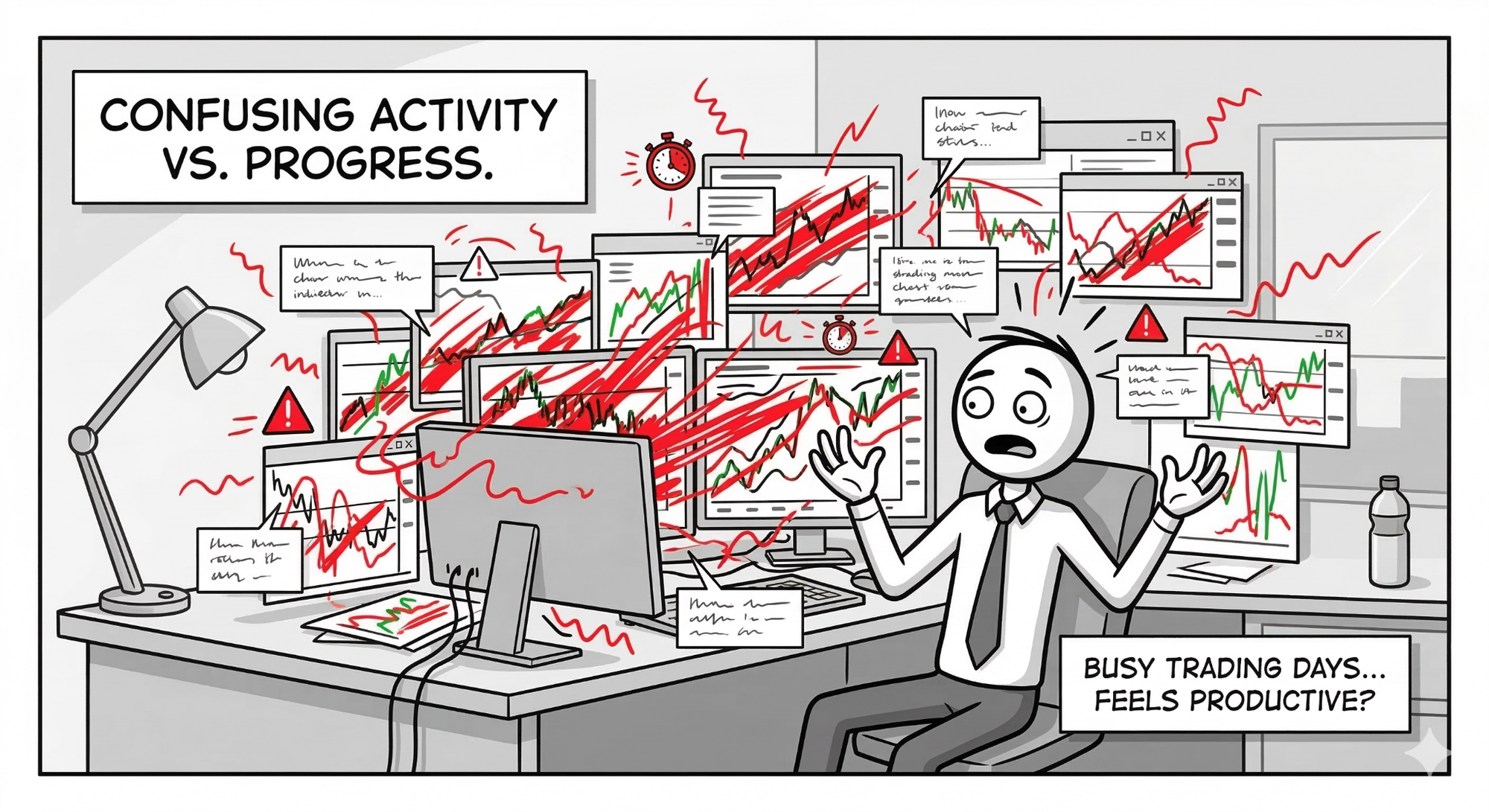
Busy trading days can feel productive. Charts open everywhere. Multiple trades taken. Constant movement on the screen. It creates the feeling that you are doing a lot.
But activity is not the same as improvement.
Many traders fill their day with small trades, constant chart checking, and reacting to every move. By the end of the day they feel exhausted, yet nothing meaningful has improved in their process.
Strong traders focus on decision quality, not activity. They wait for clear setups, follow their plan, and review their execution. Sometimes the most productive day is the one with fewer trades but better discipline.
When you measure progress by how well you follow your rules instead of how busy you were, trading becomes calmer and more consistent.
Better decisions create real growth.
Good traders don’t just trade. They keep learning how markets behave and how other disciplined traders think. If you enjoy thoughtful market insights and structured trading ideas, these newsletters are worth exploring.

Dark Cloud Cover

The Dark Cloud Cover is a two-candle bearish reversal pattern that appears at the end of an uptrend. It is the bearish counterpart to the Piercing Line. It begins with a strong green candle, followed by a red candle that gaps higher but then collapses to close deep within the body of the previous day’s green candle. It visualizes the moment "optimism" turns into "panic," as bulls fail to hold new highs.
🛠️ The Strategy Logic
Use these logical triggers to identify when an uptrend has hit a "ceiling" and a reversal is starting:
- IF: The second (red) candle closes below the 50% midpoint of the first (green) candle’s body...
- THEN: The pattern is valid. This "dark cloud" piercing through the midpoint proves that sellers have successfully reclaimed more than half of the previous day's gains, signaling a major loss of bullish momentum.
- THEN: The pattern is valid. This "dark cloud" piercing through the midpoint proves that sellers have successfully reclaimed more than half of the previous day's gains, signaling a major loss of bullish momentum.
- IF: The red candle "gaps up" above the previous day's high before the sell-off begins...
- THEN: The "Bull Trap" is confirmed. This gap represents the final "chase" by late buyers, who are then immediately trapped when the price reverses, creating a wave of forced liquidations.
- THEN: The "Bull Trap" is confirmed. This gap represents the final "chase" by late buyers, who are then immediately trapped when the price reverses, creating a wave of forced liquidations.
- IF: The Dark Cloud Cover forms near the Upper Keltner Channel or a major Resistance level...
- THEN: You have a "High-Conviction Short" setup. The technical resistance provides the "why," and the candlestick pattern provides the "when" for the reversal.
- THEN: You have a "High-Conviction Short" setup. The technical resistance provides the "why," and the candlestick pattern provides the "when" for the reversal.
- IF: The red candle completely "engulfs" the previous green candle (closes below the green open)...
- THEN: The pattern has upgraded to a Bearish Engulfing pattern. This is an even more aggressive signal, indicating that the bears have totally wiped out the previous day's progress.
- THEN: The pattern has upgraded to a Bearish Engulfing pattern. This is an even more aggressive signal, indicating that the bears have totally wiped out the previous day's progress.
- IF: The volume on the second (red) day is significantly higher than the first (green) day...
- THEN: The move is supported by "Distribution." High volume on the down day suggests that large institutions are offloading their positions, making the subsequent drop more likely to be sustained.
💡 Pro Tip
The "Midpoint" Check: Just like the Piercing Line, the 50% mark is the line in the sand. If the red candle fails to close below the midpoint of the green candle, it is considered a "weak" signal and the uptrend might still be intact. For the most reliable trades, wait for a third candle to break the low of the red candle; once that low is broken, the "Cloud" has officially burst, and the downtrend is likely to accelerate.

The Micro-Management Mistake
A trader I know sent me a message last month.
He had a solid Nasdaq long. Clean breakout. Risk defined. Target mapped. Everything about the setup was correct.
But he made one mistake.
He watched every single tick.
Level 2 open. 1-minute chart open. Trade ladder open. P&L flashing.
Every tiny pullback looked dangerous. Every red candle felt like the start of a reversal.
So he started managing the trade… constantly.
First adjustment: “Let me tighten the stop a bit.”
Second adjustment: “That pullback looks heavy.”
Third adjustment: “Maybe I should just lock the profit.”
He exited for +0.4R.
Thirty minutes later the market completed the move.
The original setup hit +3R almost perfectly.
Nothing was wrong with the trade.
The problem was proximity.
When you watch every tick, the market stops looking like structure and starts looking like chaos.
A normal pullback feels like a reversal. A small pause feels like weakness. A healthy retest feels like danger.
Your brain begins reacting to noise, not the plan.
MICRO-MANAGEMENT TURNS NORMAL MARKET MOVEMENT INTO PERCEIVED THREATS.
So traders do three things:
They cut winners early.
They move stops too tight.
They exit out of discomfort, not invalidation.
Ironically, the more closely you watch a trade, the worse your decision-making becomes.
Professional traders understand something powerful:
Execution and observation are two different jobs.
The trade is planned on structure — higher timeframe levels, risk zones, targets.
Once the trade is placed, the job is not to babysit every tick.
It’s to wait for one thing only:
INVALIDATION.
If the level breaks, the trade is wrong.
If it doesn’t, the trade is still alive.
That’s it.
Watching every fluctuation only creates fake reasons to exit.
The market moves in waves. Your edge lives in those waves.
But if you react to every ripple, you’ll never stay in the water long enough to catch the move.
The strongest traders don’t stare harder at their trades.
They trust the structure they planned.
Because the goal isn’t to control every tick.
It’s to stay in the trade long enough for your edge to actually play out.