Iran Blocks Hormuz
....................................................................................................................


Good morning,
The trading floor is waking up to a heavy mid-week session as the Middle East conflict continues to dictate the tape.
Equity futures are leaning red this Wednesday, with the S&P 500 (ES) and Dow (YM) both slipping 0.2%, while the Nasdaq (NQ) is down 0.3%.
This comes after a brutal Tuesday where major benchmarks shed nearly 1%.
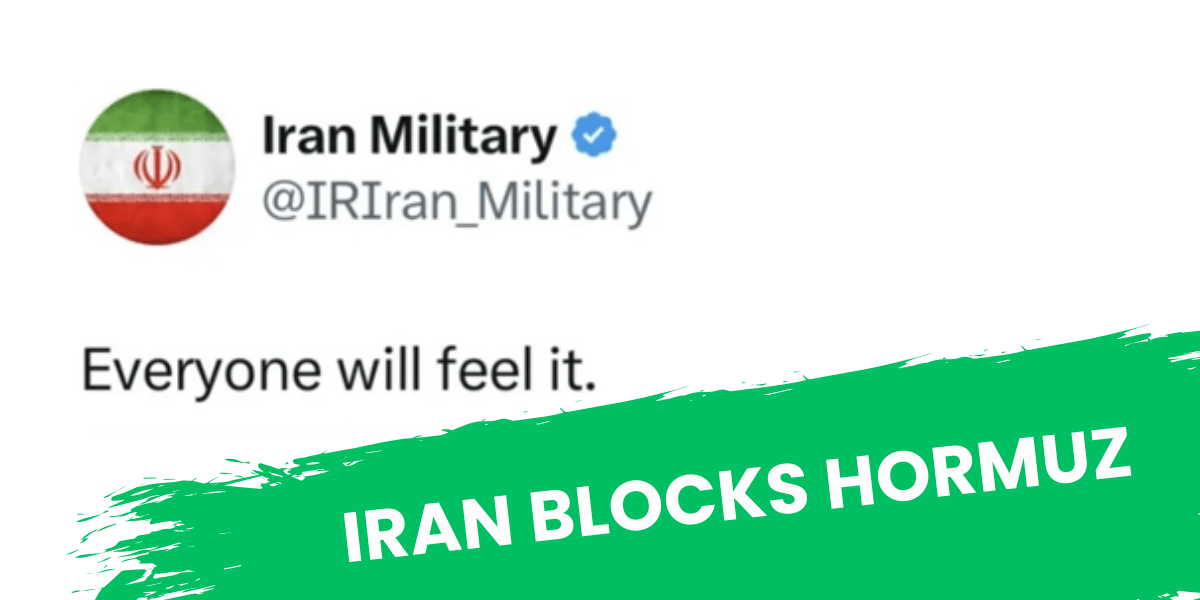
The dominant theme today is the Strait of Hormuz Standoff. Following the weekend strikes on Iran, the Revolutionary Guards have effectively closed the world’s most vital oil chokepoint. They’ve warned that any ship attempting to pass will be "set ablaze," and we've already seen reports of tankers being struck by missiles.
President Trump has fired back on Truth Social, ordering the U.S. Navy to prepare for tanker escorts and offering government-backed insurance to keep the energy flowing. Despite this, the market is panicked.
Brent crude has surged past $84 a barrel, and some analysts are already calling for $100 if the "chokehold" isn't broken soon. With gas prices at the pump already jumping, the inflation scare is officially back.
Beyond the geopolitics, the market is bracing for a labor market reality check with today's ADP private payrolls report. We’ve got the crucial updates to give you details of what is trending this morning.

🛢️ Markets React to War Shock
Oil, gold, and the S&P 500 made jarring moves after U.S. and Israeli strikes on Iran, and history shows volatility often lingers for weeks after global shocks.
🚢 Brent Nears $84 as Hormuz Risk Builds
Brent crude surged nearly 12% in two days — its biggest jump since 2020 — as tanker traffic stalled despite U.S. escort plans, fueling fears of a prolonged supply shock.
📉 Kospi Crashes 12% in Risk-Off Rout
South Korea’s Kospi plunged over 12%, its worst session in years, as investors dumped risk assets amid escalating Middle East tensions.
💾 Micron Drops 8% on Geopolitical Jitters
Micron slid nearly 8% during the broader selloff, though analysts still see up to 45% upside as tightening memory supply could fuel the next rally.
🪙 40% of Altcoins Near Cycle Lows
Nearly 40% of altcoins are hovering close to all-time lows as weak liquidity and fading risk appetite favor Bitcoin and Ethereum instead.
💵 Dollar Hits Three-Month High
The U.S. dollar rallied as energy prices surged, pressuring the euro and reinforcing safe-haven flows across global markets.
🌏 Asia Stocks Slide on Energy Shock Fears
Brent is up more than 12% this week, Seoul has erased double-digit gains, and markets fear rising oil could delay rate cuts.

Stop Negotiating With the Market
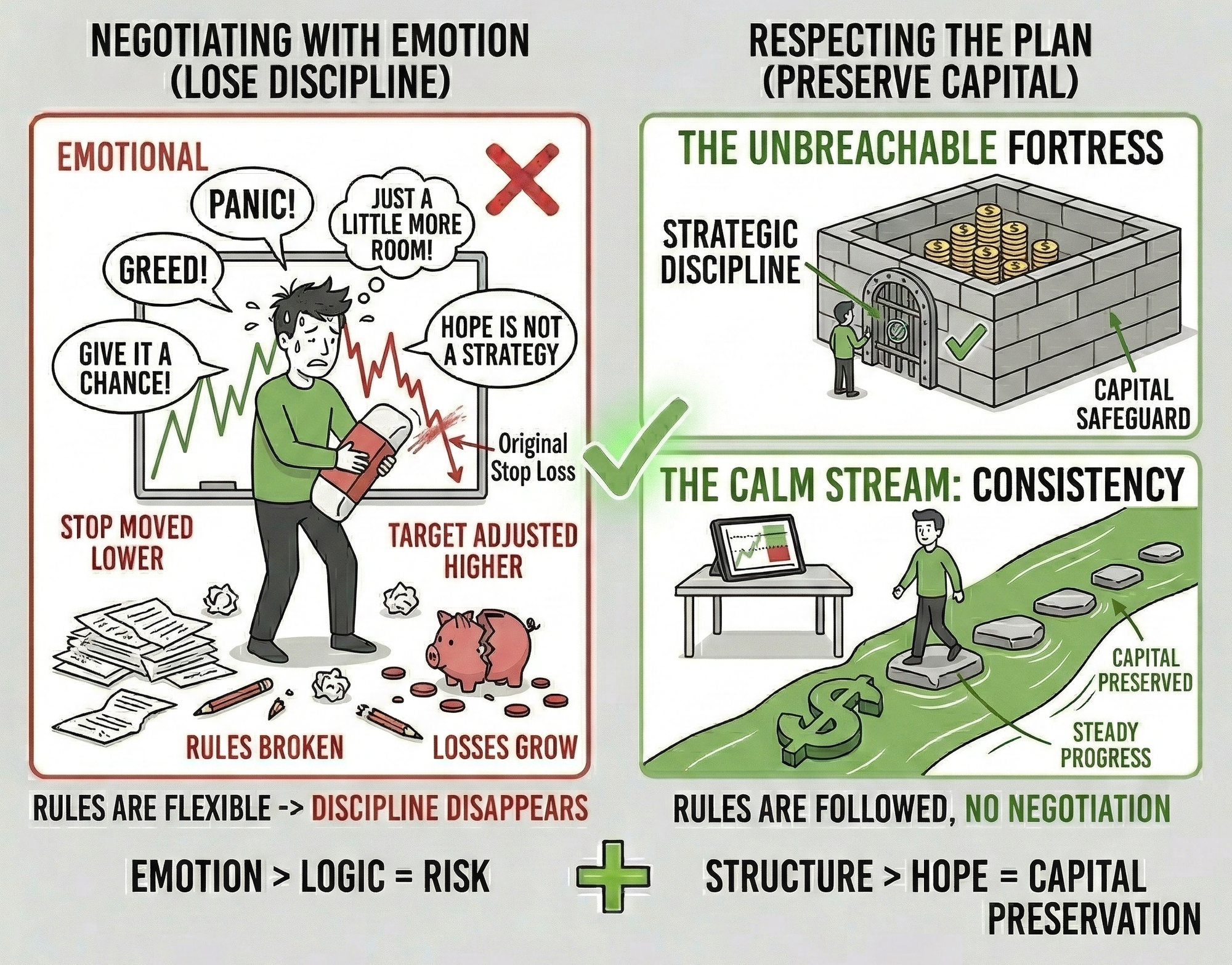
You set your stop loss. You set your target. The trade makes sense. Then price moves against you and suddenly you want to “give it a little more room.”
That’s not strategy. That’s negotiation.
The market does not care what you hoped would happen. It does not reward you for holding longer. When you move stops or adjust targets out of emotion, you break your own rules. And once rules become flexible, discipline disappears.
Strong traders decide everything before they enter. Risk is defined. Exit is defined. If the stop gets hit, it gets hit. No debate. No emotional edits.
When you stop negotiating, trading becomes cleaner. Losses stay controlled. Wins follow structure. Most importantly, you can actually measure your performance because the rules stay the same.
Consistency builds trust in yourself.
If you want trading guidance that reinforces discipline and helps you follow your rules without emotional changes mid-trade, these newsletters help. They focus on structured thinking and steady improvement.

Relative Vigor Index (RVI)
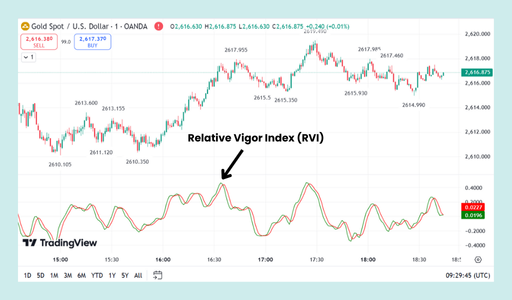
The Relative Vigor Index is a momentum oscillator based on the belief that in a bullish market, the closing price will generally be higher than the opening price, and in a bearish market, the close will be lower than the open.
By comparing the "energy" (vigor) of the price move to its daily range, it identifies when a trend is gaining strength or losing its spark.
🛠️ The Strategy Logic
Use these logical triggers to identify high-conviction momentum shifts and potential trend reversals:
- IF: The RVI line (green) crosses above the Signal line (red)...
- THEN: A bullish momentum shift is occurring. This suggests the market is consistently closing in the upper half of its daily range, signaling a high-probability "Buy" entry.
- THEN: A bullish momentum shift is occurring. This suggests the market is consistently closing in the upper half of its daily range, signaling a high-probability "Buy" entry.
- IF: The RVI line crosses below the Signal line...
- THEN: Bearish momentum is taking over. The market is struggling to hold its intraday gains and is closing near the lows of its range, signaling a "Sell" or profit-taking exit.
- THEN: Bearish momentum is taking over. The market is struggling to hold its intraday gains and is closing near the lows of its range, signaling a "Sell" or profit-taking exit.
- IF: Price makes a new high, but the RVI makes a lower high (Bearish Divergence)...
- THEN: The uptrend is "exhausted." Even though prices are rising, the "vigor" or conviction behind the move is fading. This is a major warning that a price drop is coming.
- THEN: The uptrend is "exhausted." Even though prices are rising, the "vigor" or conviction behind the move is fading. This is a major warning that a price drop is coming.
- IF: The RVI shows a Bullish Divergence (Price makes a lower low, but RVI makes a higher low)...
- THEN: Sellers are losing their grip. The price is falling, but it is closing higher within its daily range than before, suggesting a V-shaped recovery is building.
- THEN: Sellers are losing their grip. The price is falling, but it is closing higher within its daily range than before, suggesting a V-shaped recovery is building.
- IF: The RVI line is flat and oscillating tightly around the zero line...
- THEN: The market is in a "Congestion" phase. Vigor is low and there is no clear trend. Avoid crossover signals here as they are prone to "whipsaws."
💡 Pro Tip
The "Trend Confirmation" Filter: The RVI is most powerful when used as a Trend Validator. If your Keltner Channels show a breakout and your EMA is sloping upward, look for an RVI crossover above the zero line. A crossover that happens above zero during an uptrend is much stronger than one that happens below zero, as it confirms the trend already has established "vigor."

The Identity Crisis Trade

This one is subtle.
You’re in a trade… but you’re not really trading the setup.
You’re trading your reputation.
Your self-image.
Your need to feel competent.
And that changes everything.
WHEN TRADING BECOMES ABOUT IDENTITY, OBJECTIVITY DIES.
You don’t want to lose because it hurts your P&L. You don’t want to lose because it challenges who you believe you are.
So you hold losers longer. You defend bad entries.
You ignore invalidation levels.
Why?
Because closing the trade feels like admitting, “I’m not as good as I thought.”
That’s the Identity Crisis Trade.
You’re no longer asking: “Is this setup valid?”
You’re asking: “Am I still a good trader?”
Those are two completely different questions.
Professionals detach identity from outcome.
A losing trade does not mean:
- You’re undisciplined.
- Your system is broken.
- You’re falling behind.
- You don’t belong here.
It means one thing:
The probability didn’t play out this time.
That’s it.
But when ego enters the trade, logic exits.
- You start revenge trading to “prove” something.
- You size up to reclaim confidence.
- You avoid journaling because the mistake feels personal.
Let’s get real:
YOU ARE NOT YOUR LAST TRADE.
Your identity is built on process.
- On rule-following.
- On risk control.
- On consistency over time.
Not on a single outcome.
Here’s the professional shift:
Before entering, ask: “Would I take this trade if nobody ever saw the result?”
If the answer is no — it’s ego.
Trade the setup.
Not the story you want to tell about yourself.
Because the strongest traders don’t need to prove they’re good.
They just execute.
And let the stats speak.