
Ground War Oil Alert
....................................................................................................................



Good morning.
The stock market is trying to stage a comeback, but President Trump just changed the entire script.
We’re opening this Easter-shortened week with a bit of a relief bounce—Nasdaq and S&P futures are up 0.4%—but don't let the green fool you. After five straight weeks of losses and the Dow officially sliding into correction territory, the vibe is less "recovery" and more "bracing for impact."
Trump isn't just looking for a ceasefire anymore; he’s looking for the deed. Over the weekend, he told the Financial Times his preference is to simply "take the oil" and control Iran’s energy industry indefinitely. While he claims Tehran has already folded on most of his demands, the oil pits aren't buying the "peace" story yet. Brent crude just spiked 3% to $108, and WTI is back above the $100 mark. It’s a bold, "TACO-style" playbook that has everyone wondering if we're looking at a resolution or a permanent occupation.
The "Magnificent Seven" aren't looking so magnificent lately. Big Tech just watched $850 billion in market cap vanish in a single week. Meta and Google are leading the retreat after losing a massive lawsuit over social media addiction, proving that even AI darlings aren't immune to the legal hammer.
This week is a sprint to the finish. We’ve got a massive pile of jobs data—JOLTS, ADP, and the March Payrolls report—all packed into a week that ends early for Good Friday. Investors are desperate for a sign that the labor market isn't cooling as fast as the Middle East is heating up.
It’s a "watch the headlines" Monday.
With Nike earnings on deck to check the pulse of the consumer, we're about to find out if this bounce has legs or if the "take the oil" rhetoric is going to set the market on fire again.

📊 Stock Futures Inch Higher to Start Holiday-Shortened Week
U.S. equity futures edged up early Monday, with Dow (+0.2%) and Nasdaq (+0.29%) contracts recovering slightly from a brutal Friday sell-off. The bounce comes as investors navigate the fifth week of conflict, following a 1.6% drop in the S&P 500 that marked its fifth straight weekly decline and a seven-month low.
🛢️ Oil Climbs Over $107 as Iran Issues Ground War Warning
Brent crude rose 2.47% to $107.92 after Tehran’s parliament speaker warned that Iranian forces are "waiting" for U.S. troops. Despite President Trump’s claims that "talks are ongoing," the rhetoric has overshadowed the extension of his ultimatum to reopen the Strait of Hormuz.
🥇 Gold Reclaims $4,500 Level as Dip-Buyers Step In
Bullion rose 1.3% to trade above $4,500 an ounce, extending its first weekly gain since the war began. Investors are increasingly using gold as a resilient hedge against war-driven inflation, even as expectations for central bank interest-rate cuts continue to fade.
📉 Government Bonds Rally Globally on Growth Fears
Sovereign debt prices advanced across the U.S., Japan, and Australia as investors pivoted back to bonds on fears of a global economic slowdown. Speculation is mounting that a protracted fuel shortage could derail growth, reviving the "haven appeal" of government debt.
🌏 Asia Markets Plunge as War Enters Fifth Week
South Korea’s Kospi led regional declines with a nearly 3% drop, while Japan’s Nikkei fell 2.79% on Monday. Sentiment was further dampened by a Bank of Japan summary suggesting that soaring oil prices might force an accelerated timeline for interest rate hikes.
📊 Graphics Show the Scale of Middle East Market Chaos
New data visualizations illustrate the "dizzying" impact of the Iran war on global finance. Key charts highlight the decoupling of traditional asset correlations as surging energy costs continue to send stocks and bonds into a simultaneous tailspin.
💎 Ethereum Risks 45% Crash as "Bull Trap" Emerges
ETH is flashing technical patterns similar to those that preceded historic 40%+ collapses, according to new market analysis. If the "bull trap" is confirmed, Ethereum could face a fresh breakdown toward the $1,200 level amid the broader macro downturn.

Winning Streaks Can Be Dangerous
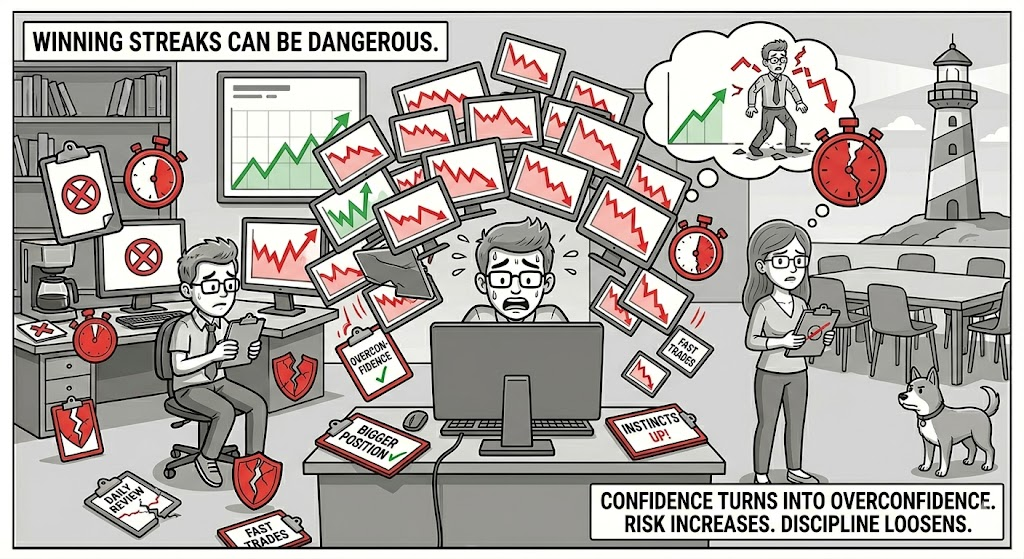
A few wins in a row… and everything feels easy.
You start trusting your instincts more. You increase your position size. You take trades faster. It feels like you’ve figured it out.
That’s where the risk builds.
Confidence turns into overconfidence. Risk quietly increases. Discipline loosens. When the inevitable losing trade comes, it hits harder because more is on the line.
What looked like progress turns into a sharp drawdown.
Strong traders stay steady during winning streaks. They keep their position sizes consistent. They follow the same rules that got them the wins in the first place. They understand that a streak does not change their edge.
When you manage confidence properly, your results stay stable. You protect your gains instead of giving them back.
Control matters most when things are going well.
Consistency protects profits.
Some traders like exploring how others think about markets and manage risk.
If that’s you, you can check out a few market reads here:

Tweezer Top
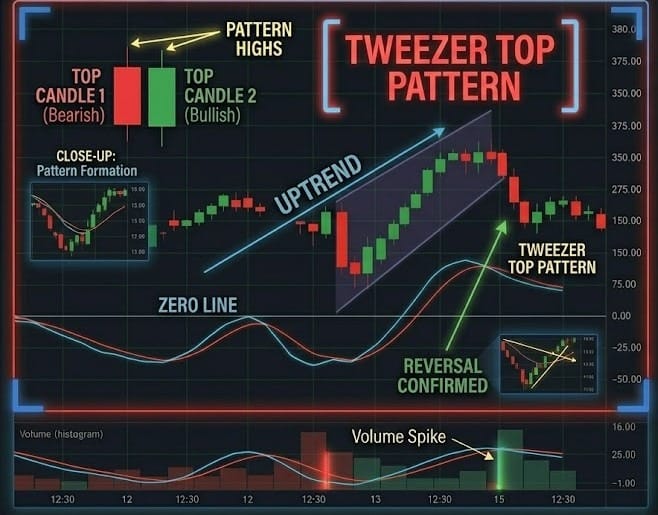
A Tweezer Top is a two-candle bearish reversal pattern that appearing at the end of an uptrend. It is the exact opposite of the Tweezer Bottom. It consists of two or more candlesticks with matching (or very near-matching) highs.
Usually, the first candle is bullish and the second is bearish. It visualizes a "Ceiling of Resistance"—a specific price point where the bulls tried to break through twice and were rejected both times, signaling that the upward momentum has hit a hard limit.
🛠️ The Strategy Logic
Use these logical triggers to identify when a rally has stalled and a reversal is imminent:
- IF: Two consecutive candles have identical (or near-identical) highs after a steady advance...
- THEN: The pattern is valid. This indicates that the buyers have lost the power to create a "Higher High." The market has found a price level where supply completely overwhelms demand.
- IF: The Tweezer Top forms at a major horizontal resistance level or the Upper Keltner Channel...
- THEN: You have a "High-Conviction Reversal." The structural ceiling provides the technical "Why," and the Tweezer provides the visual "When" to exit longs or enter shorts.
- IF: The second candle of the Tweezer is a Shooting Star or a Gravestone Doji...
- THEN: The signal is significantly more potent. Not only did the price stop at the previous high, but it was violently rejected, leaving a long upper wick that "traps" the late buyers.
- IF: The next candle closes below the lows of the Tweezer candles...
- THEN: The bearish reversal is confirmed. This is your "Trigger" to execute the trade. It proves that the "ceiling" held and the bears are now in control of the short-term direction.
- IF: The Volume Oscillator shows a spike on the second (bearish) candle...
- THEN: Institutional "Distribution" is occurring. High volume at a matching high suggests that big players are using the liquidity of the rally to exit their positions.
💡 Pro Tip
The "Double-Tap" Secret: A Tweezer Top is essentially a "Double Top" pattern compressed into a very short timeframe. The most powerful Tweezer Tops are those where the matching highs are also the daily or weekly highs.
If you see this pattern on a 4-hour or Daily chart, it often marks a major turning point for the trend. Always place your stop-loss just 2–3 ticks above the matching highs. If the price breaks that level, the "ceiling" has been shattered and the uptrend is likely to accelerate.

You Took Profit… Then Lost Control
The trade starts well.
Price moves in your favor.
You feel good. In control.
So you do the “smart” thing.
You take partial profits.
Lock something in.
Reduce risk. Secure the win.
Feels professional.
Then price keeps moving.
Further. Faster. Cleaner.
Now you’re watching the rest of the position run without you.
And something shifts.
SATISFACTION TURNS INTO REGRET.
“That could’ve been bigger.”
“Why did I cut so much?”
“I left money on the table.”
Now you’re no longer objective.
You’re emotional.
So when price pulls back… you react.
You add back in.
You re-enter late.
You chase the move you already participated in.

THAT’S WHERE THE DAMAGE STARTS.
Because now this isn’t the original trade.
This is a revenge trade disguised as opportunity.
Your entry is worse.
Your risk is unclear.
Your conviction is emotional.
And when it reverses?
You lose on the re-entry.
You dilute the original win.
Sometimes you erase it completely.
All because you couldn’t accept one thing:
YOU DON’T NEED TO CAPTURE THE ENTIRE MOVE.
Partial profits are not the problem.
EMOTIONAL REACTION AFTER THEM IS.
Professionals scale out with a plan.
Predefined levels.
Predefined percentages.
No second-guessing mid-trade.
And most importantly…
They don’t re-enter just because price kept going.
Because the market will always offer more moves.
But not every move is yours to take.
Let’s be clear:
You executed a good trade.
You followed risk management.
You locked profit.
That’s success.
Turning it into a loss because of regret?
That’s a discipline failure.
So here’s the rule:
If you take partials, accept the outcome fully.
No chasing.
No emotional re-entries.
No “I deserve more” trades.
Because the goal isn’t to catch every pip.
It’s to execute your plan — and keep what you earn.