Gold Wipes Gains
....................................................................................................................



Good morning.
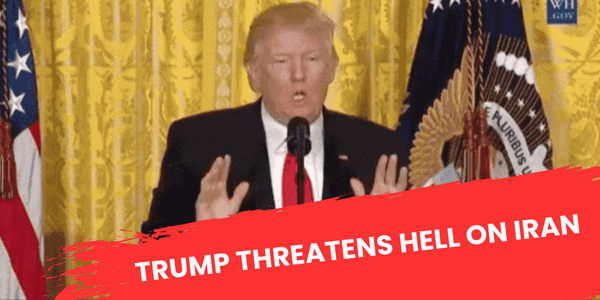
If you were hoping for a smooth start to the week, the market has other plans. We’re opening with a messy gap down as the tension between President Trump and Tehran finally boiled over.
Futures are sliding—the Nasdaq is taking the biggest hit, down 0.9%, while the S&P 500 has dropped 0.8%. Investors are clearly scrambling to figure out what a direct face-off means for their portfolios.
The clock officially ran out over the weekend. After Trump warned he’d pull the trigger on Iran’s energy grid if the Strait of Hormuz stayed closed, Tehran responded with fresh attacks this morning.
We’re now in a full-blown supply crunch. Brent crude has jumped past $113, and WTI is back over $100. It’s the kind of price spike that makes everything from gas to groceries more expensive, and the market is feeling the heat.
The Fed is stuck in a tough spot. With energy prices going through the roof, any hope that inflation would just fade away is pretty much gone. It’s a "safety first" kind of Monday, and most traders are bracing for a rough ride as the global economy takes this hit.
Stay sharp and keep your eyes on the news - things are moving fast and the old playbook might not work today.

📉 U.S. Futures Sink as Iran Strikes Back
Dow, S&P 500, and Nasdaq futures tumbled Monday as Iran launched retaliatory strikes following a warning from President Trump. The tech-heavy Nasdaq led the retreat, falling 0.9% as the market entered its fifth consecutive week of downward pressure.
🥇 Gold Erases 2026 Gains in Brutal Flush
Gold futures plunged roughly 4% Sunday night to $4,372 per ounce, extending last week’s 10% decline—the metal's worst weekly performance since 1983. Investors are fleeing the previous momentum trade as inflation worries and Middle East escalations mount.
🛢️ Oil Rises on Trump’s 48-Hour Hormuz Ultimatum
Brent crude climbed above $113 a barrel after President Trump issued a two-day deadline for Iran to reopen the Strait of Hormuz or face infrastructure bombings. Tehran has countered with threats to attack key Middle Eastern energy sites, keeping prices at mid-2022 highs.
🚗 Tesla Slips on $25B "Terafab" Skepticism
Tesla shares dropped over 1% in overnight trading after Elon Musk shared details of a massive $25 billion chip facility. Analysts warn the project's success is tethered to advanced manufacturing tech controlled exclusively by TSMC, Samsung, and Intel.
🌏 Asia Shares Slide as Bond Yields Hit 8-Month Highs
Pan-Asian markets retreated Monday, led by the Nikkei, as escalating threats between the U.S. and Iran dampened risk appetite. The sell-off was compounded by U.S. bond yields climbing to eight-month peaks amid expectations of "weeks" of further fighting.
💵 Dollar Gains on Safe-Haven Demand
The dollar index advanced to 99.62 as investors sought safety from the widening Middle East conflict. The greenback’s rise pressured the Australian dollar and the Japanese yen, prompting Japan’s currency diplomat to warn of potential intervention to curb volatility.
₿ Bitcoin Faces 50% Crash Risk on Stock Correlation
Bitcoin is under threat of a massive correction as its 20-week rolling correlation with the S&P 500 turns positive. Analysts warn that this alignment with equities has historically preceded major price collapses, potentially putting a 50% drop on the table.

Trading Is a Skill, Not a Talent
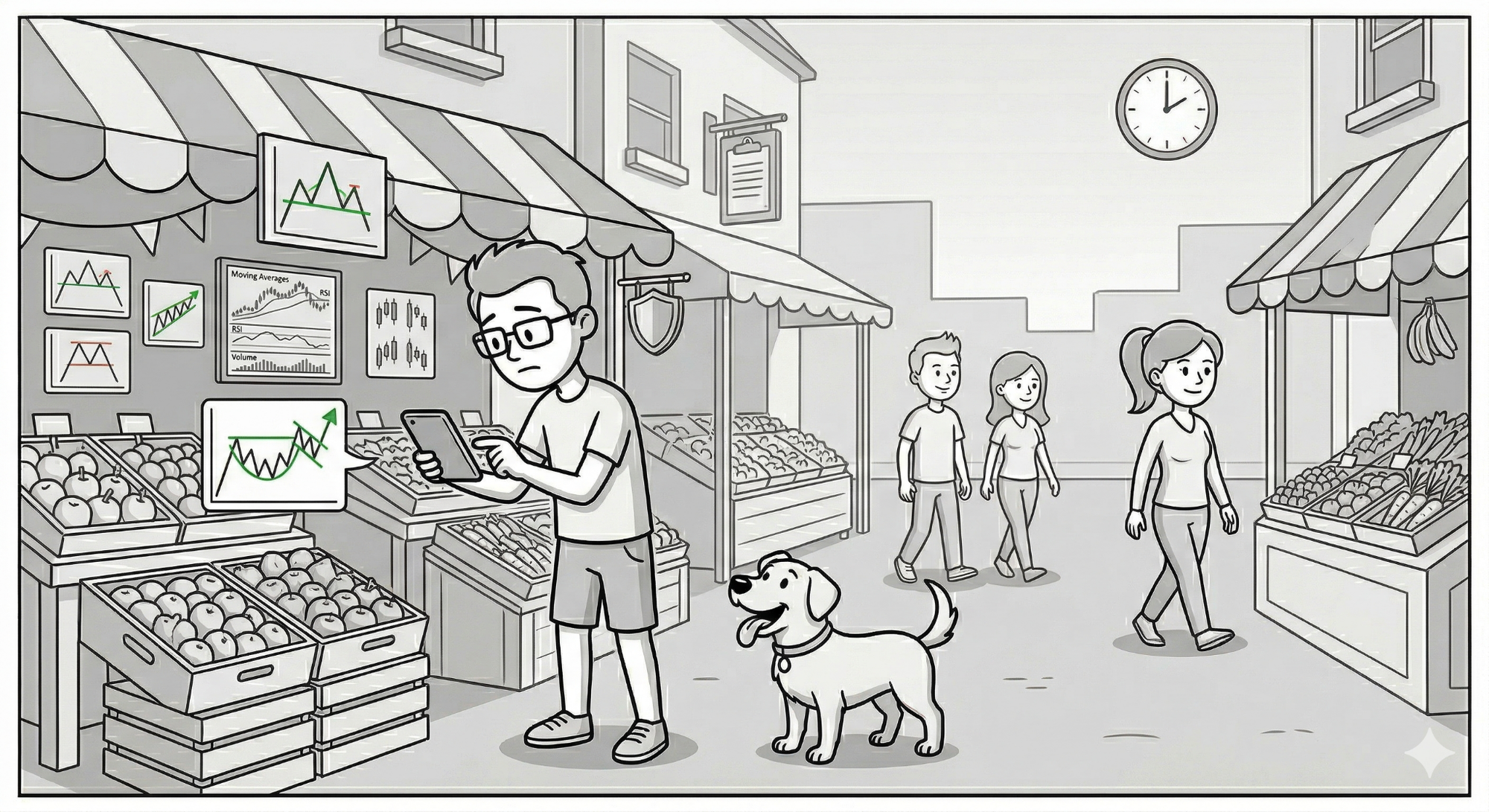
Many traders expect things to just “click.” They rely on instinct, gut feeling, or hope that experience alone will make them better over time.
But trading doesn’t work like that.
Without structure, practice turns into repetition without improvement. The same mistakes repeat. The same confusion stays. It starts to feel like you’re trying, but not progressing.
Strong traders treat trading like a skill. They study setups. They follow rules. They review their decisions. They focus on improving specific parts of their process over time.
Skill comes from deliberate practice, not random experience.
When you approach trading this way, progress becomes clearer. You know what you’re working on. You see where you’re improving. Confidence builds because it’s based on development, not guesswork.
Structure builds skill.
Some traders like learning from different market perspectives and ideas.
If that’s you, you can explore a few newsletters here:

Klinger Oscillator
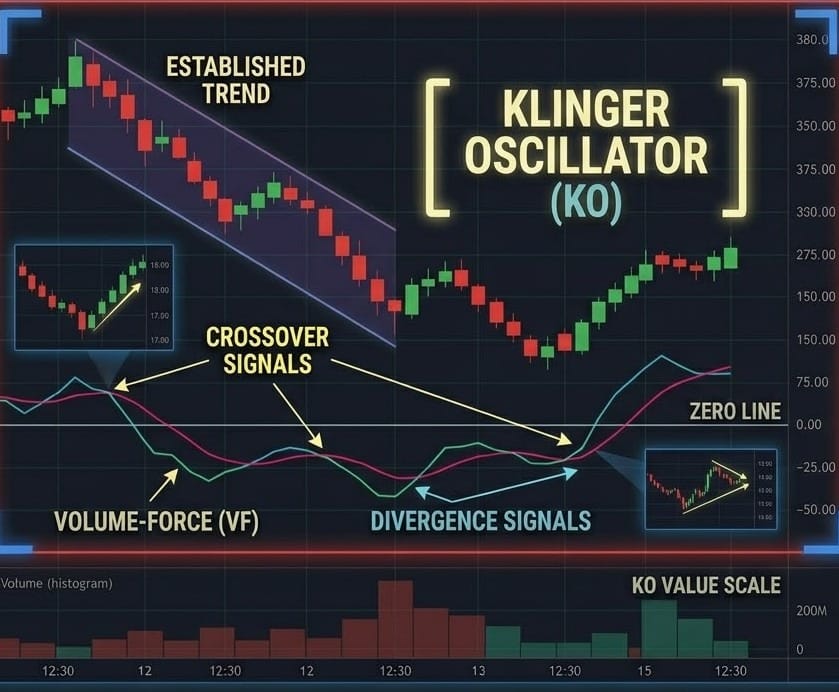
Developed by Stephen Klinger, this volume-based oscillator is designed to predict long-term trends while remaining sensitive enough to catch short-term fluctuations. It compares the volume flowing through an asset to its price movement and then converts that data into two lines: the Klinger Oscillator (KO) and the Signal Line. It is essentially the "Force Index" on steroids.
🛠️ The Strategy Logic
Use these logical triggers to identify the "Volume Force" behind price moves and spot hidden accumulation:
- IF: The Klinger Oscillator line (KO) crosses above the Signal Line while below the Zero Line...
- THEN: A bullish reversal is likely beginning. This indicates that while the price is still "low," volume is starting to trend upward, signaling institutional accumulation.
- THEN: A bullish reversal is likely beginning. This indicates that while the price is still "low," volume is starting to trend upward, signaling institutional accumulation.
- IF: The KO line crosses below the Signal Line while above the Zero Line...
- THEN: A bearish reversal or "distribution" is occurring. This suggests that "smart money" is selling into the strength of the rally, and the price is likely to follow downward soon.
- THEN: A bearish reversal or "distribution" is occurring. This suggests that "smart money" is selling into the strength of the rally, and the price is likely to follow downward soon.
- IF: The price makes a new high, but the Klinger Oscillator makes a lower high (Bearish Divergence)...
- THEN: The uptrend is "hollow." The price is rising, but the volume-force supporting that rise is dying out. This is one of the most reliable signals for a major trend collapse.
- THEN: The uptrend is "hollow." The price is rising, but the volume-force supporting that rise is dying out. This is one of the most reliable signals for a major trend collapse.
- IF: The KO line stays consistently above the Zero Line during a price rally...
- THEN: The trend is "High-Conviction." This confirms that the uptrend is being fueled by heavy volume, making it a "Buy the Dip" environment whenever the KO touches the Signal Line.
- THEN: The trend is "High-Conviction." This confirms that the uptrend is being fueled by heavy volume, making it a "Buy the Dip" environment whenever the KO touches the Signal Line.
- IF: The KO line shows a Bullish Divergence (Price makes a lower low, but KO makes a higher low)...
- THEN: The selling pressure is exhausted. Even though the price is hitting new lows, the volume-force is already turning upward, signaling a massive V-shaped recovery is imminent.
💡 Pro Tip
The "Trend Filter" Rule: The Klinger Oscillator is very sensitive and can produce "whipsaws" (false signals) if used alone.
To fix this, pair it with a 100-period Exponential Moving Average (EMA). Only take Bullish crossovers when the price is above the 100 EMA, and only take Bearish crossovers when the price is below the 100 EMA.
This ensures you are only trading in the direction of the "Big Tide" while using the Klinger to time your entry.

The “I’ll Make It Back Tomorrow” Lie

A trader breaks a rule.
Maybe it was an oversized position.
Maybe it was a revenge trade.
Maybe it was a setup that never really qualified.
The trade loses.
And instead of stopping… he says something dangerous:
“I’ll make it back tomorrow.”
Sounds harmless. Even optimistic.
But underneath?
IT’S NOT HOPE. IT’S AVOIDANCE.
That statement does one thing:
It removes accountability from today.
The mistake doesn’t feel urgent anymore.
The loss doesn’t feel final.
The discipline breach gets postponed.
So the mind relaxes.
No need to reflect.
No need to correct.
No need to confront what actually went wrong.
Because tomorrow becomes the solution.
FUTURE PROFITS BECOME AN EXCUSE FOR PRESENT MISTAKES.
That’s the trap.
Because tomorrow’s trades have nothing to do with today’s errors.
Different conditions.
Different setups.
Different probabilities.
You can’t “recover” from bad discipline with good outcomes later.
That’s not trading.
That’s gambling on redemption.
Professionals think differently.
They treat each day as complete.
If a rule is broken today, it gets addressed today.
Journal it.
Own it.
Fix it.
Because every time you push accountability forward, the habit gets stronger.
And habits are what shape your equity curve.
Let’s be clear:
Losses are part of the game.
Mistakes are part of the process.
But unexamined mistakes are where damage compounds.
The goal isn’t to win it back tomorrow.
The goal is to trade correctly today.
Because the trader who protects their process daily doesn’t need to chase recovery later.
And the market doesn’t reward intentions.
It rewards discipline — in the present moment.