Big Tech $500B Wiped Out
....................................................................................................................


Good morning.
After a week that felt like one long "risk-off" nightmare, we’re seeing a tiny bit of green this Friday morning.
Futures for the S&P 500 and Nasdaq are up about 0.3%, mostly because President Trump decided to push his "energy grid strike" deadline back to April 6th.
It’s not exactly a peace treaty, but in a week where the Nasdaq fell into a correction, we'll take any breather we can get.
Oil is finally losing its grip on the steering wheel. Brent crude, which was threatening to run away to $130, has cooled off to around $105 after Trump hinted that talks are "going very well." WTI is following suit, sliding back toward $93.
It’s a massive relief for our wallets, but don't get too comfortable—Tehran is already calling the U.S. peace plan "one-sided," so this "cooldown" is currently held together by little more than hope and a 10-day extension.
The "Jensen Jump" is the only thing keeping tech alive. While the macro headlines are all about missiles and mandates, Nvidia’s GTC conference is the lone bright spot.
Investors are desperately clinging to the AI story to distract themselves from the fact that the Strait of Hormuz is still effectively a ghost town for tankers.
It’s a "stay light on your feet" finish to the week.
We’re bouncing for now, but with 10,000 more U.S. troops potentially heading to the region, the peace talk vibe is still feeling pretty fragile.

📉 $500B Wiped From Big Tech as Nasdaq Enters Correction
The S&P 500 suffered its worst session in two months while the Nasdaq officially fell 11% from recent highs. Investors are fleeing "Magnificent Seven" names like NVDA and MSFT, signaling that even AI dominance is no longer viewed as a safe haven amid escalating Middle East tensions.
🛢️ Oil Drives Higher Toward $110 as Trump Extends DeadlineBrent crude surged toward the $110 mark after President Trump pushed back the deadline for strikes on Iranian energy infrastructure by 10 days. The delay has prolonged market anxiety, with traders now bracing for the conflict to choke the Strait of Hormuz well into April.
📉 'Magnificent 7' Face Shocking Slump as MSFT Drops 30%
Every member of the elite "Mag 7" cohort has now entered double-digit drawdown territory from 52-week highs. Microsoft is leading the retreat, down over 30% as investors weigh aggressive capital expenditures against a backdrop of slowing sales growth.
⚖️ Tech Sinks as Meta and Google Held Liable for Addiction
A landmark Los Angeles jury verdict has ordered Alphabet and Meta to pay $3 million in damages for platform-related harm to a minor. The ruling sets a massive legal precedent, opening the door for a wave of liability lawsuits against social media giants.
🌏 Asian Stocks Pare Losses as War Deadlines Shift
Regional markets in Asia stabilized slightly on Friday as a temporary dip in oil prices provided a breather. However, the Nikkei and Hang Seng remain under pressure as the global energy crunch continues to cloud the long-term economic outlook.
🚀 Musk Targets 30% Retail Allocation for SpaceX IPO
In a move to democratize one of the most anticipated market debuts in history, Elon Musk plans to offer 30% of SpaceX shares to retail investors. The allocation is significantly higher than the standard 5-10%, aiming to reward loyal individual fans of the aerospace firm.
₿ Bitcoin Crashes to $69K Amid "Extreme Fear" Sentiment
Crypto markets turned deep red as Bitcoin slipped below $70,000, triggering $273 million in liquidations. The Fear & Greed Index has plummeted to a score of 9 (Extreme Fear) as BTC’s growing correlation with a struggling stock market weighs on the entire sector.

Chasing the Move Usually Costs You
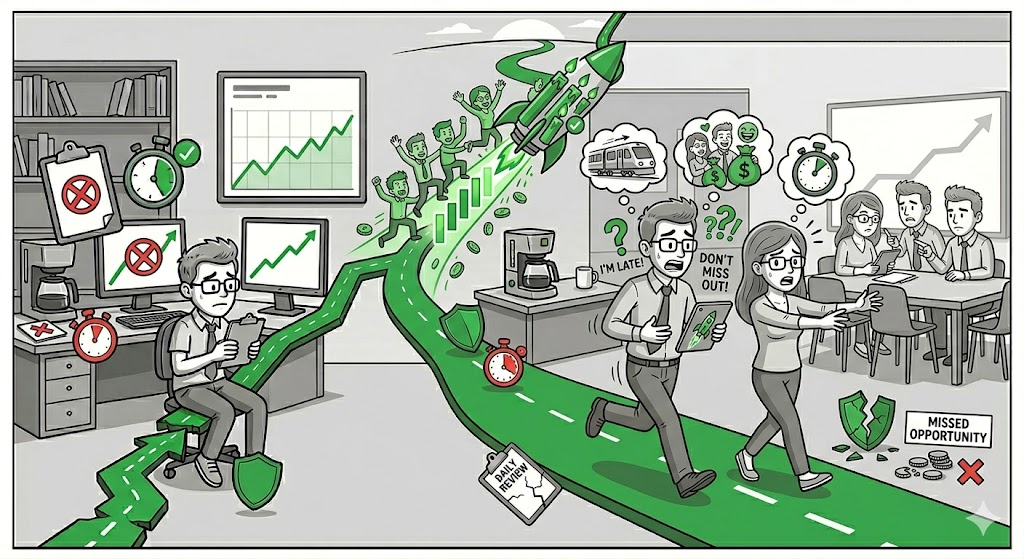
You see the move already happening. Price is running. Everyone is talking about it. It feels like you’re late… but not too late.
So you enter.
Not because your setup is there, but because you don’t want to miss out.
That’s where the problem begins.
Late entries come with poor risk. Stops are wider. Upside is smaller. You’re buying into excitement, not structure. When the move slows or pulls back, you’re the one holding the worst position.
In fast markets, this happens quickly. What looks like opportunity turns into frustration just as fast.
Strong traders accept that they will miss moves. They wait for their levels. They enter when the risk makes sense, not when the crowd is loud.
When you stop chasing, your trades become cleaner. You focus on timing, not emotion. You protect your capital instead of reacting to noise.
Patience keeps you in the game.
Some traders like seeing how others break down market moves and trends from different angles.
If that’s you, you can explore a few market reads here:

Pring's Know Sure Thing (KST)
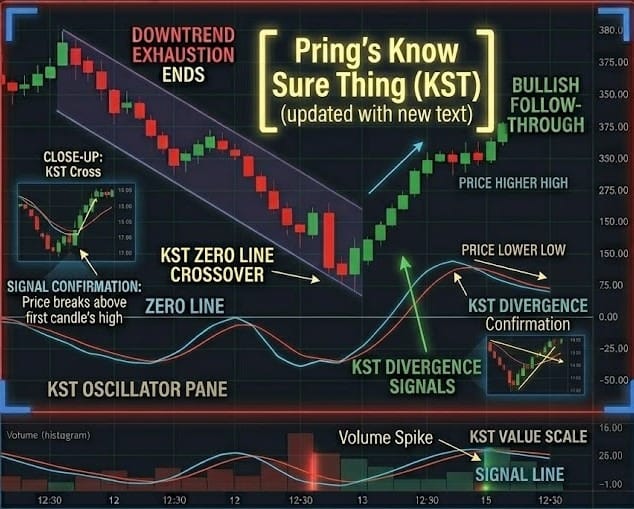
Developed by Martin Pring, the KST is a "summed" momentum oscillator. Unlike the RSI or MACD which focus on a single timeframe, the KST combines four different timeframes of Price Rate of Change (ROC) into one smoothed indicator. Its goal is to identify the "primary" trend by filtering out the daily noise that often traps shorter-term traders.
🛠️ The Strategy Logic
Use these logical triggers to identify major trend shifts and find high-conviction entry points:
- IF: The KST line (solid) crosses above the Signal Line (dotted) while both are below the Zero Line...
- THEN: A major bullish reversal is beginning. Because the KST is "weighted" toward longer timeframes, this crossover suggests that the long-term momentum has finally turned upward.
- THEN: A major bullish reversal is beginning. Because the KST is "weighted" toward longer timeframes, this crossover suggests that the long-term momentum has finally turned upward.
- IF: The KST line crosses below the Signal Line while in overbought territory (high above Zero)...
- THEN: A cyclical peak has been reached. This is a high-probability signal to exit long positions or tighten your stop-loss, as the "summed" momentum of all four timeframes is exhausting.
- THEN: A cyclical peak has been reached. This is a high-probability signal to exit long positions or tighten your stop-loss, as the "summed" momentum of all four timeframes is exhausting.
- IF: The KST line crosses the Zero Line from below...
- THEN: The "Primary Trend" has officially flipped to bullish. This is the "Know Sure Thing" confirmation that the bulls are now in control across multiple time horizons (short, medium, and long-term).
- THEN: The "Primary Trend" has officially flipped to bullish. This is the "Know Sure Thing" confirmation that the bulls are now in control across multiple time horizons (short, medium, and long-term).
- IF: Price makes a new high, but the KST makes a lower high (Bearish Divergence)...
- THEN: The rally is "failing internally." Even if the price looks strong, the underlying momentum across the four timeframes is decoupling. Expect a significant trend correction soon.
- THEN: The rally is "failing internally." Even if the price looks strong, the underlying momentum across the four timeframes is decoupling. Expect a significant trend correction soon.
- IF: The KST line is sloping upward while the price is in a sideways consolidation...
- THEN: You are seeing "Hidden Accumulation." The oscillator is "pre-heating" for a breakout. This often precedes a violent move to the upside once the horizontal resistance breaks.
💡 Pro Tip
The "Multi-Timeframe" Secret: Because the KST is a "momentum of momentums," it is much slower than a standard MACD. To get the best results, never trade a KST crossover against the 200-day Moving Average. If the price is below the 200-day MA, ignore bullish KST crossovers—they are likely just "relief bounces."
The "Holy Grail" setup is a bullish KST crossover that happens just as the price breaks above the 200-day MA, signaling the start of a multi-month bull run.

Chasing a Green Close
The session is almost over.
Maybe you’re slightly red.
Maybe you’re barely green.
Either way… it doesn’t feel finished.
So you tell yourself:
“One more trade.”
Not because the setup is clean.
Not because it fits your plan.
But because you want to end the day right.
That’s where it slips.
YOU STOP TRADING THE MARKET — AND START TRADING THE OUTCOME.
Late in the day, energy is lower.
Focus is thinner.
Discipline is already tested.
But ego gets louder.
“I can’t close red.”
“I should at least finish green.”
“Let me just fix this.”
So you take a trade that’s almost there.
Slightly early entry.
Slightly forced level.
Slightly larger size.
Because now it’s not about execution.
IT’S ABOUT HOW THE DAY LOOKS.
That’s the trap.
You’re trying to control the final score, not the quality of play.
And late-day trades carry hidden risk:
Fatigue clouds judgment.
Impatience speeds up decisions.
You skip confirmations you respected earlier.
One forced trade turns into two.
A small loss turns into a bigger one.
And now the day ends worse than it started.
Not because of the market.
But because of one emotional decision at the end.
Professionals understand something most traders ignore:
THE DAY DOESN’T NEED A PERFECT ENDING.
Some days are green.
Some days are red.
Some days are flat.
All of them are acceptable — if the process was followed.
The real win is not the P&L.
It’s the discipline to stop when the plan says stop.
That’s where most traders fail.
Not at the open.Not in the middle.
But at the end — when they try to edit the outcome.
So here’s the shift:
Your last trade should meet the same standard as your first.
If it doesn’t qualify, it doesn’t get taken.
No exceptions.
Because the market doesn’t reward a clean finish.
It rewards consistent execution — even when your ego wants one more shot.