Alibaba Eyes Big Profits
....................................................................................................................


Good morning.
It looks like the bulls are trying to stage a Friday comeback, but the vibe is still pretty tense. After a week that saw the Dow hit its lowest close of 2026, futures are finally flashing green, up about 0.9%.
It’s a much-needed breather, but let’s be real: we’re still looking at the fourth straight weekly loss for the major indexes.
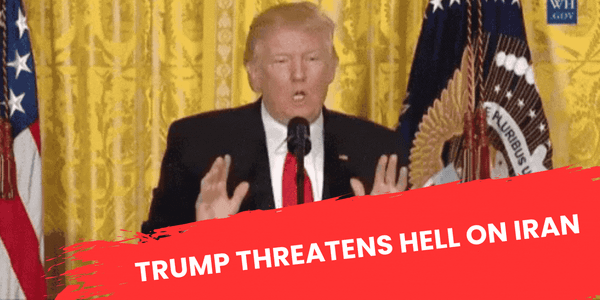
The "War Fog" is showing a few cracks. Prime Minister Netanyahu signaled he’s ready to help the US reopen the Strait of Hormuz, which was the magic word for oil traders.
Brent crude, which was threatening to go parabolic, has pulled back toward $107, while WTI is dipping toward $94. It’s not "cheap" by any means, but it’s a far cry from the $130 "heart attack" scenarios analysts were whispering about yesterday.
The Fed is officially in "Wait-and-See" mode. Following Wednesday’s decision to hold rates steady, Jerome Powell made it clear that while one cut might happen this year, he’s not moving until the inflation dust from the Iran conflict settles. With the 10-year Treasury yield creeping up to 4.27%, the market is still wrestling with the reality of "higher for longer."
It’s a "watch the headline" Friday.
We’re bouncing, but with the S&P still below its 200-day moving average, the burden of proof is still on the bulls.

📈 U.S. Futures Rise as War Fears Ease
Dow, S&P 500, and Nasdaq futures edged higher as Middle East tensions showed signs of cooling following comments from Israeli PM Netanyahu. West Texas Intermediate settled at $96, while Brent crude retreated from its highest close since July 2022.
🛢️ Goldman Warns Oil Could Stay Above $100
Goldman Sachs analysts caution that supply shocks from ongoing conflict could keep oil prices elevated above $100 in the near term. While their base case sees Brent potentially falling to $70 by late 2026, they noted that long-term risks remain skewed to the upside.
☁️ Alibaba Eyes $100B AI Revenue Amid Profit Plunge
Alibaba shares face pressure after reporting a 67% drop in quarterly earnings, prompting CEO Eddie Wu to set an ambitious goal to quintuple AI and cloud revenue within five years. The pivot aims to offset stagnation in the firm’s core e-commerce business.
🥇 Gold Set for Worst Week in Six Years
Bullion plummeted roughly 7% this week to $4,685 an ounce, marking its steepest decline since the 2020 pandemic onset. Surging energy costs have reignited inflation fears, slashing bets on central bank rate cuts and reducing the appeal of non-yielding gold.
💻 Super Micro Slides 9% on Export Indictment
Shares of SMCI tumbled in extended trading after the company addressed its connection to an alleged conspiracy involving Nvidia chip export violations. The news adds fresh regulatory pressure to the server maker already grappling with market volatility.
₿ Bitcoin Tussles at $70K as Bottom Remains Uncertain
Bitcoin slipped below the $70,000 threshold as spot demand cooled and selling pressure in the futures market ramped up. While some technical setups suggest a rebound, analysts warn that the market bottom may not yet be established.
🌏 Asian Markets Slump on Middle East Contagion
Regional indices across Asia-Pacific mostly declined Friday as investors weighed the impact of the Iran conflict on global energy supplies. The Nikkei and Hang Seng struggled to find footing as risk sentiment remained dampened by geopolitical instability.

Trading Is Not a Solo Struggle
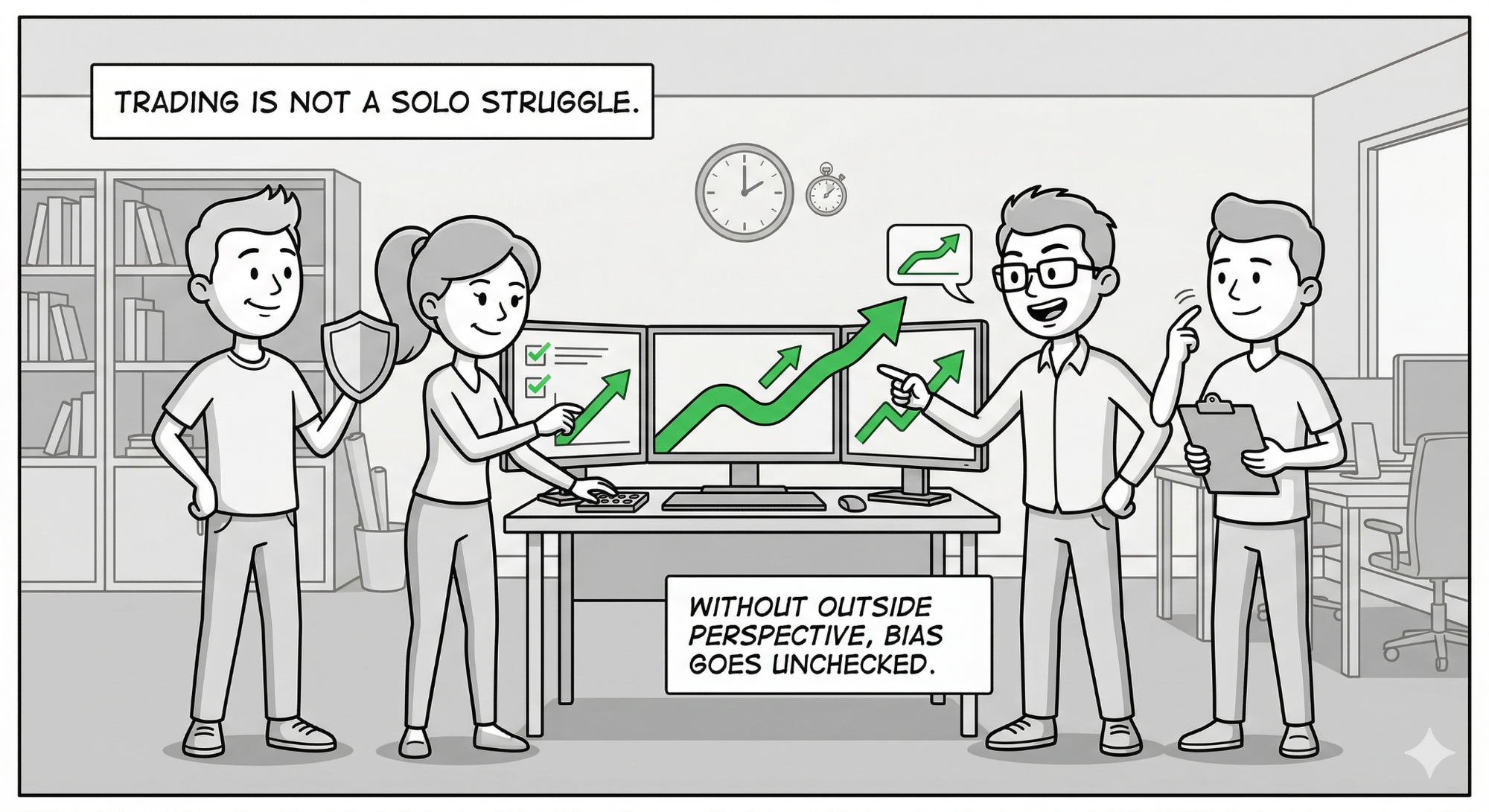
Many traders try to figure everything out on their own. They take losses, overthink mistakes, and keep everything internal.
At first, it feels like independence. Over time, it becomes isolation.
Without outside perspective, small mistakes repeat. Bias goes unchecked. Emotions build quietly. What could be corrected quickly turns into a pattern.
Strong traders don’t rely only on themselves. They learn from others. They observe how experienced traders think. They compare ideas and refine their own approach.
This doesn’t mean copying. It means expanding perspective.
When you expose your thinking to new viewpoints, clarity improves. You spot blind spots faster. You grow with direction instead of guessing.
Different traders see the same market in different ways. Sometimes, a new perspective is all it takes to notice what you missed.
You can explore a few market viewpoints here:

Three Inside Down
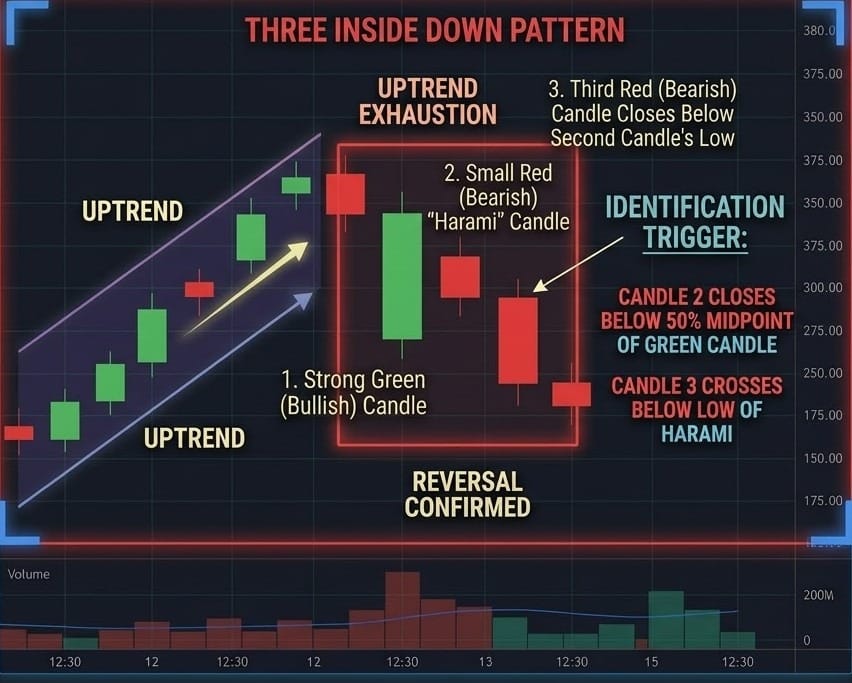
The Three Inside Down is a three-candle bearish reversal pattern that serves as the confirmed Bearish Harami.
It signals that an uptrend has officially hit a ceiling and that sellers have successfully hijacked the momentum.
The pattern consists of a large green candle, a smaller red candle contained within it (the Harami), and a third red candle that closes below the second.
🛠️ The Strategy Logic
Use these logical triggers to identify high-probability reversal entries with built-in confirmation:
- IF: The first candle is a long green candle and the second is a small red candle fully inside the first's body...
- THEN: You have a Bearish Harami. This is your "Alert" phase. It indicates that the buying pressure has suddenly stalled, but the bears haven't yet proven they can drive the price lower.
- THEN: You have a Bearish Harami. This is your "Alert" phase. It indicates that the buying pressure has suddenly stalled, but the bears haven't yet proven they can drive the price lower.
- IF: The third candle is red and closes below the low of the second candle...
- THEN: The pattern is complete. This is the "Confirmation" signal. It proves that the indecision of the Harami has been resolved to the downside, signaling a high-probability short entry.
- THEN: The pattern is complete. This is the "Confirmation" signal. It proves that the indecision of the Harami has been resolved to the downside, signaling a high-probability short entry.
- IF: The third candle closes below the midpoint or low of the first (large green) candle...
- THEN: The signal is high-conviction. Breaking the base of the "mother" candle proves that the bulls who entered on day one are now "trapped" and at a loss, which usually leads to a wave of forced selling.
- THEN: The signal is high-conviction. Breaking the base of the "mother" candle proves that the bulls who entered on day one are now "trapped" and at a loss, which usually leads to a wave of forced selling.
- IF: The pattern forms at the Upper Keltner Channel or a major resistance level...
- THEN: You have a "Structural Breakdown." The location provides the ceiling, and the Three Inside Down provides the visual proof that the ceiling is holding and the trend is turning bearish.
- THEN: You have a "Structural Breakdown." The location provides the ceiling, and the Three Inside Down provides the visual proof that the ceiling is holding and the trend is turning bearish.
- IF: The Volume Oscillator shows a spike on the third (confirmation) day...
- THEN: The move is backed by "Institutional Distribution." High volume on the breakdown confirms that large players are offloading their positions, increasing the chance of a sustained downtrend.
💡 Pro Tip
The "Stop Placement" Secret: One of the best features of the Three Inside Down is its clear "Risk-to-Reward" setup. Always place your stop-loss just above the high of the first (large green) candle. If the price climbs back above that level, the bearish thesis is invalidated. By waiting for the third candle to close before entering, you avoid the "Harami Trap" where price simply consolidates before continuing the original uptrend.

The P&L Mood Swing
A trader starts the day strong.
First trade wins.
P&L turns green.
Confidence spikes.
Suddenly everything feels clear.
Setups look cleaner.
Decisions feel faster.
Risk feels lighter.
He takes the next trade — a little bigger.
Why not? He’s “in sync.”
Then the market shifts.
That trade loses.
Now the P&L flips.
Green fades… red appears.
And just like that, the mindset changes.
Hesitation creeps in.
Doubt replaces clarity.
Every setup now feels uncertain.
Same trader.Same system.Different P&L.
CONFIDENCE SHOULD NOT BE TIED TO COLOR.
But for many traders, it is.
Green day = “I’m sharp.”Red day = “Something’s wrong.”
So behavior starts reacting to the number, not the process.
After a win: You get aggressive.
You loosen rules.
You overestimate your read.
After a loss: You hesitate.
You second-guess valid setups.
You under-execute your edge.
YOUR P&L BECOMES YOUR EMOTIONAL DRIVER.
That’s the trap.
Because the P&L is a lagging result — not a real-time decision tool.
It reflects what already happened.
It tells you nothing about the quality of your next trade.
Professionals understand this deeply.
They don’t trade the P&L.
They trade the process.
Same risk.Same criteria.Same execution — whether they’re up or down.
Because edge doesn’t disappear after one loss.And it doesn’t multiply after one win.
It plays out over series, not moments.
The moment your confidence starts rising and falling with your P&L, you lose consistency.
And consistency is where profits actually live.
So here’s the shift:
Stop asking,“How much am I up or down?”
Start asking,“Did I follow my rules on the last trade?”
Because in the long run, the trader who controls execution beats the trader who reacts to outcomes.
The market doesn’t reward emotional swings.
It rewards stability.
And stability comes from one place:
Detaching your mindset from the number on the screen.